Tom Simpson: Powerful Cyclist Who Made British History
The inspiring rise, remarkable victories, and lasting legacy of Britain's legendary road racing pioneer

Introduction
Tom Simpson was one of Britain’s most influential professional cyclists of the 20th century. Born in Haswell, County Durham, in 1937, he rose from local cycling to the highest level of international road racing, becoming an Olympic medallist, a Tour de France yellow-jersey wearer, a world champion, and a winner of some of Europe’s most prestigious one-day races.
His career was remarkable but tragically short. Simpson became the first British professional men’s road world champion in 1965 and won the BBC Sports Personality of the Year award that same year. He died in 1967 during the Tour de France at only 29. His story remains an important part of British cycling history, combining extraordinary sporting success with difficult lessons about the pressures of elite competition.
Quick Bio
| Category | Details |
|---|---|
| Full Name | Thomas Simpson |
| Common Name | Tom Simpson |
| Alternative Name | Tommy Simpson |
| Nickname | Major Tom |
| Date of Birth | 30 November 1937 |
| Birthplace | Haswell, County Durham, England |
| Hometown | Harworth, Nottinghamshire |
| Nationality | British |
| Profession
|
Professional cyclist |
| Main Sport | Road and track cycling |
| Famous For | 1965 World Road Race Championship and Tour de France yellow jersey |
| Olympic Achievement | Bronze medal in team pursuit |
| Major Race | Tour de France |
| Wife | Helen Sherburn |
| Children | Two daughters |
| Died | 13 July 1967 |
| Age at Death | 29 |
| Place of Death | Mont Ventoux, France |
| Book | Cycling Is My Life |
Early Life and Childhood
Tom Simpson was born on 30 November 1937 in Haswell, County Durham. His family later moved to Harworth in Nottinghamshire, where cycling became an increasingly important part of his young life. The town would eventually become closely connected with his sporting legacy.
As a young cyclist, Simpson developed through local club competition and gradually discovered that he had the ability to compete at a much higher level. He was interested in both road and track cycling, and his track-pursuit experience helped develop the endurance and tactical awareness that later became valuable in professional road racing.
His progress was not an overnight success. Simpson worked his way through Britain’s amateur cycling system before looking toward continental Europe, where professional road racing was much more established.
Family Background and Personal Life
Simpson came from a working-class background and remained connected to the communities that shaped his early life. His family supported his growing interest in cycling, although detailed information about every member of his extended family is not reliably documented.
In his personal life, Simpson married Helen Sherburn in 1961. The couple had two daughters, Jane and Joanne. His family life existed alongside the demanding schedule of a professional cyclist who spent much of his career competing across continental Europe.
Simpson’s autobiography, Cycling Is My Life, provides an especially valuable insight into his ambitions, experiences and outlook. It was published in 1966, only a year before his death.
Education and Cycling Development
There is limited reliable information about Simpson’s formal educational qualifications, so claims about specific degrees or university attendance should not be made without evidence.
His real education came through cycling. Local clubs, amateur competition, track racing and international events taught him how to handle the physical and tactical demands of professional competition. His development as a pursuit rider was particularly important because it gave him a strong endurance base.
Olympic Success
One of Simpson’s first major international achievements came at the 1956 Melbourne Olympic Games. He competed for Great Britain in the team pursuit and won a bronze medal.
Two years later, he represented England at the 1958 British Empire and Commonwealth Games, where he won silver in the individual pursuit.
These results established Simpson as one of Britain’s most promising young cyclists and demonstrated that his talent extended beyond domestic racing.
Moving to France
In 1959, Simpson moved to France to pursue greater opportunities in cycling. Continental Europe was the center of professional road racing, and moving abroad gave him access to a stronger competitive environment.
This decision became a turning point. Instead of remaining primarily within Britain’s cycling scene, Simpson entered the European professional world and began racing against some of the best riders of his generation.
His willingness to leave home and establish himself abroad demonstrated the ambition that became one of the defining characteristics of his career.
Professional Career Breakthrough
Simpson’s professional career developed rapidly during the early 1960s. His breakthrough came in 1961, when he won the Tour of Flanders.
The victory was especially significant because the race was already one of Europe’s most demanding and respected classics. Simpson’s success proved that a British cyclist could compete successfully against the established continental stars.
This achievement helped transform him from a promising British rider into an internationally recognized professional cyclist.
Tour de France Yellow Jersey
The 1962 Tour de France produced one of Simpson’s most historic achievements.
He became the first British rider to wear the famous yellow jersey. The achievement was a major milestone for British cycling because few British riders had previously established themselves as serious contenders in the world’s most famous stage race.
Simpson eventually finished sixth overall. Although he did not win the Tour, his performance showed that he could compete successfully at the highest level of international road racing.
Major Classic Victories
Tom Simpson became particularly successful in major one-day races, where endurance, positioning and tactical judgment were essential.
His important victories included the Tour of Flanders in 1961, Bordeaux–Paris in 1963, Milan–San Remo in 1964, and the Giro di Lombardia in 1965.
Winning Milan–San Remo was especially prestigious because it was one of the great Italian classics. His 1965 Giro di Lombardia victory further established him among the elite riders of his generation.
World Champion in 1965
The greatest achievement of Simpson’s career came in 1965, when he won the World Professional Road Race Championship in San Sebastián, Spain.
He became the first British rider to win the professional men’s world road championship. The rainbow jersey represented the highest honor available in professional road racing, and Simpson’s victory was a landmark moment for British cycling.
British Cycling continues to recognize Simpson as Britain’s only professional men’s road world champion, making the achievement central to his historical importance.
BBC Sports Personality of the Year
Simpson’s success in 1965 extended beyond cycling. He was named BBC Sports Personality of the Year.
The award reflected his popularity and the growing public interest in his achievements. He had become more than a successful cyclist; he was a recognizable British sporting personality.
His combination of confidence, determination and international success helped him attract attention from people who did not normally follow professional cycling.
Final Season and Paris–Nice
The beginning of 1967 brought further success. Simpson won Paris–Nice, becoming the first British winner of the prestigious stage race.
This achievement demonstrated that he remained capable of competing against the world’s best riders shortly before the final Tour de France of his career.
His results during the opening months of 1967 suggested that his competitive ambitions were still strong. He entered the Tour de France with considerable experience and an established reputation.
Career Timeline
| Year | Career Milestone |
|---|---|
| 1937 | Born in Haswell, County Durham |
| 1956 | Olympic bronze medal in team pursuit |
| 1958 | Commonwealth Games silver medal |
| 1959 | Moved to France |
| 1961 | Won Tour of Flanders |
| 1962 | Became first British Tour de France yellow-jersey wearer |
| 1963 | Won Bordeaux–Paris |
| 1964 | Won Milan–San Remo |
| 1965 | Won World Professional Road Race Championship |
| 1965 | Won Giro di Lombardia |
| 1965 | Won BBC Sports Personality of the Year |
| 1966 | Published Cycling Is My Life |
| 1967 | Won Paris–Nice |
| 1967 | Died during the Tour de France |
Career Achievements and Records
Tom Simpson’s career included several achievements that remain historically important:
- Olympic bronze medallist
- Commonwealth Games silver medallist
- Tour of Flanders winner
- Bordeaux–Paris winner
- Milan–San Remo winner
- Giro di Lombardia winner
- Paris–Nice winner
- 1965 World Professional Road Race Champion
- First British rider to wear the Tour de France yellow jersey
- BBC Sports Personality of the Year
- British Cycling Hall of Fame member
His record is particularly impressive considering that his professional career ended at only 29.
Cycling Style and Public Image
Simpson was known for his determination and willingness to take risks in competition. He became admired for his ability to attack races and compete aggressively against established European riders.
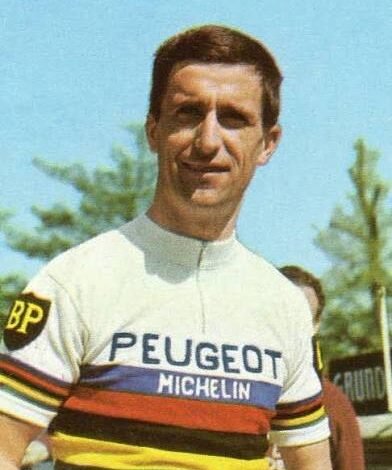
His appearance also contributed to his public image. Contemporary memories describe him in the distinctive Peugeot racing colours, and his confident personality made him easy for fans to remember.
British Cycling president Brian Cookson later recalled seeing Simpson race in Britain in 1967 and described him as a personal cycling hero. Such memories demonstrate the influence Simpson had on younger British cyclists.
Books and Written Legacy
Simpson’s autobiography, Cycling Is My Life, was published in 1966.
The book is particularly important because it was written during his lifetime rather than being reconstructed after his death. It offers a first-person perspective on professional cycling and his own ambitions.
His story has also inspired later books and documentaries about British cycling and the history of the Tour de France.
Death on Mont Ventoux
On 13 July 1967, Tom Simpson died during the 13th stage of the Tour de France while climbing Mont Ventoux in France.
He was only 29 years old.
His death became one of the most remembered tragedies in Tour de France history. Contemporary investigations identified stimulant substances in his system, while the extreme physical demands of the race and conditions on the mountain were also important factors in understanding the tragedy.
The event became a powerful warning about the dangers associated with the intense competitive culture of professional cycling at the time. It also contributed to broader discussions about athlete safety and substance use in sport.
Legacy and Memorial
Simpson’s legacy has survived for generations. His hometown of Harworth remains closely associated with his memory, and cycling events have been organized in his name.
A memorial on Mont Ventoux also commemorates the place where his life ended. Cyclists visiting the mountain continue to remember him there.
In 2010, Simpson was inducted into the British Cycling Hall of Fame, further confirming his importance to the history of the sport.
Positive and Difficult Sides of His Legacy
The positive side of Simpson’s story is clear. He broke barriers for British cyclists, won the world championship, achieved major European victories and inspired a generation of riders.
The difficult side is equally important. His death revealed the enormous pressures facing professional athletes and the dangers surrounding the cycling culture of his era. His story therefore represents both extraordinary achievement and a serious historical lesson.
Personal Life and Lasting Influence
Away from racing, Simpson was a husband and father who also wrote about his life and career. His family life was necessarily affected by the demands of international professional cycling, but his autobiography gives readers an opportunity to understand the person behind the racing results.
His influence continued after his death. Later British champions competed in a cycling environment that had become increasingly international, something Simpson had helped demonstrate was possible.
Conclusion
Tom Simpson remains a powerful figure in British cycling history because he achieved what few British riders of his era had managed. He became an Olympic medallist, won major continental classics, wore the Tour de France yellow jersey and became world champion in 1965.
His story ended tragically on Mont Ventoux in 1967, but his sporting achievements did not disappear. His victories, autobiography, memorials and Hall of Fame recognition continue to preserve his place in cycling history. For British cycling, Simpson was not simply another successful cyclist; he was a pioneer who helped show that British riders could compete and win on Europe’s biggest stages.
Frequently Asked Questions
Who was Tom Simpson?
Tom Simpson was a British professional road and track cyclist who became world champion in 1965.
When was Tom Simpson born?
Tom Simpson was born on 30 November 1937 in Haswell, County Durham, England.
Where did Tom Simpson grow up?
His family later moved to Harworth in Nottinghamshire, which became his hometown and an important part of his legacy.
Who was Tom Simpson’s wife?
Tom Simpson married Helen Sherburn in 1961.
Did Tom Simpson have children?
Yes, he and Helen had two daughters, Jane and Joanne.
What was Tom Simpson famous for?
He was famous for becoming Britain’s first professional men’s road world champion and the first British cyclist to wear the Tour de France yellow jersey.
What was Tom Simpson’s biggest cycling achievement?
His greatest achievement was winning the 1965 World Professional Road Race Championship.
When and where did Tom Simpson die?
He died on 13 July 1967 during the Tour de France while climbing Mont Ventoux in France.vvv