Ben Emmerson: Remarkable Career, Age and Human Rights Work
A clear look at the British barrister’s age, education, international cases, United Nations work and major professional achievements.

Introduction
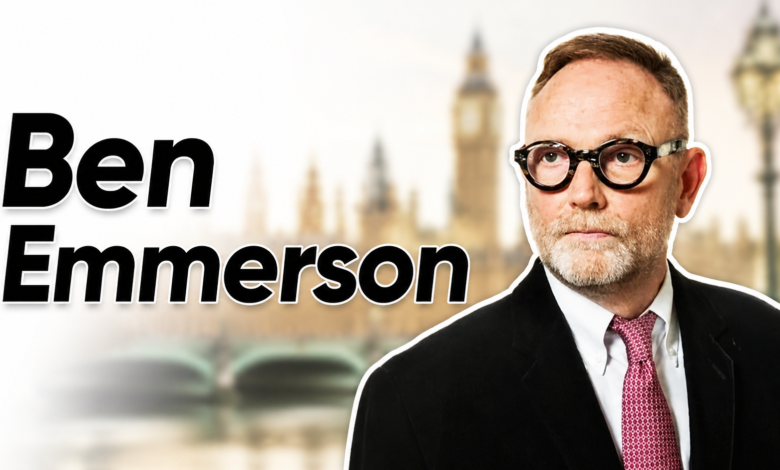
Ben Emmerson is a British barrister and international lawyer known for handling major cases involving human rights, national security, armed conflict and international criminal law.
Table of Contents
ToggleHe has represented individuals, governments and political figures before courts and tribunals in the United Kingdom and around the world. Readers interested in more carefully researched people stories can explore Topic Mint.
His career includes service as a United Nations Special Rapporteur, work before the European Court of Human Rights and involvement in cases linked to Ukraine, Kosovo, counter-terrorism and state accountability.
Who Is Ben Emmerson?
His full name is Michael Benedict Emmerson, although he is professionally known as Ben Emmerson.
He holds the titles CBE and KC. CBE means Commander of the Order of the British Empire, while KC means King’s Counsel, a senior professional rank awarded to highly experienced barristers.
He was born on 30 August 1963 in the United Kingdom. He is 62 years old as of 10 July 2026 and holds British nationality. Official public records describe his occupation as a barrister and international lawyer.
Quick Facts
| Field | Verified detail |
|---|---|
| Full name | Michael Benedict Emmerson |
| Professional name | Ben Emmerson |
| Date of birth | 30 August 1963 |
| Age | 62 years old as of 10 July 2026 |
| Birth country | United Kingdom |
| Nationality | British |
| Profession | Barrister and international lawyer |
| Main legal fields | Human rights, public international law, humanitarian law and international criminal law |
| University | University of Bristol |
| Qualification | LLB, completed in 1985 |
| Called to the Bar | 1986 |
| Appointed Queen’s Counsel | 2000 |
| Honour | CBE, awarded in 2020 |
| Former UN role | Special Rapporteur on human rights and counter-terrorism |
| UN term | 2011 to 2017 |
Early Life and Interest in Law
Detailed information about his childhood has not been widely documented in authoritative public records. His later interviews, however, help explain why he chose a legal career.
He studied law during a period of major political and industrial change in Britain. He has said that law appeared to provide a practical way to support political change and social justice.
That interest became central to his professional life. Rather than focusing only on commercial disputes, he built a career around civil liberties, criminal justice, government responsibility and the protection of people affected by conflict.
Education at the University of Bristol
He studied at the University of Bristol and completed an LLB degree in 1985. During his studies, he became particularly interested in constitutional law, administrative law, employment law and the relationship between courts and government.
His university later recognised the international importance of his work. Bristol awarded him an honorary Doctor of Laws degree in 2015 and the Alumni Award for Global Citizenship in 2023.
The university described him as a leading international human-rights lawyer who had worked on significant cases involving armed conflict, national security and international criminal law. Its detailed University of Bristol alumni feature also explains how his education influenced his professional values.
Beginning of His Legal Career
Emmerson was called to the Bar in 1986. This allowed him to practise as a barrister in England and Wales.
His early work covered criminal law, civil liberties and European human-rights cases. He later helped judges and criminal barristers understand the changes created by the Human Rights Act.
This work strengthened his standing within the British legal profession. In 2000, at the age of 37, he was appointed Queen’s Counsel. The title changed to King’s Counsel after the accession of King Charles III.
He was also one of the founding members of Matrix Chambers, which became well known for public law, human rights and international cases.
Judicial and Professional Appointments
His work has not been limited to representing clients. He has also held several judicial and professional positions.
In 2005, he was appointed a Recorder of the Crown Court, serving as a part-time judge in criminal cases. In 2010, he became a Deputy High Court Judge dealing with public and administrative law matters.
He was elected a Master of the Bench of Middle Temple in 2010 and became an honorary fellow of Mansfield College at the University of Oxford in 2011.
He was also elected as a judge of the United Nations Residual Mechanism responsible for unfinished legal matters connected with the international tribunals for Rwanda and the former Yugoslavia.
United Nations Special Rapporteur
One of the most important stages of his career began in 2011, when he became the United Nations Special Rapporteur on the promotion and protection of human rights while countering terrorism.
He held the position until 2017.
The role required him to examine whether governments were respecting human rights when creating and enforcing counter-terrorism policies. His responsibilities included visiting countries, communicating with governments and reporting to the UN Human Rights Council and General Assembly.
His reports addressed subjects including armed drones, torture, electronic surveillance, migration, terrorism victims, civil society and government accountability.
The official United Nations human-rights profile also confirms his extensive experience before domestic and international courts.
Major Human-Rights Cases
During his career, he has appeared before the European Court of Human Rights, the International Court of Justice, the International Criminal Court and other major tribunals.
His cases have covered the right to life, fair trials, torture evidence, prison proceedings, police responsibility, discrimination and the legal limits of government power.
He was involved in important European litigation that challenged the ban on gay men and lesbians serving openly in the British armed forces. The successful cases helped bring an end to the policy.
He also worked on proceedings involving the indefinite detention of foreign terrorism suspects at Belmarsh Prison. The litigation raised important questions about discrimination, personal liberty and the use of evidence obtained through torture.
These cases helped shape the way British courts examine national-security decisions and government claims.
Ramush Haradinaj Case
Between 2005 and 2012, he led the defence of Ramush Haradinaj, a former prime minister of Kosovo, at the International Criminal Tribunal for the former Yugoslavia.
Haradinaj faced war-crimes charges connected with the Kosovo conflict. He was acquitted at his first trial.
After an appeal led to a partial retrial, he was acquitted again in November 2012. The case became one of Emmerson’s most prominent pieces of international criminal-defence work.
Katharine Gun and Official Secrets
He represented former GCHQ employee Katharine Gun after she disclosed a secret communication connected with diplomatic activity before the 2003 Iraq War.
Gun was prosecuted under the Official Secrets Act, but the case against her was later dropped.
The events inspired the film Official Secrets. Actor Ralph Fiennes portrayed Emmerson in the film, introducing his legal work to a wider international audience.
Alexander Litvinenko Case
He represented Marina Litvinenko following the poisoning and death of her husband, Alexander Litvinenko, in London in 2006.
He helped challenge the British government’s initial refusal to establish a full public inquiry into the killing.
The inquiry later concluded that the operation was probably approved at the highest levels of the Russian state. Emmerson continued to represent Marina Litvinenko in related human-rights proceedings.
Work for Ukraine
He has represented the Government of Ukraine in international legal proceedings arising from Russia’s actions in Crimea, eastern Ukraine and the wider armed conflict.
This work has included cases before the European Court of Human Rights involving alleged killings, unlawful detention, torture, forced displacement and attacks on civilians.
It also included proceedings connected with the destruction of Malaysia Airlines flight MH17.
His involvement demonstrates how international law can be used by states seeking legal findings and accountability for alleged violations during armed conflict.
Other Well-Known Clients
His publicly documented clients have included former Maldives president Mohamed Nasheed, Catalan political leader Carles Puigdemont, WikiLeaks founder Julian Assange and Lockerbie bombing defendant Abdelbaset al-Megrahi.
He has also worked with people affected by alleged crimes against the Rohingya community in Myanmar and the Yazidi community in Iraq and Syria.
These cases have involved different legal issues, but many share a common theme: the relationship between individual rights, government power and international accountability.
Books and Legal Writing
Emmerson has also contributed to legal education and professional writing.
He was a co-author of Human Rights and Criminal Justice, a practitioner text examining how human-rights law affects criminal proceedings.
He founded the European Human Rights Law Review and worked as human-rights editor of Archbold Criminal Pleading, Evidence and Practice.
His writing helped lawyers, judges and students understand the practical use of the European Convention on Human Rights in criminal and public-law cases.
Awards and Honours
He received the Human Rights Lawyer of the Year Award in 1999.
In 2000, he took Silk and became Queen’s Counsel, now King’s Counsel.
The University of Bristol awarded him an honorary Doctor of Laws degree in 2015 and its Global Citizenship Award in 2023.
In the 2020 Birthday Honours, he was appointed a Commander of the Order of the British Empire for services to international human rights and humanitarian law. The official honours record lists him as Michael “Ben” Emmerson and identifies him as an international lawyer.
His Views on Law and Justice
His public comments show a strong belief that courts must be able to examine government decisions properly, especially when basic rights are at risk.
He has argued that national security should not be used as a simple reason to avoid legal scrutiny. In his view, independent judges, clear evidence and transparent decision-making are essential parts of a fair legal system.
His work also reflects support for fair trials, protection from torture, equality before the law and legal remedies for victims of war or state abuse.
He has described advocacy as demanding work that requires lawyers to understand large amounts of evidence and respond quickly under pressure.
Why Ben Emmerson Became Famous
He became widely known because his work moved beyond ordinary courtroom disputes.
His cases have involved:
- International armed conflicts
- Terrorism and national-security laws
- War-crimes proceedings
- Government accountability
- Political detention
- Torture and unlawful evidence
- Freedom from discrimination
- The rights of conflict victims
His ability to work across British, European and international legal systems helped establish him as a major figure in human-rights advocacy.
Current Professional Standing
He continues to be publicly recognised as a British international lawyer specialising in human rights, armed conflict and international disputes.
Middle Temple’s professional directory lists him as an Ordinary Bencher, reflecting his senior standing within the Inn of Court. His public work in recent years has continued to include major international proceedings.
Readers can find more public-figure profiles covering verified careers, achievements and personal backgrounds.
Interesting Facts
- His full name is Michael Benedict Emmerson.
- He completed his Bristol law degree in 1985.
- He was called to the Bar in 1986.
- He became Queen’s Counsel at the age of 37.
- He served as a UN Special Rapporteur from 2011 to 2017.
- He was portrayed by Ralph Fiennes in Official Secrets.
- He received a CBE for services to international human rights and humanitarian law.
- He has appeared before several of the world’s most important courts and tribunals.
Frequently Asked Questions
What is Ben Emmerson’s full name?
His full name is Michael Benedict Emmerson.
How old is Ben Emmerson?
He is 62 years old as of 10 July 2026.
When was he born?
He was born on 30 August 1963.
What is his nationality?
He is British.
What is he famous for?
He is famous for his work as an international human-rights lawyer and for handling major cases involving terrorism, armed conflict, war crimes and government accountability.
Where did he study?
He studied law at the University of Bristol and completed his LLB in 1985.
Was he a United Nations official?
Yes. He served as the UN Special Rapporteur on human rights and counter-terrorism from 2011 until 2017.
What do CBE and KC mean?
CBE means Commander of the Order of the British Empire. KC means King’s Counsel, a senior rank within the legal profession.
Final Words
Ben Emmerson has built a distinguished career around some of the most difficult questions in modern law.
His work has examined how governments use power, how courts protect individual rights and how international institutions respond to conflict and serious alleged abuses.
From British human-rights cases to United Nations investigations and international disputes, his career shows the important role lawyers can play in public accountability and global justice.
Category: Legal Personalities
Tags:
SEO Title:
Meta Description: