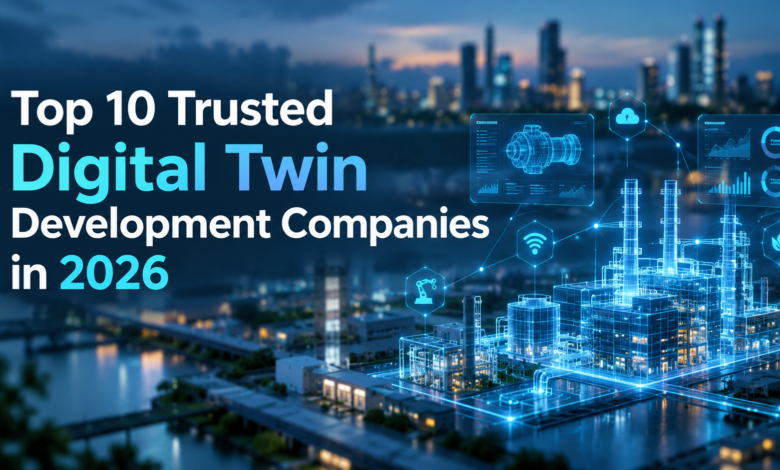
Top 10 Trusted Digital Twin Development Companies in 2026
Discover the top digital twin development companies in 2026, their technologies, services, industry expertise, and how to choose the right partner for your business.

Introduction
Discover 10 established digital twin technology providers, their services, industry expertise, and what makes each one worth considering for your next project.
Digital twins are changing how businesses manage factories, buildings, machines, and large infrastructure projects. Instead of relying only on reports or physical inspections, companies can use a virtual representation of real-world assets to monitor performance, test changes, and identify problems before they become expensive.
But finding the right development partner isn’t always easy.
Some companies specialize in industrial simulation. Others build cloud-based digital twins, connected IoT systems, or realistic 3D environments. Their technology may look similar in a demonstration, but what they can deliver in a real business setting can be very different.
This article covers 10 trusted digital twin development companies in 2026, including major software providers and enterprise technology specialists. Each has identifiable technology, services, or industry experience worth reviewing.
Quick Facts About Digital Twin Development
| Feature | Details |
|---|---|
| Technology | Digital Twin |
| Main Purpose | Create digital representations of physical assets and processes |
| Common Technologies | IoT, AI, 3D modelling, cloud computing, simulation |
| Main Industries | Manufacturing, construction, energy, transport, healthcare |
| Key Applications | Predictive maintenance, monitoring, simulation, operational planning |
| Main Benefits | Better visibility, faster testing, improved planning |
| Development Options | Custom software, enterprise platforms, system integration |
| Company Selection | Technical expertise, proven delivery, integration, security, support |
What Is Digital Twin Development?
Digital twin development is the process of creating a digital representation of a physical object, system, or environment.
Consider a manufacturing plant with hundreds of machines.
A digital twin can combine equipment specifications, sensor readings, production information, and simulation models in one digital environment. Engineers can inspect operating conditions, compare performance, and test possible changes without immediately interrupting production.
A useful digital twin doesn’t necessarily need impressive 3D graphics. For some companies, a data-driven model showing how equipment behaves is far more valuable.
Digital twin systems commonly combine several technologies:
- Internet of Things (IoT) sensors to collect physical asset data.
- Cloud platforms to connect and manage information.
- Simulation software to test operating conditions.
- Artificial intelligence to support forecasting and anomaly detection.
- 3D modelling to provide visual representations.
- Enterprise integrations to connect manufacturing, maintenance, and business systems.
Not every project requires all six. The right combination depends on the problem the business wants to solve.
Top 10 Trusted Digital Twin Development Companies in 2026
The following shortlist combines established platform vendors with technology and engineering service providers.
Editor’s note: These companies are numbered for easy comparison, not ranked by independently measured customer satisfaction. Selection is based on documented digital twin capabilities, recognizable products, enterprise delivery experience, and suitability for different industries. Buyers should still verify current prices, references, and contractual terms.
1. Siemens Digital Industries Software
Best for: Industrial manufacturing and product lifecycle digital twins
Siemens is one of the best-known names in industrial automation and engineering software. Its digital twin capabilities support manufacturers that want to connect product design, engineering, manufacturing, and operational information.
The Siemens Xcelerator portfolio brings together industrial software and related technologies. Its simulation tools help engineers assess products and production processes before making changes in the physical world.
In 2026, Siemens also introduced Digital Twin Composer and Teamcenter Digital Reality Viewer in markets including India and the United Kingdom, building on its partnership with NVIDIA.
Key capabilities:
- Manufacturing and production simulation.
- Product lifecycle management.
- Industrial automation integration.
- Physics-based modelling.
- Factory and production planning.
- Engineering data visualization.
Siemens is particularly relevant for automotive, aerospace, electronics, and industrial equipment manufacturers.
For companies already using Siemens engineering products, its connected software ecosystem may simplify digital twin implementation.
Website: siemens.com
2. Microsoft
Best for: Cloud-based digital twins and connected IoT environments
Microsoft offers Azure Digital Twins, a cloud service designed to represent physical environments and their relationships digitally.
It can model factories, commercial buildings, utilities, transportation systems, and other connected environments.
Its main strength is the ability to connect business information with IoT data and organize relationships between assets.
For example, a property management company could create digital representations of its buildings, floors, rooms, and equipment. Relevant sensor information could then help teams monitor operating conditions across the portfolio.
Key capabilities:
- Cloud-based digital twin architecture.
- Asset relationship modelling.
- IoT and business data integration.
- Event-driven data processing.
- Connections to analytics and AI services.
- Support for custom applications.
Microsoft supplies the platform rather than automatically delivering a complete industry-specific digital twin application. Most organizations will still need developers or integration partners.
Website: microsoft.com
3. NVIDIA
Best for: Realistic 3D simulation, robotics, and industrial environments
NVIDIA has become an important technology provider for advanced digital twin applications.
Its Omniverse technology and OpenUSD-based development workflows support virtual environments used in manufacturing, robotics, industrial planning, and AI simulation.
One particularly useful application is virtual factory planning.
Businesses can bring together engineering models and simulation tools to study factory layouts, robot movement, and production processes before making physical changes.
NVIDIA has documented virtual factory work involving manufacturers such as Pegatron and Wistron.
Key capabilities:
- Real-time 3D simulation.
- Industrial facility visualization.
- Robotics simulation.
- OpenUSD-based workflows.
- AI training environments.
- Virtual factory development.
NVIDIA is a strong technology choice when simulation fidelity and visual interaction are central to the project.
However, building a working solution generally requires additional software development, integration, and suitable computing infrastructure.
Website: nvidia.com
4. Dassault Systèmes
Best for: Product engineering and virtual product lifecycle management
Dassault Systèmes has extensive experience developing industrial design, engineering, and simulation software.
Its 3DEXPERIENCE platform connects product development information with engineering workflows and virtual twin experiences.
This makes the company relevant to organizations developing complicated products, including aircraft, vehicles, industrial equipment, and advanced manufacturing systems.
Engineers can work with digital product models, evaluate design alternatives, and collaborate across different stages of development.
Key capabilities:
- Virtual product modelling.
- Engineering simulation.
- Product lifecycle management.
- Collaborative design.
- Manufacturing process planning.
- Integrated engineering information.
Dassault Systèmes is worth considering when the main goal is to connect design, engineering, and manufacturing information rather than simply visualize existing equipment.
Website: 3ds.com
5. Bentley Systems
Best for: Infrastructure, construction, and asset management
Bentley Systems concentrates on engineering software for infrastructure.
Its iTwin Platform allows developers and engineering teams to create digital twin applications that combine design information, reality data, and operational information.
That can be particularly useful for bridges, roads, railways, utilities, industrial facilities, and large construction projects.
A transport authority, for example, could use an infrastructure digital twin to compare engineering records with current site information and support maintenance planning.
Key capabilities:
- Infrastructure digital twins.
- Engineering data integration.
- Reality modelling.
- Construction progress visualization.
- Asset lifecycle management.
- Open APIs for custom applications.
Bentley stands out for organizations managing expensive physical infrastructure over long operating lifecycles.
Website: bentley.com
6. Ansys
Best for: Physics-based simulation and engineering analysis
Ansys is recognized for engineering simulation software.
Its digital twin technologies are particularly relevant when businesses need to model how a physical system behaves under different conditions.
Ansys Twin Builder supports the development of simulation-based digital twins using engineering models and system data.
Instead of focusing only on the appearance of a machine, organizations can study its physical behaviour.
That matters in sectors where heat, pressure, vibration, fluid movement, or mechanical stress can affect performance.
Key capabilities:
- Physics-based digital twin modelling.
- Multiphysics simulation.
- Reduced-order models.
- Engineering performance analysis.
- Simulation-driven predictive maintenance.
- Virtual testing.
Ansys is a suitable candidate for companies requiring detailed engineering analysis and simulation accuracy.
Website: ansys.com
7. Accenture
Best for: Enterprise digital twin consulting and implementation
Accenture differs from companies that primarily sell engineering platforms.
It provides consulting, engineering, software development, integration, and operational services that can help organizations introduce digital twins into existing business environments.
Large digital twin projects often involve several suppliers, legacy IT systems, industrial equipment, and different departments.
Getting those systems to work together can be harder than building the visual model.
Accenture has demonstrated enterprise activity in this field. In June 2026, it announced a multi-year partnership with Unilever to expand AI-enabled digital twins across the manufacturer’s global production network.
Key capabilities:
- Digital twin strategy and consulting.
- Enterprise technology integration.
- Manufacturing modernization.
- AI-enabled operational analytics.
- Industrial engineering services.
- Large-scale implementation support.
Accenture may be especially suitable for multinational organizations coordinating digital twin programs across multiple sites.
Website: accenture.com
8. PTC
Best for: Connected products and industrial IoT systems
PTC develops industrial software covering product lifecycle management, computer-aided design, and connected operations.
Its ThingWorx industrial IoT technology and related engineering software can support digital twin applications that connect physical equipment with software-driven information.
One application is monitoring deployed industrial products throughout their working lives.
Manufacturers can combine equipment information with operational data to help service teams understand how products perform outside the factory.
Key capabilities:
- Industrial IoT integration.
- Connected product information.
- Product lifecycle management.
- Asset monitoring applications.
- Engineering data connectivity.
- Industrial application development.
PTC is a relevant option for companies interested in connected products, equipment servicing, and digital product information.
Website: ptc.com
9. Schneider Electric and AVEVA
Best for: Energy systems, utilities, and industrial operations
Schneider Electric and AVEVA offer complementary technologies for industrial operations, electrical infrastructure, process engineering, and operational information management.
AVEVA’s industrial software capabilities include engineering and simulation tools, operational data systems, and visualization solutions.
Schneider Electric also brings expertise in electrical systems, automation, and energy management.
Together, these capabilities can support digital twin projects involving industrial plants, energy facilities, and other operational environments.
Key capabilities:
- Industrial process simulation.
- Operational data management.
- Energy system modelling.
- Plant monitoring.
- Engineering information integration.
- Industrial performance analysis.
This is a particularly relevant technology ecosystem for organizations in energy, utilities, chemicals, and process manufacturing.
Websites: se.com and aveva.com
10. IBM
Best for: Enterprise asset management and maintenance-focused digital twins
IBM has a long history in enterprise software, analytics, and asset management.
Its Maximo Application Suite supports asset monitoring, maintenance planning, inspection workflows, and operational intelligence.
These capabilities can form part of a digital twin solution, particularly when the main objective is to understand asset condition and improve maintenance decisions.
A utility company, for example, might combine equipment records and operational measurements to help maintenance teams identify problems and prioritize repairs.
Key capabilities:
- Enterprise asset management.
- Predictive maintenance support.
- Asset condition monitoring.
- Operational analytics.
- Maintenance workflow integration.
- AI-assisted asset insights.
IBM is worth reviewing when asset reliability and maintenance operations matter more than immersive 3D simulation.
Website: ibm.com
Comparison of Digital Twin Technology Providers
| Company | Main Strength | Best Suited For |
|---|---|---|
| Siemens | Industrial digital twins | Manufacturing |
| Microsoft | Cloud twin architecture | IoT and smart buildings |
| NVIDIA | 3D and AI simulation | Robotics and virtual factories |
| Dassault Systèmes | Virtual product lifecycle | Engineering and design |
| Bentley Systems | Infrastructure twins | Construction and utilities |
| Ansys | Physics-based simulation | Engineering-intensive assets |
| Accenture | Consulting and integration | Enterprise deployment |
| PTC | Connected products | Industrial IoT |
| Schneider Electric / AVEVA | Industrial operations | Energy and process industries |
| IBM | Asset management | Maintenance and reliability |
The biggest difference between these providers isn’t simply company size.
It’s their role in the final solution.
Microsoft and NVIDIA, for instance, may supply different parts of the same digital twin system. Accenture or another engineering partner might then bring those components together for the customer.
That is why a business should choose the required technical architecture before comparing vendors.
How to Choose a Digital Twin Development Company
A good digital twin project starts with a business problem, not a software demonstration.
Before hiring a company, consider the following factors.
Industry Experience
A developer with expertise in smart buildings may not be the best choice for a complex aerospace simulation project.
Look for experience with similar equipment, operating environments, and data requirements.
Technical Expertise
Check whether the company can handle the actual development requirements.
These may include IoT integration, cloud infrastructure, simulation engines, engineering models, cybersecurity, and operational software.
Data Integration
A digital twin becomes more useful when it can receive accurate information from physical assets and existing systems.
Ask how the company will connect sensors, maintenance platforms, manufacturing software, and business databases.
Project Costs
Pricing may include software licensing, development, cloud infrastructure, equipment integration, training, and continuing support.
Request an itemized estimate. A low initial development price doesn’t necessarily mean the lowest total ownership cost.
Security and Ownership
Industrial and infrastructure data can be commercially sensitive.
Clarify who owns the models and underlying data, who can access them, and what happens if the organization changes suppliers.
Support After Deployment
Digital twins require updates as equipment, software, and operating conditions change.
A reliable implementation partner should explain how monitoring, validation, troubleshooting, and maintenance will be handled after launch.
Benefits of Digital Twin Technology for Businesses
Improved Equipment Monitoring
Connected models can help teams see how machines and physical systems are operating.
Better Maintenance Decisions
Sensor information and suitable analytical models can support earlier detection of equipment problems.
Safer Virtual Testing
Engineers can test certain design or operational changes in simulation before applying them physically.
Better Operational Planning
Businesses can compare alternative configurations and assess how changes may affect production, energy use, or infrastructure performance.
Stronger Team Collaboration
A shared digital representation can make it easier for engineering, maintenance, and operations teams to work from consistent information.
These benefits are possibilities, not guaranteed results. Actual performance depends on the quality of the model, available data, implementation, and business processes.
Major Digital Twin Development Trends in 2026
AI-Assisted Simulation
Artificial intelligence is increasingly being connected to digital twin environments to support monitoring, prediction, and simulated decision-making.
Realistic Industrial Environments
Advanced 3D technologies are making it possible to create detailed virtual representations of factories, robots, and other industrial systems.
Connected Infrastructure
Engineering teams are using digital twin platforms to bring together construction records, physical asset information, and operational data.
Cloud-Based Development
Cloud services allow development teams to connect distributed systems and build applications around shared digital models.
Greater Interest in Operational Results
Businesses are increasingly looking beyond demonstration projects.
A digital twin must answer practical questions. Can it help identify faults? Reduce unnecessary inspections? Improve planning? Support safer decisions?
A visually impressive model is only valuable when it solves a real problem.
Final Thought
Choosing between digital twin development companies in 2026 means understanding what each provider actually does.
Siemens and Dassault Systèmes offer extensive industrial engineering ecosystems. Microsoft supports cloud-connected environments. NVIDIA specializes in advanced simulation technologies, while Bentley focuses on infrastructure.
Ansys brings engineering simulation expertise. PTC, IBM, and Schneider Electric with AVEVA support different aspects of connected operations and asset management. Accenture offers enterprise implementation experience.
There is no single company that fits every digital twin project.
The best starting point is to identify the physical system, the data available, and the decisions the digital twin needs to support. Then compare providers based on relevant technical capabilities, proven delivery, cost, and long-term support.
Frequently Asked Questions
1. What are the best digital twin development companies in 2026?
Siemens, Microsoft, NVIDIA, Dassault Systèmes, Bentley Systems, Ansys, Accenture, PTC, Schneider Electric with AVEVA, and IBM are established options worth evaluating.
2. Which company is best for manufacturing digital twins?
Siemens is a strong option for manufacturing environments, while NVIDIA and Dassault Systèmes offer capabilities suited to particular simulation and engineering requirements.
3. What is the difference between a digital twin and a 3D model?
A 3D model primarily represents appearance or geometry. A digital twin connects a digital representation to relevant asset information and may include live data, simulation, analytics, and operational behaviour.
4. Can small businesses use digital twin technology?
Yes. Small businesses can start with limited projects, such as monitoring a particular machine or facility. Costs depend on system complexity, data requirements, and the selected technology.
5. How much does digital twin development cost?
There is no universal price. A small monitoring application and an enterprise-wide physics-based simulation system have very different development, integration, licensing, and operating costs.
6. Which industries use digital twins?
Manufacturing, construction, energy, transportation, utilities, aerospace, and commercial property management are among the major application areas.
7. Are AI and digital twins the same technology?
No. A digital twin represents a physical asset or process. AI can be added to analyze information, detect patterns, support forecasts, or help evaluate operating scenarios.
8. How long does a digital twin project take?
Timelines vary significantly. A limited proof of concept may require weeks or months, while complex multi-site projects can involve much longer development and deployment programs.