Introduction
From racing in Chennai to driving Formula 1 cars and becoming a familiar voice on Sky Sports, his career has taken several interesting turns.
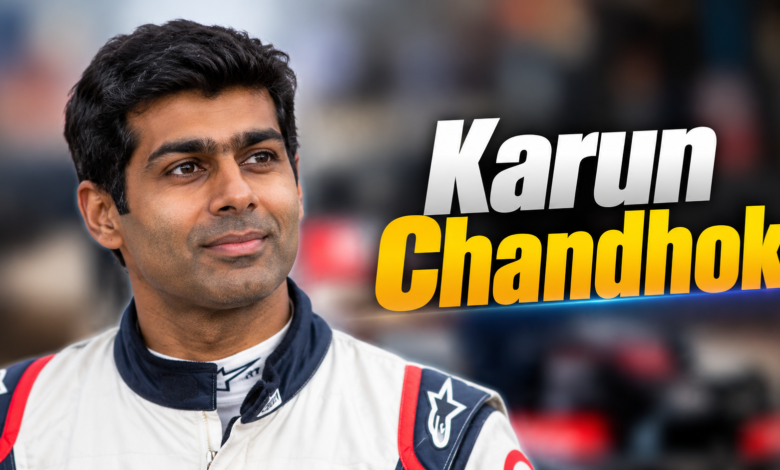
Karun Chandhok is a former Indian Formula 1 driver, motorsport commentator and racing analyst. He competed for HRT in 2010 and Team Lotus in 2011. Today, he is widely known for his work in Formula 1 broadcasting and his involvement with Williams Racing’s historic cars.
His racing story started in India. But getting into Formula 1 was tough. He moved to Britain, raced through several junior championships and spent years working towards a Grand Prix seat.
He made it. That mattered.
Although his Formula 1 career was short, his connection with motorsport continued through endurance racing, Formula E, television and racing administration.
Quick Facts About Karun Chandhok
| Detail | Information |
|---|---|
| Full Name | Karun Chandhok |
| Date of Birth | 19 January 1984 |
| Age | 42 years (as of October 2026) |
| Birthplace | Madras, now Chennai, India |
| Racing Nationality | Indian |
| Profession | Former racing driver, commentator and analyst |
| Father | Vicky Chandhok |
| Brother | Suhail Chandhok |
| Known For | Formula 1 and Sky Sports F1 |
| F1 Debut | 2010 Bahrain Grand Prix |
| Last F1 Race | 2011 German Grand Prix |
| Formula 1 Teams | HRT and Team Lotus |
| F1 Race Starts | 11 |
| Best F1 Result | 14th place |
| F1 Wins | 0 |
| F1 Points | 0 |
| GP2 Victories | 2 |
| Formula E Team | Mahindra Racing |
| Major Championships | Formula Maruti, Formula 2000 Asia, Formula V6 Asia |
| Net Worth | Not publicly verified |
Early Life and Childhood in Chennai
Karun Chandhok was born on 19 January 1984 in Madras, the city now called Chennai, in Tamil Nadu.
Cars were part of his childhood.
His father was already involved in Indian motorsport, so Karun grew up hearing about racing, watching competitions and learning how drivers built their careers.
International racing was harder to follow in India during the 1980s and 1990s. Television coverage was limited. Motorsport magazines sometimes arrived months after races had taken place.
Still, he kept watching.
In a 2024 interview with Formula 1, Chandhok recalled growing up with racing magazines sent from Europe. Those early experiences helped build his interest in international motorsport.
He wanted to race professionally.
That was a big ambition for a young driver from India, where opportunities to reach Formula 1 were limited.
Family Background and Parents
His family had strong motorsport connections long before he entered international racing.
His father and racing influence
His father, Vicky Chandhok, was a multiple Indian rally champion.
He also served as president of the Federation of Motor Sports Clubs of India, commonly called FMSCI.
Vicky understood racing from experience. He knew about preparing cars, competing under pressure and working in motorsport.
That gave Karun an early connection to the sport.
Still, family experience alone could not secure a Formula 1 seat. Karun needed race results, international experience and financial backing to progress.
His brother and family connections
His younger brother, Suhail Chandhok, also built a career connected with sport.
Suhail is known for sports presenting and commentary, particularly in Indian cricket and other televised competitions.
Both brothers entered sports-related careers, though their professional interests took different directions.
Karun has generally kept the more private parts of his family life away from extensive public discussion.
Education and Early Interests
His interest in motorsport developed during childhood.
He followed racing closely and began competing while still young. By his teenage years, he was already taking part in organised competitions.
His public racing biographies provide much more detail about his early championships than his formal education.
Reliable primary information about his school, university or academic qualifications is limited.
For that reason, specific educational institutions should not be presented as confirmed facts.
How His Racing Career Started
His first major success came in India.
In 2000, he won the Formula Maruti championship. Williams Racing records show that he collected seven race victories and 10 pole positions during that campaign.
He was only 16.
It was a strong start.
The following year, he moved into Formula 2000 Asia and won another championship. His season included eight victories and 10 pole positions.
Those early results helped establish him as a promising young driver.
But his next challenge was bigger.
He needed to race in Europe, where the competition was stronger and Formula 1 teams could watch young drivers more closely.
Moving to Britain and Competing in Formula 3
In 2002, Chandhok entered British Formula 3.
He raced with T-Sport in the National Class. Across his time in that category, he recorded seven victories before moving into the main championship class for 2004.
The change was demanding.
He had to adjust to new circuits, stronger competition and life away from India.
In his later Formula 1 interview, he spoke about the practical and financial difficulties of pursuing racing abroad.
He kept pushing.
British Formula 3 gave him experience on circuits used by talented young drivers from around the world.
It was another important part of his career.
Formula Renault and A1 Grand Prix
In 2005, he competed in Formula Renault 3.5.
He also became the first driver to represent A1 Team India in the A1 Grand Prix championship.
A1 Grand Prix was an international racing series in which teams competed under national identities.
Representing India carried personal meaning.
Chandhok had spent years trying to build an international racing career. Now he was competing with his country’s name attached to his team.
His results soon improved.
In 2006, he won the Formula V6 Asia championship, taking seven victories and four pole positions.
That was his third major single-seater championship title.
GP2 Career and First Major European Victories
GP2 was one of the main routes into Formula 1.
Chandhok joined the championship in 2007 with Durango. The level of competition was high, with several drivers hoping to earn Formula 1 seats.
He faced experienced opponents.
Yet he found success.
First victory in Belgium
His first GP2 victory came at Spa-Francorchamps in 2007.
Spa is one of the most respected circuits in international motorsport. Winning there gave him a major result to add to his racing record.
He also tested a Formula 1 car for Red Bull Racing at Barcelona that year.
That was an important opportunity.
Driving an F1 car was different from competing in GP2. The power, braking performance and technical demands were higher.
Racing alongside Bruno Senna
In 2008, he moved to iSport International.
His teammate was Bruno Senna, the nephew of three-time Formula 1 world champion Ayrton Senna.
Chandhok won a GP2 race at Hockenheim and recorded podium finishes at Monaco and Silverstone.
He ended the championship in 10th position.
His 2009 season with Ocean Racing Technology proved more difficult. He recorded one podium finish at Silverstone and scored 10 points during the championship.
Still, his Formula 1 ambition remained.
Formula 1 Debut With Hispania Racing
The big opportunity arrived in 2010.
Chandhok signed for Hispania Racing, commonly known as HRT, alongside his former GP2 teammate Bruno Senna.
He became the second Indian driver to compete in Formula 1, following Narain Karthikeyan.
The team was new.
And preparation was difficult.
HRT faced financial and technical problems before the season began. Formula 1’s official history notes that Chandhok’s first laps in the team’s F110 car came during qualifying for the opening race.
That was hardly ideal.
Experienced teams spent months preparing their cars. HRT was still trying to get everything working.
His first Grand Prix
His Formula 1 debut came at the Bahrain Grand Prix on 14 March 2010.
He retired after one lap.
It was a disappointing start, but the team faced much bigger problems than one race result.
During the following rounds, he kept racing against established drivers in far better-funded cars.
His best officially recorded result was 14th at the Australian Grand Prix.
Results from his first season
| Grand Prix | Result |
|---|---|
| Bahrain | Did not finish |
| Australia | 14th |
| Malaysia | 15th |
| China | 17th |
| Spain | Did not finish |
| Monaco | Did not finish |
| Turkey | Did not finish |
| Canada | 18th |
| European Grand Prix | 18th |
| Great Britain | 19th |
These are the results shown in Formula 1’s official 2010 driver standings.
The season was tough.
After the British Grand Prix, he lost his race seat and did not compete in the remaining rounds.
He finished his first Formula 1 season without championship points.
Joining Team Lotus in 2011
Another Formula 1 opportunity arrived in 2011.
Chandhok joined Team Lotus as a reserve driver.
His work included practice sessions and supporting the team’s race programme.
He eventually received a Grand Prix start.
At the German Grand Prix on 24 July 2011, he replaced Jarno Trulli and finished in 20th position.
It was his final Formula 1 race.
He wanted to compete in front of Indian fans at the inaugural Indian Grand Prix later that year, but he did not receive a race seat for that event.
His Formula 1 driving career ended after 11 Grand Prix starts across two seasons.
Why His Formula 1 Career Was Short
His brief Formula 1 career raises an obvious question.
What went wrong?
The answer needs context.
HRT was a new team with serious financial and preparation difficulties. Its cars struggled to compete with established Formula 1 teams.
Chandhok joined during an unusually difficult period.
His second opportunity came with Team Lotus, but he held a reserve position rather than a permanent race seat.
He had limited racing opportunities.
Formula 1 is expensive, competitive and heavily influenced by team contracts and available seats.
A driver’s results matter, but the machinery and opportunities available can strongly affect those results.
It would be inaccurate to judge his entire career from his Formula 1 points total alone.
Formula 1 Career Statistics
| Record | Total |
|---|---|
| Seasons | 2010 and 2011 |
| Grand Prix Starts | 11 |
| Formula 1 Teams | 2 |
| Best Race Result | 14th |
| Race Victories | 0 |
| Podium Finishes | 0 |
| Pole Positions | 0 |
| Championship Points | 0 |
His first 10 starts came with HRT. His final start came with Team Lotus.
Racing at the 24 Hours of Le Mans
Leaving Formula 1 did not end his racing career.
He moved into endurance racing.
In 2012, he entered the FIA World Endurance Championship with JRM Racing and competed in the 24 Hours of Le Mans.
Le Mans is a demanding race.
Drivers share a car during a 24-hour event, dealing with changing conditions, traffic and long periods behind the wheel.
Motorsport UK identifies Chandhok as the first Indian driver to compete in the famous race.
His JRM team finished sixth overall in 2012.
He continued competing in sports car racing over the following years, including further appearances at Le Mans.
His class results included top-six finishes in 2012, 2013 and 2015.
These achievements added another chapter to his racing career.
Formula E Career With Mahindra Racing
Electric racing offered another opportunity.
In 2014, Chandhok joined Mahindra Racing for the first Formula E championship.
He reunited with Bruno Senna.
The series used fully electric single-seater cars and raced on street circuits in major cities.
Chandhok competed during the championship’s first season in 2014–15.
He finished fifth at the opening race in Beijing and sixth in Putrajaya.
He ended the season in 17th place in the drivers’ standings, collecting 18 points.
Motorsport UK has also credited him with helping negotiate Mahindra Racing’s entry into the championship.
His connection with the series went beyond driving.
Working With Williams Racing
In 2016, Chandhok joined Williams Racing’s Heritage programme.
It was a different kind of driving job.
Instead of competing in a modern Formula 1 championship, he helped test and demonstrate historic Williams cars.
These included machines connected with some of the team’s most famous racing periods.
He drove historic cars at events such as the Goodwood Festival of Speed.
Williams’ published career history lists his Heritage Driver role from 2016 to 2021, while later Formula 1 coverage has described his continued involvement in testing and demonstrating historic cars.
In a 2025 feature for Motor Sport Magazine, Chandhok discussed how much he enjoyed testing restored Williams cars.
He particularly valued the chance to experience the differences between racing machinery from different decades.
Broadcasting and Sky Sports F1 Career
Many younger Formula 1 fans know Chandhok from television rather than his own races.
His broadcasting career has included work with BBC Radio 5 Live, Channel 4, Sky Sports F1 and other motorsport outlets.
He works as a commentator and racing analyst.
His job involves explaining what happens during a Grand Prix, why teams make certain decisions and how drivers handle the cars.
He also discusses technical problems, race strategy and circuit conditions.
His experience helps here.
He has driven modern Formula 1 cars and historic racing machinery, so he can explain aspects of racing from a driver’s point of view.
That practical background gives viewers a different perspective from ordinary race commentary.
His television career has helped him remain closely connected with Formula 1 after leaving full-time racing.
Motorsport Leadership and Other Responsibilities
Chandhok has also worked away from the racetrack.
In June 2021, Motorsport UK announced his appointment to its Board of Directors.
The organisation highlighted his racing experience, broadcasting work and interest in improving representation within motorsport.
He has been involved in FIA driver-related commissions and motorsport administration.
In 2024, he was appointed as a director of the British Racing Drivers’ Club.
These responsibilities reflect his long association with the sport.
He has also supported charitable initiatives connected with opportunities for disadvantaged children.
Personal Life and Family Privacy
His professional life is well documented.
His private life is less public.
He frequently discusses racing, Formula 1 history and television work. But reliable public information about his marriage and children is limited.
Details about a spouse, wedding date or children should not be published without dependable confirmation.
The same applies to private addresses and family information.
Height, Weight and Net Worth
Several websites publish personal measurements and estimated wealth figures for former racing drivers.
But these numbers are not always supported.
No reliable official figure for Chandhok’s current height, weight or personal net worth was established in the sources used for this article.
His professional activities include racing, broadcasting, consulting and motorsport-related appointments.
Still, that does not provide enough information to calculate his actual wealth.
A net worth estimate without proper financial evidence would be speculation.
Major Career Achievements
Here are his most notable confirmed achievements:
- Won the Formula Maruti championship in 2000.
- Won the Formula 2000 Asia championship in 2001.
- Won the Formula V6 Asia championship in 2006.
- Took two race victories in the GP2 Series.
- Tested for Red Bull Racing.
- Reached Formula 1 with HRT in 2010.
- Raced for Team Lotus in 2011.
- Became the first Indian to race at the 24 Hours of Le Mans, according to Motorsport UK.
- Competed for Mahindra Racing in Formula E.
- Joined the Williams Heritage programme in 2016.
- Built a broadcasting career covering Formula 1.
- Joined the Motorsport UK Board in 2021.
What Makes His Career Different?
Most racing drivers aim to win championships.
Chandhok certainly followed that ambition.
He won titles in India and Asia before moving into European racing. His results eventually helped him reach Formula 1.
But his career continued after his final Grand Prix.
He raced endurance cars, competed in electric motorsport and became an established voice in Formula 1 coverage.
He also found work with historic racing machinery.
Few drivers experience such a broad range of cars across different generations and categories.
That experience remains useful in his media work.
Frequently Asked Questions
1. Who is Karun Chandhok?
He is a former Indian Formula 1 driver and motorsport commentator. He raced for HRT and Team Lotus and later became known for his work on Sky Sports F1.
2. How old is he?
He is 42 years old as of October 2026. He was born on 19 January 1984.
3. Where was he born?
He was born in Madras, now called Chennai, Tamil Nadu, India.
4. Who is his father?
His father is Vicky Chandhok, a former Indian rally champion and motorsport administrator.
5. Which Formula 1 teams did he drive for?
He raced for HRT in 2010 and Team Lotus in 2011.
6. Did he win a Formula 1 Grand Prix?
No. His best officially recorded Formula 1 race finish was 14th.
7. How many F1 races did he start?
He made 11 Formula 1 Grand Prix starts.
8. What is he doing now?
He is known for his Formula 1 broadcasting, motorsport analysis and work connected with historic racing cars.
Final Thought
Karun Chandhok reached Formula 1 at a time when very few Indian drivers had managed to do so.
His time in the championship was short. His cars were rarely competitive. Yet he had already won several junior racing titles and later built a career across endurance racing, Formula E and broadcasting.
Today, his name remains familiar to Formula 1 fans.
His story shows how a racing career can continue well beyond a driver’s last Grand Prix.