The Ultimate Guide to Laser Cutting Aluminum
A Practical Guide to Materials, Machines, Cutting Parameters, Quality, and Applications

Introduction
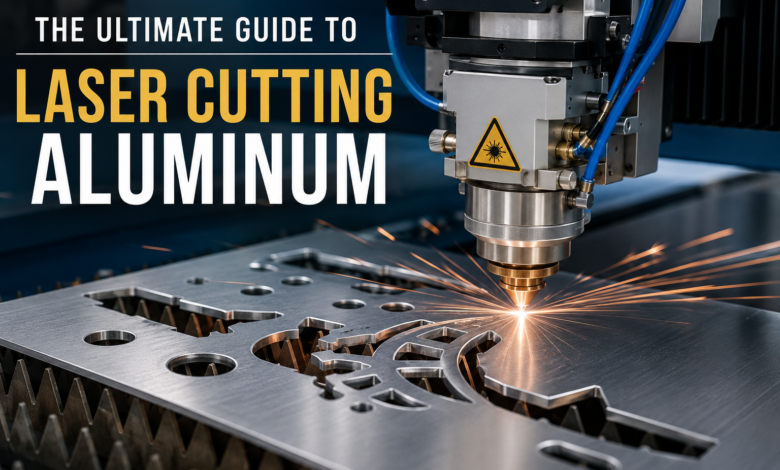
The Ultimate Guide to Laser Cutting Aluminum explains how modern laser technology can produce accurate, clean, and repeatable cuts in one of manufacturing’s most widely used lightweight metals. Aluminum is popular because it combines low weight, corrosion resistance, strength, and good machinability. However, its high thermal conductivity and reflectivity make it more challenging to laser cut than many steels.
Today, fiber laser systems have made aluminum cutting considerably more practical for industrial production. Manufacturers use the process for automotive components, electronics, aerospace parts, architectural products, machinery, and custom fabrication.
What Is Laser Cutting Aluminum?
Laser cutting uses a concentrated beam of light to heat and melt material along a programmed cutting path. An assist gas helps remove molten material from the cut zone, producing the desired shape.
Fiber lasers are particularly important for modern metal fabrication because they can deliver high power and precise beam control. Current industrial systems are available with several kilowatts of laser power, with some machines designed to process aluminum sheets several tens of millimeters thick depending on the alloy, equipment configuration, and cutting package.
Why Aluminum Is Challenging to Cut
Aluminum behaves differently from carbon steel during laser processing.
High Reflectivity
Aluminum reflects a significant portion of incoming laser energy. This can make energy coupling more difficult and places greater demands on the laser source and cutting system.
High Thermal Conductivity
Aluminum transfers heat quickly through the sheet. Instead of keeping heat concentrated around the cutting zone, the material can distribute it into surrounding areas. This can contribute to distortion and inconsistent cutting if parameters are poorly selected.
Different Aluminum Alloys
Not all aluminum behaves the same way. Common alloys such as 5052, 6061, and 7075 have different compositions and manufacturing characteristics. Consequently, a parameter that works well for one alloy may not deliver the same result with another.
Choosing the Right Laser
For industrial aluminum cutting, fiber lasers are generally a strong choice because modern solid-state laser technology can provide the power density and beam quality required for efficient metal processing.
The correct laser power depends on several factors:
- Aluminum alloy
- Sheet thickness
- Required cutting speed
- Edge-quality requirements
- Production volume
- Machine configuration
- Assist-gas system
Higher laser power can expand the practical thickness range, but simply selecting a more powerful machine does not automatically guarantee better results. The laser, cutting head, optics, motion system, gas delivery, and process parameters need to work together.
For example, current TRUMPF fiber laser systems list aluminum cutting capabilities ranging from thinner sheets to approximately 30–40 mm on certain high-power configurations, demonstrating how machine capability varies significantly with laser power and cutting equipment.
Important Cutting Parameters
Successful aluminum laser cutting depends on balancing several parameters rather than changing one setting in isolation.
Laser Power
Power determines how much energy reaches the material. Insufficient energy can prevent complete penetration, while excessive energy may increase heat input and negatively affect the edge.
Cutting Speed
Speed controls how long the laser interacts with a particular section of aluminum. Excessively slow cutting can increase heat accumulation, while excessive speed can produce incomplete cuts or rough edges.
Focus Position
The position of the laser focus affects energy concentration inside the material. The optimum focus depends on the machine, material thickness, optics, and cutting strategy.
Assist Gas
Assist gas removes molten material from the kerf and influences edge quality. Nitrogen is commonly used when a clean, low-oxidation edge is important. Compressed air can also be used in some applications, although it may produce some oxidation.
Nozzle Alignment
The cutting nozzle must be properly aligned and maintained. Poor alignment can disturb gas flow and contribute to inconsistent cuts.
Aluminum Thickness and Machine Capability
Thickness is one of the first specifications manufacturers should consider when choosing a laser cutting system.
A machine designed primarily for thin aluminum sheets may prioritize high-speed processing, while a production system intended for thicker plate may require substantially greater laser power and a suitable cutting package.
For example, published TRUMPF specifications show aluminum maximum thickness varying by laser configuration. A 6 kW system can be rated for substantially less aluminum than a 24 kW system, illustrating why manufacturers should always compare the machine’s actual specifications with their required material range.
How to Achieve Clean Aluminum Cuts
Clean edges require controlled heat input and effective removal of molten material.
Start with the manufacturer’s recommended cutting parameters for the specific aluminum alloy and thickness. Then evaluate the finished edge for:
- Burr formation
- Roughness
- Dross
- Incomplete penetration
- Excessive melting
- Dimensional accuracy
- Heat-related distortion
Small adjustments to speed, power, focus, and gas conditions can significantly influence the final result.
Manufacturers should avoid relying on generic online parameter charts as a substitute for machine-specific testing because laser sources, optics, nozzles, materials, and software can differ.
Common Problems and Their Causes
Burrs on the Bottom Edge
Burrs may indicate unsuitable cutting conditions, including incorrect speed, insufficient gas performance, or inappropriate process parameters. TRUMPF notes that cutting speed that is too high or too low can contribute to roughness and burr formation.
Warping
Thin aluminum can be particularly sensitive to heat. Excessive heat input may cause distortion, so process optimization should aim to achieve complete cutting without unnecessary thermal buildup.
Rough Cutting Edges
Rough edges can result from incorrect power-speed relationships, poor focus, unsuitable gas conditions, or material variation.
Incomplete Cutting
If the laser fails to penetrate completely, manufacturers should check the programmed parameters, material thickness, focus, nozzle condition, gas delivery, and laser performance.
Nitrogen, Oxygen, and Compressed Air
The choice of assist gas affects both cutting performance and the appearance of the finished part.
Nitrogen is useful when manufacturers want to minimize oxidation because it is an inert gas in the cutting process. Compressed air may reduce operating costs in suitable applications, although it can introduce some oxidation.
There is no single gas that is ideal for every aluminum application. Production requirements, edge appearance, thickness, operating cost, and downstream finishing should all be considered.
Applications of Laser Cut Aluminum
Laser-cut aluminum is used across many industries.
Automotive Manufacturing
Manufacturers use laser cutting for brackets, panels, structural components, housings, and prototypes.
Aerospace
Aluminum’s high strength-to-weight characteristics make it important in aerospace manufacturing. Laser cutting can support the production of accurately shaped components when the material and process are properly qualified.
Electronics
Thin aluminum sheets can be used for enclosures, mounting components, heat-management products, and equipment housings.
Architectural Fabrication
Laser cutting allows fabricators to create decorative panels, signs, screens, and customized architectural components.
General Engineering
Machine builders and fabrication companies use aluminum laser cutting for brackets, covers, frames, guards, and custom components.
Benefits of Laser Cutting Aluminum
Laser cutting offers several important advantages:
- High dimensional accuracy
- Repeatable production
- Complex shape capability
- Reduced mechanical contact
- Efficient digital programming
- Fast processing for suitable thicknesses
- Minimal tool wear compared with conventional mechanical cutting
- Easy integration with automated production systems
Modern laser cutting technology is valued for precision, speed, and edge quality across many manufacturing applications.
Safety and Machine Operation
Industrial laser cutting should only be performed using properly designed equipment and appropriate safety procedures. Operators should receive machine-specific training and follow the manufacturer’s operating instructions.
Metal cutting can also produce airborne particulate matter, making suitable extraction and ventilation important. Bystronic highlights particulate hazards associated with lightweight-metal cutting and emphasizes appropriate machine and process controls.
Operators should never bypass machine interlocks, protective enclosures, extraction systems, or other built-in safety features.
How to Choose a Laser Cutting Service
If you are outsourcing aluminum cutting, ask the supplier about:
- Aluminum alloys they regularly process
- Maximum and minimum sheet thickness
- Available laser power
- Expected dimensional tolerances
- Edge-quality requirements
- Assist-gas options
- Production volume
- Prototype capabilities
- Inspection procedures
- Finishing and post-processing services
A good supplier should be able to explain how its equipment and process are suited to your particular material and part requirements.
Final Thoughts
The Ultimate Guide to Laser Cutting Aluminum shows why aluminum remains both a valuable and technically demanding material for laser fabrication. Its reflectivity and thermal conductivity require careful process control, but modern fiber laser technology has made high-quality aluminum cutting a practical manufacturing solution.
The best results come from matching the laser system, material alloy, thickness, power, speed, focus, nozzle, and assist gas to the application. Rather than relying on one universal setting, manufacturers should use validated machine-specific parameters and test representative materials before moving into full production.
With the right equipment and process control, laser cutting can deliver accurate aluminum components efficiently while supporting the flexibility required by modern manufacturing.