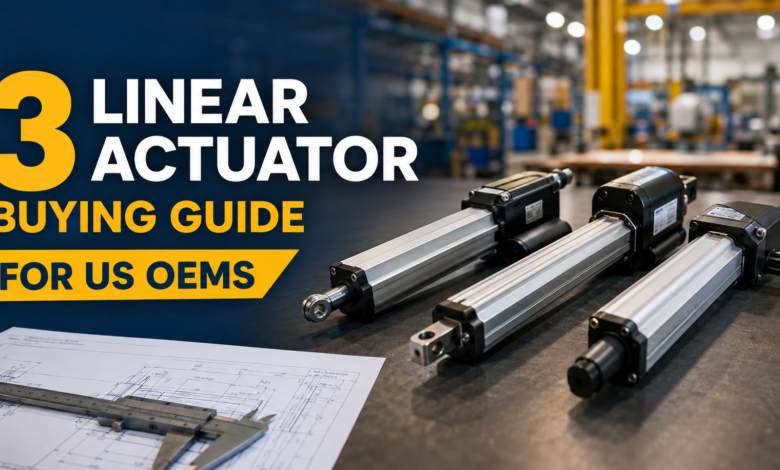
3 Linear Actuator Buying Guide for US OEMs
A Practical Guide to Choosing the Right Linear Actuator for Performance, Reliability, and OEM Integration

Introduction
For U.S. original equipment manufacturers (OEMs), selecting the right linear actuator is an engineering decision that can affect machine performance, reliability, maintenance costs, and production efficiency. A suitable actuator must do more than move a load. It needs to deliver the required force, stroke, speed, duty cycle, accuracy, and environmental protection while fitting the machine’s mechanical and electrical architecture.
Current OEM guidance consistently emphasizes evaluating the complete operating cycle rather than choosing an actuator solely by its maximum force rating. Load, stroke, speed, duty cycle, mounting arrangement, controls, feedback, and environmental conditions should all be considered before final selection.
This 3 Linear Actuator Buying Guide for US OEMs highlights three practical areas that procurement and engineering teams should evaluate before approving an actuator for production.
1. Match Force, Stroke and Speed to the Real Application
The first step is defining exactly what the actuator must accomplish.
Calculate the Required Force
Determine the actual force needed to move the mechanism, including the load, friction, acceleration, mounting angle, and any additional mechanical resistance. Do not automatically select the actuator with the highest available force rating.
A safety margin can be useful, but excessive oversizing may increase cost, power consumption, physical size, and integration complexity.
For vertical applications, gravity becomes especially important. The actuator may need to support the load as well as move it. For off-center or side-loaded mechanisms, an external guide may be necessary because many rod-style actuators are designed primarily for axial push-and-pull loads.
Specify the Required Stroke
Stroke is the distance the actuator needs to travel. Measure the actual mechanical movement required by the machine rather than selecting a longer stroke simply because it is available.
The actuator’s overall retracted and extended dimensions also matter. An actuator may have the correct stroke but still be unsuitable because its mounting envelope does not fit the equipment.
Check Speed Under Load
Manufacturers often publish maximum or no-load speed figures, but an OEM should evaluate the speed that can actually be achieved under working load.
Travel time can be estimated from:
Travel time = Stroke ÷ Linear speed
However, acceleration, deceleration, load changes, and control settings can affect the real machine cycle.
The correct actuator therefore needs to satisfy the required combination of force, stroke and speed, rather than excelling at only one specification.
2. Evaluate Duty Cycle, Environment and Control Requirements
Once the mechanical requirements are established, examine how the actuator will operate inside the finished machine.
Duty Cycle Matters
Duty cycle describes the relationship between operating time and rest time. Two machines that perform the same number of movements per day can place very different demands on an actuator if one performs those movements consecutively.
OEM buyers should document:
- Operations per hour
- Maximum consecutive cycles
- Continuous running time
- Rest time between movements
- Expected operating hours
- Required service life
Recent OEM guidance specifically recommends giving suppliers the complete operating sequence rather than relying on an average daily operating figure.
An actuator with a high force rating is not automatically suitable for frequent operation. Force, speed, current draw and duty cycle should be considered together.
Consider the Operating Environment
The actuator’s surroundings can significantly influence selection.
For equipment exposed to dust, moisture, outdoor conditions, vibration, cleaning processes, or other contaminants, examine the required ingress protection and construction materials. IP ratings are commonly used to communicate enclosure protection against solids and water.
The correct specification depends on the actual environment. A dry indoor machine may have very different requirements from outdoor equipment or machinery exposed to washdown conditions.
Choose the Right Feedback and Controls
Basic applications may only require simple extend-and-retract control. More advanced OEM equipment may need position feedback, multiple stopping points, synchronization, speed control, or closed-loop operation.
Common feedback approaches include potentiometers, Hall-effect sensors and encoders. The appropriate option depends on the required positioning performance and the machine’s control architecture.
Also confirm compatibility between the actuator, motor, controller, PLC, drive, power supply and safety system before production approval.
3. Compare Integration, Supplier Support and Total Cost
A good actuator is not necessarily the cheapest component on the quotation. OEMs should consider the total cost of integrating and supporting the actuator throughout the product lifecycle.
Check Mechanical Integration
Review:
- Mounting points
- Retracted length
- Extended length
- Available installation space
- Cable routing
- Alignment
- External guides
- Mounting orientation
- Access for maintenance
Misalignment and inappropriate side loading can increase wear and reduce service life. If the moving load requires mechanical guidance, integrate suitable linear guides rather than expecting the actuator to handle unsupported side forces.
Evaluate Electrical Integration
Before ordering production quantities, verify voltage, current requirements, controller compatibility, connector type, feedback interface and cable requirements.
Power-supply capacity is particularly important when several actuators operate simultaneously. A system should be evaluated as a complete electrical package rather than treating the actuator as an isolated component.
Examine Supplier and Production Support
For U.S. OEM programs, supplier capability can be as important as the actuator’s published specifications.
Ask potential suppliers about:
- Prototype availability
- Production quantities
- Lead times
- Quality-control procedures
- Documentation
- Replacement parts
- Engineering support
- Customization options
- Warranty terms
- Long-term product availability
Standard OEM configurations may provide a faster route to production, while custom or ODM solutions can be useful when the actuator needs specialized dimensions, connectors, feedback, firmware, or mechanical characteristics.
Build a Clear RFQ Before Requesting Quotes
A detailed request for quotation can help suppliers recommend the correct actuator instead of simply sending a catalog model.
A strong RFQ should include:
- Application description
- Required force
- Stroke length
- Required speed under load
- Operating voltage
- Duty cycle
- Cycles per hour
- Maximum consecutive cycles
- Mounting dimensions
- Mounting orientation
- Environmental conditions
- Required IP rating
- Feedback requirements
- Control interface
- Number of actuators operating together
- Prototype quantity
- Expected annual production volume
A mechanical drawing or sketch showing the actuator mounting position can make the evaluation even more accurate.
Common Buying Mistakes US OEMs Should Avoid
Choosing Only by Maximum Force
Maximum force does not describe speed, duty cycle, service life or positioning performance.
Using No-Load Speed
The machine’s cycle should be based on realistic operating conditions and working load.
Ignoring Installation Geometry
A technically powerful actuator can still fail to fit the machine or create unwanted side loading.
Treating Duty Cycle as an Afterthought
Repeated operation can create thermal and mechanical stresses that are not apparent during short prototype tests.
Selecting the Actuator Before the Machine Cycle Is Defined
The best approach is to define the complete movement profile first, then compare actuator options against those requirements.
Final Takeaway
For U.S. OEMs, buying a linear actuator should be approached as a complete system-design decision. Start with the application’s real force, stroke and speed requirements. Then evaluate duty cycle, environment, feedback and controls. Finally, assess mechanical integration, electrical compatibility, supplier support and lifecycle cost.
A well-prepared specification gives suppliers the information needed to recommend an appropriate actuator and reduces the risk of discovering performance or integration problems after production begins. Current manufacturer selection tools similarly emphasize parameters such as load, speed, stroke, IP rating, voltage and interface when matching actuators to industrial applications.
For OEM procurement teams, the goal is not simply to buy an actuator that can move the load. The goal is to select a motion component that can reliably perform the complete machine cycle, integrate cleanly with the equipment, and remain supportable throughout the product’s expected life.