Understanding Nano Banana 2.5 and the Evolution of AI Image Generation
Exploring the Evolution, Features, and Future of AI Image Generation

Introduction
Artificial intelligence has changed the way people create, edit, and communicate with images. What once required advanced photography, graphic design, or editing skills can now be accomplished with a simple written prompt. Among the developments attracting significant attention is Google’s Nano Banana family of image-generation models.
The phrase Understanding Nano Banana 2.5 and the Evolution of AI Image Generation can be confusing because Nano Banana was originally associated with Gemini 2.5 Flash Image, while Google’s newer Nano Banana 2 is based on Gemini 3.1 Flash Image. The original model was designed for fast, conversational image generation and editing, while later versions have expanded quality, consistency, speed, and creative control.
What Is Nano Banana?
Nano Banana is the name Google uses for its native Gemini image-generation technology. The original Nano Banana model was introduced as Gemini 2.5 Flash Image, providing capabilities for both creating images from text and editing existing images through natural-language instructions.
Instead of relying only on traditional image-editing controls, users can describe what they want to change. An image can be transformed through conversational instructions, making the creative process more accessible to beginners as well as experienced creators.
Google has described the original model as particularly suitable for high-volume visual creation, conversational editing, and workflows where speed is important.
Why the “2.5” Name Matters
The “2.5” in the keyword refers to Gemini 2.5 Flash Image, the model that became known as the original Nano Banana. It is important not to confuse this with Nano Banana 2, which is a later generation based on Gemini 3.1 Flash Image.
Google’s current documentation describes Gemini 2.5 Flash Image as the legacy pioneer of the Nano Banana series. The newer Nano Banana 2 is positioned as a more advanced general-purpose image model with improvements in image quality, editing, consistency, and speed.
This distinction shows how quickly generative AI models are evolving. A model that was considered highly capable when introduced can soon become part of a larger family of newer technologies.
How AI Image Generation Has Evolved
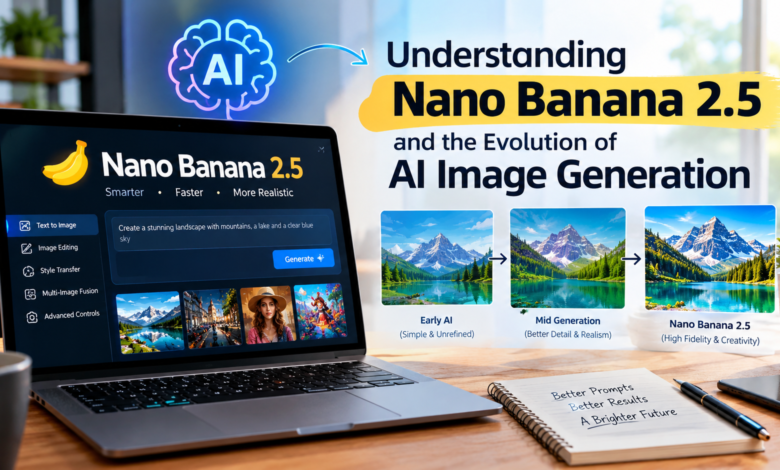
Early AI image generators often struggled with details such as hands, text, object relationships, and consistency between multiple images. Creating a visually convincing result could also require repeated prompting and considerable experimentation.
Modern systems have become much more capable of understanding natural-language instructions and visual context. Instead of simply converting individual words into pixels, multimodal models can interpret relationships between objects, styles, scenes, and editing instructions.
Nano Banana contributed to this shift by making image generation more conversational. Users could provide an image, describe a desired modification, and continue refining the result through additional instructions. Google’s documentation specifically highlights conversational image editing and multimodal understanding as important capabilities.
Key Features of Nano Banana
Text-to-Image Creation
One of the fundamental capabilities is generating an image from a written description. Users can describe a location, object, character, product concept, illustration, or visual style and ask the model to create it.
This reduces the technical barrier traditionally associated with digital image creation.
Conversational Editing
Nano Banana is also designed for editing. Rather than manually selecting individual areas and applying numerous adjustments, users can describe changes using natural language.
For example, a creator can request a different background, lighting adjustment, object replacement, or stylistic change and then continue refining the result.
Multimodal Understanding
The technology is not limited to text-only workflows. Google’s Gemini image-generation documentation describes systems that can work with combinations of text and images, allowing users to provide visual references alongside instructions.
This is particularly useful for creative workflows where an existing image provides important context.
Nano Banana 2 and the Next Stage
In February 2026, Google introduced Nano Banana 2, officially identified as Gemini 3.1 Flash Image. Google describes it as combining advanced image capabilities with the speed associated with its Flash models.
The newer generation focuses on higher-fidelity image generation, faster editing, improved world knowledge, subject consistency, and production-oriented workflows. These developments demonstrate that AI image generation is moving beyond simple novelty and toward practical creative production.
Google’s current developer documentation lists Nano Banana 2 as its versatile general-purpose image model, while Nano Banana Pro is intended for more complex professional visual tasks.
From Simple Prompts to Creative Workflows
The biggest change in AI image generation is not simply better-looking pictures. It is the transition from one-time generation toward complete creative workflows.
A creator can generate an initial concept, request modifications, compare different directions, and refine an image through multiple conversational steps. This can make AI useful for advertising concepts, educational visuals, product ideas, presentations, social media content, and creative experimentation.
The process also changes the role of the human creator. Instead of performing every technical editing task manually, people increasingly focus on describing goals, evaluating results, and deciding which visual direction best communicates their idea.
AI Image Generation and Real-World Applications
AI-generated images are becoming useful across many industries. Designers can use them for early concepts, educators can create visual learning materials, and businesses can explore advertising or product concepts before committing to expensive production.
Google has also expanded Nano Banana technology into products such as Search and NotebookLM. Google reported in October 2025 that more than five billion images had been generated with Nano Banana since its introduction, illustrating the scale of interest in AI-assisted visual creation.
More recently, Adobe introduced an experimental Lightroom feature using Nano Banana 2 for prompt-based image editing, showing how these models are moving into established creative software.
Understanding the Future of AI Images
The evolution from Nano Banana to Nano Banana 2 highlights a broader trend in artificial intelligence. Image models are becoming faster, more context-aware, and increasingly capable of maintaining consistency while following detailed instructions.
At the same time, responsible use remains important. AI-generated visuals can blur the distinction between photographs and synthetic content. Google says its generated images include SynthID, a technology intended to help identify AI-generated content.
For publishers, businesses, educators, and creators, transparency can therefore become an important part of responsible AI-assisted visual production.
Conclusion
Understanding Nano Banana 2.5 and the Evolution of AI Image Generation requires looking beyond a single model name. The original Nano Banana, based on Gemini 2.5 Flash Image, helped demonstrate how conversational image generation and editing could become practical for everyday users. Nano Banana 2 represents a newer stage, bringing stronger image quality, faster workflows, improved consistency, and broader creative capabilities.
The technology continues to develop rapidly. As AI image models become more capable, the future of visual creation is likely to involve closer collaboration between human creativity and intelligent image-generation systems. The goal is not simply to produce attractive pictures faster, but to make sophisticated visual creation more accessible, flexible, and useful across everyday creative and professional work.




