The Future of AI-Powered Revenue Cycle Management: How Healthcare Billing Is Changing
From smarter medical billing and faster claims processing to predictive analytics, artificial intelligence is changing how healthcare providers manage payments, reduce administrative work, and maintain financial stability.

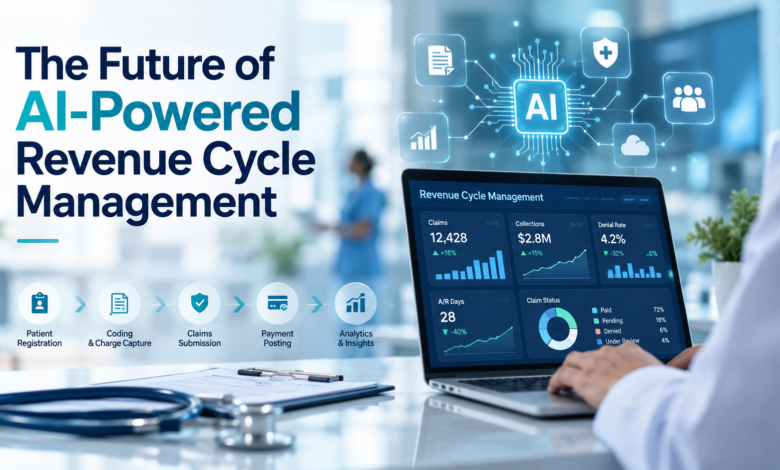
Introduction
Healthcare providers face a problem that rarely gets attention outside hospital offices. Doctors provide treatment, patients receive care, and bills are submitted. Yet getting paid can take weeks or months.
A missing insurance detail, an incorrect medical code, or a delayed authorization can hold up thousands of dollars.
That is where AI-powered revenue cycle management (RCM) is beginning to make a difference.
Instead of relying entirely on manual billing processes, healthcare organizations can use artificial intelligence to identify mistakes, predict payment delays, review documentation, and help employees resolve claims more efficiently.
The future is not simply about replacing paperwork with software. It is about preventing billing problems before they happen while keeping people responsible for important financial and clinical decisions.
Quick Facts About AI in Healthcare Revenue Management
| Category | Details |
|---|---|
| Technology | Artificial intelligence and machine learning |
| Industry | Healthcare administration and finance |
| Main purpose | Improving the accuracy and efficiency of revenue operations |
| Common applications | Medical coding, claims processing, denial management |
| Other applications | Insurance verification, patient billing, payment forecasting |
| Main users | Hospitals, clinics, physician groups, billing companies |
| Key benefits | Less repetitive work, earlier error detection, faster claim resolution |
| Main challenges | Data privacy, integration costs, accuracy, regulatory compliance |
| Future direction | Predictive analytics, intelligent automation, agentic AI |
| Human involvement | Required for oversight, exceptions, and sensitive decisions |
Understanding How Healthcare Revenue Management Works
Revenue cycle management covers the financial activities involved in delivering healthcare services.
The process usually starts when a patient schedules an appointment and continues until the healthcare provider receives payment.
Along the way, employees must verify insurance coverage, document services, assign billing codes, submit claims, handle rejected payments, and communicate with patients.
Each step matters.
One small error at the beginning can create additional problems later. For example, an incorrect insurance identification number might prevent a claim from being accepted.
Traditional RCM systems often depend on employees manually reviewing information across several platforms.
AI changes this approach by helping software recognize errors, process routine information, and identify accounts that need attention.
Rather than examining every claim with equal effort, billing teams can concentrate on cases where their judgment is most valuable.
Why Healthcare Organizations Are Investing in AI
Healthcare billing has become increasingly complicated.
Insurance rules change. Documentation requirements grow. Payment disputes consume employee time.
The 2026 HFMA–Guidehouse Revenue Cycle Management Trends report found that 88% of surveyed healthcare finance executives ranked payer-related issues among their top three concerns.
The same research reported that 78% of respondents were using automation and AI to accelerate manual revenue-cycle processes.
These findings show why technology investment has become a major consideration for healthcare finance leaders.
Hospitals cannot solve every financial problem by hiring more administrative staff.
They also need more accurate information, better workflows, and systems capable of identifying problems earlier.
AI offers opportunities in all three areas.
How Artificial Intelligence Is Changing Medical Billing
Medical billing involves much more than entering numbers into a computer.
Every claim must accurately represent the treatment provided, follow coding standards, and satisfy the requirements of the relevant insurance plan.
AI-assisted billing systems can review information from clinical records and compare it with billing requirements.
They may identify missing documentation, suggest appropriate codes, or flag potential inconsistencies.
Consider a clinic submitting hundreds of claims daily.
Instead of having employees examine each one from the beginning, an AI system could identify claims with missing information and direct those cases to trained staff.
The result may be fewer avoidable errors and more time for complicated billing questions.
However, software-generated recommendations still need appropriate validation. Incorrect codes or unsupported services can create compliance problems even when an automated system suggested them.
Predictive Analytics Could Prevent More Claim Denials
One of the most promising uses of artificial intelligence is identifying claims that might be denied.
Traditional revenue teams frequently discover problems only after an insurer rejects a submission.
By then, employees must investigate the claim, correct the issue, and sometimes file an appeal.
Predictive analytics offers a different approach.
AI systems can examine historical claims, payer requirements, coding patterns, and prior denial reasons to estimate whether a new claim is likely to encounter problems.
If the system identifies an issue, the billing team can investigate before submission.
For example, an outpatient procedure may require additional medical documentation.
A predictive tool could flag the missing information before the claim reaches the insurer.
This does not guarantee reimbursement. Insurance coverage, medical necessity, contractual terms, and other factors still determine payment.
Nevertheless, catching preventable mistakes earlier could reduce unnecessary rework.
The Growing Role of Intelligent Claims Automation
Claims processing contains numerous repetitive activities that are suitable for automation.
These include checking claim status, matching documents, identifying missing fields, and routing exceptions to the right employee.
Earlier generations of automation generally followed fixed instructions.
Modern AI-supported systems can also interpret certain unstructured information, such as notes and documents, and recommend an appropriate next action.
The distinction matters.
A traditional system might recognize that a field is empty.
An intelligent system might also identify which supporting document contains the missing information, subject to verification.
From task automation to connected workflows
The next stage involves systems that coordinate multiple administrative activities.
An AI agent might identify a claim requiring additional documentation, prepare a request, organize the response, and recommend the next step.
This emerging approach is often called agentic AI.
For healthcare organizations, the goal is to reduce repeated manual steps without allowing software to make unchecked decisions.
High-risk actions, disputed clinical determinations, and final financial approvals should remain subject to appropriate human controls.
Medical Coding Is Becoming More Data-Driven
Medical coding translates healthcare services, diagnoses, and procedures into standardized codes used for billing and reporting.
It is demanding work.
Medical records contain specialized terminology, abbreviations, and details that may affect which codes are appropriate.
AI coding assistance can examine clinical documentation and suggest possible codes.
Natural language processing helps these systems interpret written medical information.
However, medical language can be ambiguous.
A suspected diagnosis, for example, cannot always be coded in the same way as a confirmed diagnosis. Applicable coding rules also vary by setting.
That is why qualified coding professionals remain important.
The likely direction is a combination of automated assistance and expert review, with simpler cases handled more efficiently and complicated cases receiving additional attention.
Prior Authorization Is Entering a New Phase
Prior authorization is another major source of administrative pressure.
Certain medical services require insurance approval before treatment can proceed.
Healthcare providers may have to gather records, submit documentation, wait for a response, and challenge an unfavorable decision.
AI can potentially help identify authorization requirements and prepare documentation.
Regulatory changes are also creating opportunities for greater interoperability.
Under the CMS Interoperability and Prior Authorization Final Rule, certain impacted payers must implement specified prior authorization APIs, with relevant requirements generally beginning January 1, 2027.
These systems are intended to support electronic information exchange between healthcare providers and payers.
Importantly, the rule does not mean that every insurer or every medical service becomes subject to the same requirements.
AI may help healthcare organizations use these connections more effectively, but interoperability standards and AI technology serve different purposes.
Better information exchange could reduce some administrative delays, particularly when combined with well-designed provider workflows.
Can AI Improve the Patient Billing Experience?
Patients often find healthcare bills confusing.
They may receive separate statements from hospitals, physicians, laboratories, and other service providers.
Insurance adjustments and unfamiliar medical terms make the situation even harder to understand.
AI-powered patient financial tools could improve communication by explaining billing categories, answering routine questions, and helping people understand their payment responsibilities.
Some systems can support appointment reminders, estimate generation, and payment-plan administration.
Imagine receiving a hospital bill and being able to ask a secure digital assistant why a particular charge appears.
The assistant could explain the billing information available to it and direct the patient to a representative when further investigation is necessary.
Still, accuracy is essential.
A chatbot should not invent coverage decisions, guarantee insurance reimbursement, or provide misleading payment advice.
Patients also need a clear way to contact a human employee when automated assistance is insufficient.
Why Data Quality Matters More Than Ever
Artificial intelligence depends on reliable information.
If a healthcare organization’s billing records contain outdated insurance details, duplicate accounts, or inconsistent documentation, an AI system may produce inaccurate recommendations.
This is one of the biggest practical barriers to adoption.
A sophisticated model cannot automatically correct every problem in the underlying data.
Healthcare organizations need consistent records, appropriate data governance, reliable system connections, and regular quality checks.
Data quality should be treated as a foundation rather than an optional improvement.
Without it, automation can process mistakes faster instead of preventing them.
The Importance of Privacy and Security
Healthcare financial systems often handle protected health information, insurance details, and sensitive personal records.
Using artificial intelligence therefore creates serious privacy and security responsibilities.
In the United States, applicable HIPAA requirements govern how covered entities and business associates protect and use protected health information.
According to U.S. Department of Health and Human Services guidance, covered entities and business associates using cloud providers to handle electronic protected health information must meet applicable HIPAA requirements, including entering into a business associate agreement when required.
Healthcare organizations evaluating AI products should examine how patient information is stored, accessed, processed, retained, and shared.
Important safeguards include:
- Restricting access to authorized users
- Encrypting sensitive information where appropriate
- Maintaining audit logs
- Reviewing vendor security practices
- Limiting unnecessary data collection
- Establishing incident-response procedures
- Monitoring automated outputs for errors
A product being described as AI-powered or secure does not automatically make it compliant with healthcare privacy laws.
Compliance depends on the actual system, its operation, contractual arrangements, and relevant legal obligations.
Will Artificial Intelligence Replace Medical Billing Professionals?
The future of healthcare administration will probably involve significant changes to job responsibilities.
Employees who spend most of their time copying information, checking routine claim statuses, or organizing documents may see more of those tasks automated.
However, healthcare revenue operations involve responsibilities that cannot easily be reduced to simple patterns.
Complex appeals, payer negotiations, unusual billing disputes, compliance investigations, and sensitive patient conversations still require human judgment.
AI may therefore change what billing employees do rather than eliminate every position.
Professionals may spend more time reviewing exceptions, investigating complicated cases, and monitoring automated systems.
Training will matter.
Healthcare organizations that introduce new tools without preparing employees risk creating confusion, poor adoption, and preventable mistakes.
Major Challenges Facing AI Adoption
Despite its potential, artificial intelligence is not a guaranteed solution to every revenue-cycle problem.
Implementation costs
Hospitals may need to invest in software licensing, system integration, staff training, cybersecurity, and ongoing monitoring.
Smaller medical practices can find these expenses especially difficult.
Integration with existing platforms
Healthcare organizations often use different electronic health record systems, billing applications, and payer portals.
Connecting these platforms can require considerable technical work.
Incorrect automated recommendations
AI systems can misunderstand documentation or make inaccurate predictions.
Generative AI may also produce information that appears convincing but is unsupported.
Human review and controlled testing remain necessary.
Limited transparency
Some advanced models do not provide straightforward explanations for their recommendations.
This creates difficulties when billing professionals need to understand why a claim was flagged or a particular action was suggested.
Employee resistance
Workers may be concerned about job security, workload changes, or unreliable technology.
Clear communication and practical training can improve adoption.
Risks of inappropriate automated denials
AI can be used by both healthcare providers and insurers.
The American Medical Association reported in 2025 that 61% of surveyed physicians were concerned that insurers’ use of AI could increase prior authorization denials.
This concern highlights why oversight is necessary. Faster administrative decisions are not necessarily better decisions, particularly when access to patient care is affected.
What the Next Five Years Could Look Like
Several developments are likely to influence healthcare revenue operations between 2026 and 2031.
These are expected directions rather than guaranteed outcomes.
Greater automation across the claim lifecycle: More organizations may connect insurance verification, coding assistance, submission checks, and payment follow-up into coordinated workflows.
Smarter denial prevention: Predictive systems may become better at identifying payer-specific rejection patterns and missing documentation before submission.
Broader use of AI agents: Certain administrative tasks may move from isolated software functions to supervised systems capable of managing several steps.
Better financial forecasting: Healthcare finance leaders may gain more detailed projections of collections, outstanding claims, and payment delays.
More attention to patient communication: Digital assistants may provide clearer explanations of estimates, bills, and payment options.
Stronger AI governance: Hospitals and vendors will face increasing pressure to document accuracy, security, accountability, and appropriate human oversight.
The organizations that benefit most may not be those buying the largest number of AI tools.
They may be those that introduce practical improvements, measure results, and maintain trustworthy processes.
How Healthcare Providers Can Prepare
Successful adoption requires more than purchasing new software.
Organizations should first examine where their current revenue processes lose time or money.
Common starting points include frequent registration errors, avoidable claim denials, slow payment follow-up, and labor-intensive document review.
A practical implementation approach includes:
- Review current performance. Establish baseline figures for denials, collection costs, payment times, and employee workloads.
- Select a specific use case. Begin with a clearly defined task where results can be measured.
- Evaluate data readiness. Check whether the information required by the system is accurate and accessible.
- Assess vendor safeguards. Review security, contractual requirements, system compatibility, and oversight capabilities.
- Run a controlled pilot. Compare results with the existing process before expanding deployment.
- Train employees. Explain when to rely on automated recommendations and when to escalate a case.
- Measure performance regularly. Track accuracy, financial outcomes, exceptions, and patient-related impacts.
Useful metrics include first-pass claim acceptance, initial denial rate, days in accounts receivable, cost to collect, appeal success rate, and net collection rate.
No single metric tells the entire story.
For example, an increase in automated claim processing is not necessarily beneficial if more claims subsequently require corrections.
Healthcare organizations should evaluate both efficiency and accuracy.
Why Human Oversight Will Remain Essential
Revenue cycle management may appear to be primarily a financial activity, but it is closely connected to patient care.
An incorrect insurance decision can delay treatment. A billing error can create financial stress. An inaccurate automated appeal can introduce compliance risks.
These consequences make accountability especially important.
Artificial intelligence is best treated as a decision-support and workflow tool whose responsibilities are clearly defined.
People should be able to question its outputs, correct mistakes, and review decisions that have significant consequences.
The strongest revenue-cycle operations will combine technological efficiency with professional experience and clear responsibility.
Final Thought
The future of healthcare revenue management is moving toward systems that identify problems earlier, process routine work more efficiently, and give financial teams better information.
Artificial intelligence can help reduce administrative pressure, but its value depends on how carefully it is introduced.
Accurate medical billing, reliable insurance data, transparent processes, and patient trust must remain priorities.
For healthcare organizations, the goal should not be automation at any cost.
It should be getting the right claim paid accurately, with less unnecessary work and fewer obstacles for patients and providers.
Frequently Asked Questions
1. What is AI-powered revenue cycle management?
AI-powered revenue cycle management uses artificial intelligence to support healthcare financial processes such as insurance verification, medical coding, claims processing, payment follow-up, and denial management.
2. How does AI improve medical billing?
AI can identify missing information, suggest billing codes, detect claim inconsistencies, and reduce repetitive administrative tasks. Its recommendations still need appropriate checks.
3. Can AI reduce healthcare claim denials?
Yes, potentially. AI can identify common denial risks before claims are submitted. Results depend on data quality, payer rules, workflow design, and implementation accuracy.
4. Will AI replace healthcare billing employees?
Some routine tasks may be automated, but complex appeals, compliance decisions, payer negotiations, and patient support will continue to require human involvement.
5. Is AI-powered healthcare billing secure?
It can be implemented securely, but security is not automatic. Organizations must assess privacy requirements, vendor practices, access controls, data protection, and applicable laws.
6. What
is the role of predictive analytics in revenue management?
Predictive analytics uses historical and current data to estimate outcomes such as claim denial risk, payment delays, and collection patterns.
7. What is agentic AI in healthcare revenue operations?
Agentic AI refers to systems designed to coordinate and carry out sequences of administrative actions. Healthcare organizations should place appropriate controls around their access and decisions.
8. What is the biggest benefit of AI in revenue management?
Its main potential benefit is reducing preventable administrative work while improving billing accuracy and helping healthcare staff address financial problems earlier.
