Riyadh’s Specialist Teacher Shortage Reshapes Education Growth
Why rising school demand is increasing the need for highly qualified subject specialists

Introduction
Riyadh is experiencing significant changes across its education sector as Saudi Arabia continues to expand and modernize its schools. New education policies, private-sector participation, international curricula, technology, and population growth are increasing demand for qualified teachers. At the same time, schools face a more specific challenge: finding teachers with the right subject expertise and experience for particular academic programs.
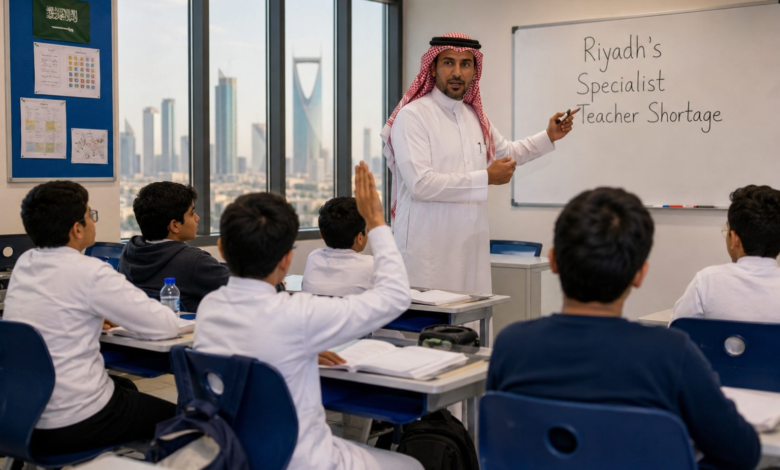
The phrase Riyadh’s Specialist Teacher Shortage describes this growing challenge, particularly in subjects where schools need teachers with deep knowledge rather than general classroom experience. Recent developments suggest that teacher specialization is becoming even more important. Saudi Arabia’s Ministry of Education has announced that teachers should not teach subjects outside their professional specializations, reinforcing the importance of matching educators with appropriate qualifications.
What Is Riyadh’s Specialist Teacher Shortage?
A specialist teacher shortage does not necessarily mean Riyadh has too few teachers overall. Instead, it can mean that schools struggle to find enough teachers with specific qualifications, experience, curriculum knowledge, or examination expertise.
This distinction is particularly important for international and private schools. A school may find a qualified science teacher, for example, but finding someone experienced in a particular international examination system can be considerably more difficult.
Specialist requirements can include subjects such as physics, chemistry, mathematics, computer science, languages, special education, and advanced examination-level courses.
The shortage therefore represents a skills-and-demand mismatch rather than simply a shortage of people willing to teach.
Why Demand for Specialist Teachers Is Increasing
Riyadh’s education market is developing alongside the Kingdom’s wider economic transformation. The Ministry of Education has emphasized improving educational quality, supporting teachers, and strengthening the role of private and nonprofit organizations in education.
The capital is also a major employment and population center. DataSaudi reports that the Riyadh region had more than 8.59 million residents in the 2022 population data and recorded more than one million employees in professional occupations during the first quarter of 2026.
A growing professional population can contribute to demand for high-quality schooling, including international curricula. As families seek stronger academic pathways, schools need teachers who can deliver those programs effectively.
This creates pressure on recruitment because specialist teaching expertise takes time to develop.
International Schools Face Particular Recruitment Pressure
International schools often require teachers who understand specific curricula and assessment systems. Knowledge of a subject alone may not be enough.
For example, an experienced physics teacher may have excellent subject knowledge, but a school offering an international examination program may prefer someone who has already taught that particular curriculum and understands its assessment expectations.
Current recruitment activity provides evidence that Riyadh schools continue to seek qualified educators. The American International School-Riyadh, for example, lists teaching opportunities for the 2026–2027 academic year and describes its preference for highly qualified educators.
The British International School Riyadh has also been building a talent pool for future teaching opportunities, with recruitment covering specialist and senior-school subjects.
These recruitment patterns do not by themselves establish a citywide numerical shortage, but they illustrate the continuing importance of specialist teacher recruitment.
High Demand for Science and Mathematics Expertise
Science and mathematics can be particularly sensitive areas because advanced courses require teachers with strong subject knowledge.
Physics, chemistry, advanced mathematics, computer science, and related technical subjects can require specialized qualifications and experience. At higher grade levels, teachers also need to understand complex assessment requirements and help students prepare for examinations.
The result is a narrower recruitment pool.
Schools competing for the same experienced specialists may have to improve professional opportunities, working conditions, training, and career development. International recruitment can also become more competitive because schools in different countries are seeking educators with similar qualifications.
New Education Rules Increase the Importance of Specialization
One of the most important developments in Saudi education during 2026 is the stronger emphasis on teaching within professional specialization.
Education Minister Yousef Al-Benyan announced measures including a restriction on teachers teaching subjects outside their specialization. The ministry has presented this approach as a way of protecting students’ right to receive instruction from appropriately specialized educators.
For Riyadh schools, this policy direction could make specialist recruitment even more important.
If schools previously relied on flexible staff allocation to cover gaps, stronger specialization requirements may reduce that flexibility. A vacant physics position, for example, may need to be filled by an appropriately qualified specialist rather than simply assigning another teacher with a related background.
Teacher Development Could Help Close the Gap
Recruitment is only one solution. Teacher development can also expand the available specialist workforce.
Saudi education authorities have emphasized training and professional development as part of broader education reforms. Recent announcements included plans involving large-scale teacher training, alongside other reforms designed to improve educational quality.
Professional development can help teachers strengthen subject knowledge, assessment skills, classroom technology capabilities, and curriculum-specific expertise.
However, developing a highly experienced specialist takes time. A teacher may need several academic cycles to build deep familiarity with a curriculum, examination standards, student expectations, and effective teaching strategies.
This means professional development is a long-term solution rather than an instant answer to recruitment gaps.
Technology and Artificial Intelligence May Change the Situation
Technology is becoming another part of the education workforce discussion.
Saudi Arabia has designated 2026 as the Year of Artificial Intelligence, and the Ministry of Education has discussed using AI tools to reduce administrative workloads for teachers and students.
AI may help teachers with administrative tasks, lesson preparation, organization, and some forms of educational support. However, technology does not remove the need for qualified subject specialists.
Students still need educators who can explain difficult concepts, identify misconceptions, assess learning, provide feedback, and adapt instruction to individual needs.
Therefore, AI is more likely to change how specialist teachers work than eliminate the underlying demand for them.
What the Shortage Means for Schools
Schools facing specialist recruitment challenges may need to think beyond simply advertising vacant positions.
Strong recruitment strategies can include international talent searches, competitive professional packages, mentoring programs, internal teacher development, and clearer career pathways.
Riyadh’s official education administration already has responsibilities related to identifying schools’ staffing requirements, determining the required qualifications, and addressing educational staffing needs through recruitment, transfers, and other measures.
Better workforce planning can help schools anticipate shortages before they become urgent.
Schools can also build talent pipelines by identifying promising teachers early and providing training that prepares them for specialist roles.
What It Means for Families and Students
For families, specialist teacher availability can influence the quality of educational experiences.
Parents choosing a school may reasonably want to understand whether teachers have relevant qualifications, appropriate classroom experience, and familiarity with the curriculum being taught.
For students, having the right specialist can make difficult subjects easier to understand. This is especially important during examination years, when detailed knowledge of course requirements and assessment methods can have a meaningful impact on preparation.
The issue is therefore not simply about filling vacancies. It is about ensuring that students receive appropriate instruction from educators whose expertise matches the subject.
Riyadh’s Opportunity to Build a Stronger Teaching Workforce
The specialist teacher shortage also creates an opportunity.
Riyadh is becoming an increasingly important education market, and continued investment could attract experienced educators from around the world while also developing Saudi teaching talent.
A stronger system would combine recruitment with long-term professional development. Experienced international teachers could contribute specialist expertise, while Saudi educators could receive opportunities to develop advanced subject and leadership capabilities.
This approach could gradually increase the depth of the teaching workforce instead of relying indefinitely on external recruitment.
Conclusion
Riyadh’s Specialist Teacher Shortage reflects a broader challenge created by the rapid development of education: demand for highly specific expertise can grow faster than the supply of experienced specialists.
Current Saudi education reforms place greater emphasis on teacher specialization, quality, professional development, and improved educational outcomes.
The evidence available today does not establish a single official citywide figure for a specialist teacher shortage. Instead, recruitment activity, policy changes, and expanding educational requirements point toward a growing need for carefully matched teaching expertise.
For Riyadh, the long-term answer will likely involve a combination of targeted recruitment, teacher training, better workforce planning, and responsible use of technology. If these measures develop together, the city can turn today’s specialist recruitment challenge into an opportunity to build a stronger, more capable, and more sustainable education system.