Digital Detox Weekend Checklist for a Refreshing Screen-Free Break
A Simple Guide to Planning a Calmer, More Focused Weekend

Intorduction
A digital detox weekend checklist can make it easier to step away from constant notifications, social media, streaming, and unnecessary screen time without making the weekend feel restrictive. Instead of trying to disconnect from every device completely, the goal is to create intentional periods when technology is put aside so you can focus on rest, hobbies, family, friends, and the world around you.
Research on digital detox interventions does not provide one universal definition or prove that complete digital abstinence is always necessary. Reviews suggest that reducing smartphone and social-media use may be more beneficial and sustainable for many people than attempting total abstinence.
What Is a Digital Detox Weekend?
A digital detox weekend is a planned period during which you reduce non-essential digital activities. This might include social media, gaming, endless scrolling, unnecessary messaging, streaming, and frequent checking of notifications.
You can still keep your phone available for important communication, emergencies, navigation, or other essential needs.
The key is to replace automatic screen habits with purposeful offline activities rather than simply sitting without a device.
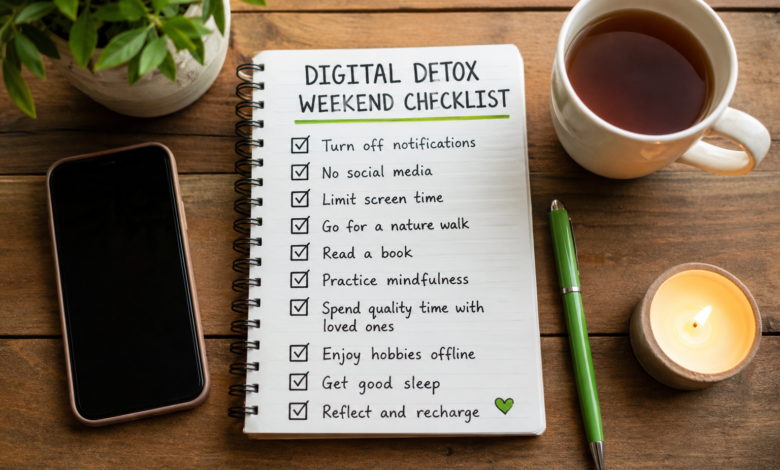
Digital Detox Weekend Checklist
Use this checklist before your weekend begins:
- Decide when your detox starts and ends
- Choose which apps and devices you will avoid
- Turn off unnecessary notifications
- Tell family and friends you may respond slowly
- Keep essential communication available
- Prepare offline entertainment
- Choose outdoor or physical activities
- Set aside time for reading
- Plan meals without screens
- Keep your phone away during conversations
- Avoid unnecessary scrolling
- Create a relaxing bedtime routine
- Reflect on how you feel at the end of the weekend
1. Choose Your Digital Detox Rules
Start by deciding what you actually want to change.
You could choose a completely screen-free period, but you don’t have to. A more realistic approach might be avoiding social media while continuing to use your phone for calls or essential tasks.
For example, your weekend rules could be:
- No social-media apps
- No unnecessary notifications
- No phone during meals
- No recreational scrolling after bedtime
- Limited entertainment streaming
- Phone used only for essential communication
Research suggests that digital-detox approaches vary considerably, and individual circumstances can affect their results.
2. Prepare Your Phone Before the Weekend
Preparation can make the detox considerably easier.
Turn off notifications that are not important. Move distracting apps away from your home screen or temporarily log out of them. If your phone provides screen-time controls, consider setting reasonable limits.
The American Psychological Association notes that frequent notifications can interfere with productivity and well-being, while setting realistic expectations about when you will respond can make disconnecting easier.
Don’t make the process unnecessarily complicated. The purpose is to reduce distractions, not create another task to manage.
3. Let People Know You Are Taking a Break
If friends, relatives, classmates, or colleagues normally expect quick replies, tell them beforehand that you will be less available.
A simple message can prevent unnecessary worry:
“I’m taking a break from social media this weekend, so I may be slower to reply.”
This is particularly useful if you normally communicate throughout the day.
4. Prepare Offline Activities
One of the most important parts of a digital detox weekend checklist is deciding what you will do instead of reaching for your phone.
Consider:
- Reading a physical book
- Drawing or painting
- Journaling
- Cooking
- Gardening
- Walking
- Playing a board game
- Organizing your room
- Spending time with family
- Visiting a friend
- Exploring a local outdoor area
- Practicing a musical instrument
- Working on a hobby
A 2025 qualitative study of a 24-hour digital detox found that participants described activities such as cleaning, exercise, gardening, reading, writing, crafting, family visits, and other offline pursuits during their device-free period.
5. Plan a Screen-Free Morning
Instead of beginning Saturday by checking notifications, create a slower morning.
Have breakfast, get ready, open a book, stretch, take a walk, or help with household activities.
Avoiding the automatic habit of checking your phone immediately after waking can help establish a clear boundary for the day.
6. Spend Time Outdoors
Outdoor activities are an easy replacement for passive scrolling.
You could take a walk, visit a park, play a sport, sit outside with a book, or spend time gardening.
The objective isn’t to make the weekend highly productive. Relaxation is also a worthwhile use of time.
7. Make Meals Phone-Free
Try putting phones away during breakfast, lunch, and dinner.
Without constant digital interruptions, meals can become opportunities for conversation and attention. If you’re eating with family or friends, use the time to talk rather than document or share the experience online.
Creating regular screen-free periods is also recommended as part of healthy technology-use practices.
8. Create a Relaxing Evening Routine
A digital detox weekend can be a useful opportunity to experiment with a calmer evening.
Instead of spending the final hours of the day scrolling, consider:
- Reading
- Journaling
- Talking with family
- Preparing things for the next day
- Listening to music without browsing
- Taking time for a quiet hobby
- Going to bed at a consistent time
You don’t need to eliminate every form of technology to make the evening calmer. The important thing is to reduce unnecessary stimulation and habitual checking.
9. Expect Some Boredom
Don’t be surprised if the first few hours feel unusual.
A 2025 study of a 24-hour digital detox reported both benefits and discomforts, including restlessness and an eagerness to reconnect with the internet for some participants.
Boredom doesn’t necessarily mean the detox is failing. It can be a sign that you are noticing a habit that normally fills small gaps in your day.
Instead of immediately returning to your phone, try one of the offline activities you prepared.
10. Don’t Turn the Detox Into a Competition
A digital detox doesn’t have to mean achieving zero minutes of screen time.
If you need your phone for an important call, navigation, schoolwork, family communication, or safety, use it.
The goal is intentional technology use—not perfection.
One exploratory study involving young adults found potential improvements after a two-week social-media reduction program, including sleep, stress, perceived wellness, and supportive relationships, but the study was small and longer-term research is still needed.
Sample Digital Detox Weekend Plan
Friday Evening
- Finish important online tasks
- Inform friends and family
- Turn off unnecessary notifications
- Put distracting apps aside
- Prepare books and hobbies
- Decide your weekend boundaries
Saturday
Morning: Breakfast without your phone, followed by a walk or hobby.
Afternoon: Spend time outdoors, cook, read, create something, or meet family or friends.
Evening: Have a screen-free meal and enjoy a quiet activity before bed.
Sunday
Morning: Start slowly without social media.
Afternoon: Complete an offline activity you enjoy.
Evening: Briefly review your weekend and decide which digital habits you want to continue during the week.
How to Make Your Digital Detox Sustainable
A weekend can be useful, but the bigger benefit may come from learning which digital habits you actually want to change.
After the weekend, ask yourself:
- Which apps did I miss?
- Which apps did I not miss?
- When did I automatically reach for my phone?
- Did I spend more time on hobbies?
- Did I enjoy meals more without notifications?
- Which screen-free periods felt easiest?
- Which habits should I continue?
You might decide to keep certain rules, such as no phone during meals, fewer notifications, or a regular screen-free evening.
Digital Detox Weekend Checklist: Final Takeaway
A successful digital detox weekend checklist doesn’t need extreme rules. Start by identifying unnecessary digital habits, preparing offline alternatives, communicating your plans, and creating specific screen-free periods.
The strongest approach is usually practical and sustainable. Research remains mixed on exactly how effective digital detox programs are, but evidence indicates that reducing problematic or excessive digital use can be useful for some people, particularly when screen reduction is combined with meaningful offline activities.
The goal isn’t to reject technology. It’s to make sure technology serves your life rather than automatically consuming your attention.
Below is a people-first, SEO-friendly article built around the focus keyword “digital detox weekend checklist”, using recent research on reducing screen and social-media use. Evidence suggests that moderation and purposeful offline activities can be more practical than demanding complete abstinence. (PubMed)
Digital Detox Weekend Checklist for a Refreshing Screen-Free Break
A Simple Guide to Planning a Calmer, More Focused Weekend
A digital detox weekend checklist can make it easier to step away from constant notifications, social media, streaming, and unnecessary screen time without making the weekend feel restrictive. Instead of trying to disconnect from every device completely, the goal is to create intentional periods when technology is put aside so you can focus on rest, hobbies, family, friends, and the world around you.
Research on digital detox interventions does not provide one universal definition or prove that complete digital abstinence is always necessary. Reviews suggest that reducing smartphone and social-media use may be more beneficial and sustainable for many people than attempting total abstinence. (PubMed)
What Is a Digital Detox Weekend?
A digital detox weekend is a planned period during which you reduce non-essential digital activities. This might include social media, gaming, endless scrolling, unnecessary messaging, streaming, and frequent checking of notifications.
You can still keep your phone available for important communication, emergencies, navigation, or other essential needs.
The key is to replace automatic screen habits with purposeful offline activities rather than simply sitting without a device.
Digital Detox Weekend Checklist
Use this checklist before your weekend begins:
- Decide when your detox starts and ends
- Choose which apps and devices you will avoid
- Turn off unnecessary notifications
- Tell family and friends you may respond slowly
- Keep essential communication available
- Prepare offline entertainment
- Choose outdoor or physical activities
- Set aside time for reading
- Plan meals without screens
- Keep your phone away during conversations
- Avoid unnecessary scrolling
- Create a relaxing bedtime routine
- Reflect on how you feel at the end of the weekend
1. Choose Your Digital Detox Rules
Start by deciding what you actually want to change.
You could choose a completely screen-free period, but you don’t have to. A more realistic approach might be avoiding social media while continuing to use your phone for calls or essential tasks.
For example, your weekend rules could be:
- No social-media apps
- No unnecessary notifications
- No phone during meals
- No recreational scrolling after bedtime
- Limited entertainment streaming
- Phone used only for essential communication
Research suggests that digital-detox approaches vary considerably, and individual circumstances can affect their results. (PubMed)
2. Prepare Your Phone Before the Weekend
Preparation can make the detox considerably easier.
Turn off notifications that are not important. Move distracting apps away from your home screen or temporarily log out of them. If your phone provides screen-time controls, consider setting reasonable limits.
The American Psychological Association notes that frequent notifications can interfere with productivity and well-being, while setting realistic expectations about when you will respond can make disconnecting easier. (American Psychological Association)
Don’t make the process unnecessarily complicated. The purpose is to reduce distractions, not create another task to manage.
3. Let People Know You Are Taking a Break
If friends, relatives, classmates, or colleagues normally expect quick replies, tell them beforehand that you will be less available.
A simple message can prevent unnecessary worry:
“I’m taking a break from social media this weekend, so I may be slower to reply.”
This is particularly useful if you normally communicate throughout the day.
4. Prepare Offline Activities
One of the most important parts of a digital detox weekend checklist is deciding what you will do instead of reaching for your phone.
Consider:
- Reading a physical book
- Drawing or painting
- Journaling
- Cooking
- Gardening
- Walking
- Playing a board game
- Organizing your room
- Spending time with family
- Visiting a friend
- Exploring a local outdoor area
- Practicing a musical instrument
- Working on a hobby
A 2025 qualitative study of a 24-hour digital detox found that participants described activities such as cleaning, exercise, gardening, reading, writing, crafting, family visits, and other offline pursuits during their device-free period. (PubMed Central (PMC))
5. Plan a Screen-Free Morning
Instead of beginning Saturday by checking notifications, create a slower morning.
Have breakfast, get ready, open a book, stretch, take a walk, or help with household activities.
Avoiding the automatic habit of checking your phone immediately after waking can help establish a clear boundary for the day.
6. Spend Time Outdoors
Outdoor activities are an easy replacement for passive scrolling.
You could take a walk, visit a park, play a sport, sit outside with a book, or spend time gardening.
The objective isn’t to make the weekend highly productive. Relaxation is also a worthwhile use of time.
7. Make Meals Phone-Free
Try putting phones away during breakfast, lunch, and dinner.
Without constant digital interruptions, meals can become opportunities for conversation and attention. If you’re eating with family or friends, use the time to talk rather than document or share the experience online.
Creating regular screen-free periods is also recommended as part of healthy technology-use practices. (NCBI)
8. Create a Relaxing Evening Routine
A digital detox weekend can be a useful opportunity to experiment with a calmer evening.
Instead of spending the final hours of the day scrolling, consider:
- Reading
- Journaling
- Talking with family
- Preparing things for the next day
- Listening to music without browsing
- Taking time for a quiet hobby
- Going to bed at a consistent time
You don’t need to eliminate every form of technology to make the evening calmer. The important thing is to reduce unnecessary stimulation and habitual checking.
9. Expect Some Boredom
Don’t be surprised if the first few hours feel unusual.
A 2025 study of a 24-hour digital detox reported both benefits and discomforts, including restlessness and an eagerness to reconnect with the internet for some participants. (PubMed Central (PMC))
Boredom doesn’t necessarily mean the detox is failing. It can be a sign that you are noticing a habit that normally fills small gaps in your day.
Instead of immediately returning to your phone, try one of the offline activities you prepared.
10. Don’t Turn the Detox Into a Competition
A digital detox doesn’t have to mean achieving zero minutes of screen time.
If you need your phone for an important call, navigation, schoolwork, family communication, or safety, use it.
The goal is intentional technology use—not perfection.
One exploratory study involving young adults found potential improvements after a two-week social-media reduction program, including sleep, stress, perceived wellness, and supportive relationships, but the study was small and longer-term research is still needed. (PubMed)
Sample Digital Detox Weekend Plan
Friday Evening
- Finish important online tasks
- Inform friends and family
- Turn off unnecessary notifications
- Put distracting apps aside
- Prepare books and hobbies
- Decide your weekend boundaries
Saturday
Morning: Breakfast without your phone, followed by a walk or hobby.
Afternoon: Spend time outdoors, cook, read, create something, or meet family or friends.
Evening: Have a screen-free meal and enjoy a quiet activity before bed.
Sunday
Morning: Start slowly without social media.
Afternoon: Complete an offline activity you enjoy.
Evening: Briefly review your weekend and decide which digital habits you want to continue during the week.
How to Make Your Digital Detox Sustainable
A weekend can be useful, but the bigger benefit may come from learning which digital habits you actually want to change.
After the weekend, ask yourself:
- Which apps did I miss?
- Which apps did I not miss?
- When did I automatically reach for my phone?
- Did I spend more time on hobbies?
- Did I enjoy meals more without notifications?
- Which screen-free periods felt easiest?
- Which habits should I continue?
You might decide to keep certain rules, such as no phone during meals, fewer notifications, or a regular screen-free evening.
Digital Detox Weekend Checklist: Final Takeaway
A successful digital detox weekend checklist doesn’t need extreme rules. Start by identifying unnecessary digital habits, preparing offline alternatives, communicating your plans, and creating specific screen-free periods.
The strongest approach is usually practical and sustainable. Research remains mixed on exactly how effective digital detox programs are, but evidence indicates that reducing problematic or excessive digital use can be useful for some people, particularly when screen reduction is combined with meaningful offline activities.
The goal isn’t to reject technology. It’s to make sure technology serves your life rather than automatically consuming your attention.