Demystifying Eminent Domain: Understanding Property Rights and Compensation
A practical guide to public use, condemnation, property valuation, and owner protections

Introduction
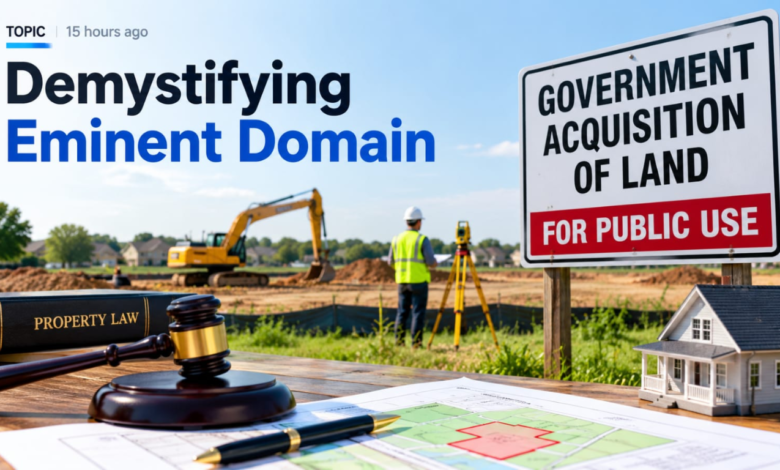
Demystifying Eminent Domain starts with understanding one of the most important principles in American property law: government can acquire private property for a qualifying public purpose, but constitutional protections limit how that power may be used.
The Fifth Amendment states that private property cannot be taken for public use without just compensation. Eminent domain therefore involves a balance between government authority to obtain property for public projects and the property rights of individuals and businesses.
Because eminent-domain procedures vary by jurisdiction, understanding the general principles is useful before examining the specific rules that apply to a particular property.
What Is Eminent Domain?
Eminent domain is the government’s legal power to acquire private property for public use. The resulting acquisition is commonly called a taking, while the legal process used to acquire the property is often called condemnation.
Governments may use eminent domain for projects involving infrastructure and public services. Examples can include roads, public utilities, schools, parks, transit facilities, and other projects serving a recognized public purpose.
The power does not mean that government can acquire property without legal limits. Public-use requirements, compensation rules, procedural requirements, and applicable state laws all matter.
The Fifth Amendment and Property Rights
The constitutional foundation of federal eminent-domain law is the Takings Clause of the Fifth Amendment.
It requires two central elements when private property is taken: the taking must be for public use, and the owner must receive just compensation.
The U.S. Department of Justice explains that the federal government has long used eminent domain to obtain property for public purposes and has a constitutional responsibility to provide just compensation when it acquires property through eminent domain.
This framework is intended to prevent a qualifying government acquisition from leaving the affected property owner without the compensation required by law.
What Does Public Use Mean?
The phrase “public use” has been interpreted broadly under federal constitutional law.
Traditional public uses include infrastructure and facilities that directly serve communities. However, the Supreme Court has also recognized broader public-purpose concepts in certain circumstances.
In Kelo v. City of New London, decided in 2005, the Supreme Court held that an economic-development plan could satisfy the federal Constitution’s public-use requirement. The decision remains an important part of the federal eminent-domain framework, while states may impose additional restrictions through their own laws.
As a result, whether a particular taking qualifies as public use can depend on both federal constitutional principles and the law of the relevant state.
Understanding Just Compensation
Just compensation is the payment required when the government takes private property for public use.
Fair market value is generally the starting point for determining compensation. It typically considers what a willing buyer would pay a willing seller under appropriate market conditions.
Property valuation can become complicated when the property is unusual, has limited comparable sales, includes leases, or has other characteristics that make its market value difficult to determine.
The owner’s personal or sentimental attachment to a property generally does not determine fair market value under the federal approach.
What Is Condemnation?
Condemnation is the legal process through which a government entity exercises eminent-domain authority to acquire private property.
A condemnation action can involve a court proceeding in which issues concerning the government’s authority and the amount of compensation are addressed. Depending on the circumstances, the government may seek property for a road, school, park, hospital, power facility, railroad, or another public project.
State and local governments must also comply with the constitutions and statutes governing their particular jurisdictions.
Can the Government Take Only Part of a Property?
Yes. Eminent-domain acquisitions do not necessarily involve an entire parcel.
A government project may require only a portion of a property or a particular interest, such as an easement. Partial acquisitions can create additional valuation questions because the remaining property may be affected by the project.
For example, acquiring part of a commercial parcel for a transportation project could change the property’s configuration or access. The legal consequences and compensation available for such effects depend on the applicable law and facts.
Physical and Regulatory Takings
Eminent domain is commonly associated with the physical acquisition of land, but takings law can also involve government regulations.
A physical taking occurs when government directly occupies or acquires property. A regulatory taking can arise when government restrictions on property use become sufficiently severe to constitute a taking under constitutional law.
Courts have developed different approaches for analyzing regulatory takings. These can involve questions about economic impact, investment-backed expectations, physical occupation, and the relationship between government requirements and legitimate public interests.
Not every regulation that reduces property value constitutes a taking.
How Property Valuation Can Become Complicated
Determining compensation is often more complicated than simply looking at the property’s purchase price.
Appraisers may consider comparable sales and other evidence relevant to market value. Unique properties may be particularly difficult to value because there may be few comparable transactions.
The legal treatment can also differ when only part of a property is acquired. Questions can arise about the value of the portion taken and the effect of the acquisition on the remaining property.
These issues explain why valuation evidence can play an important role in condemnation proceedings.
Can Property Owners Challenge a Taking?
Property owners can have legal grounds to challenge a condemnation when they believe the government lacks the necessary authority or has failed to comply with applicable requirements.
Cornell’s Legal Information Institute notes that a party whose property is subject to condemnation may challenge the action in court based on issues such as governmental authority or inadequate compensation.
The exact procedure, deadlines, and available remedies depend on the jurisdiction and circumstances.
What Is Inverse Condemnation?
Inverse condemnation is different from a traditional condemnation proceeding.
In a traditional condemnation action, the government initiates proceedings to acquire property. In an inverse-condemnation case, the property owner may bring a claim alleging that government action effectively took or damaged property without first completing an eminent-domain proceeding.
Such cases can involve physical interference or certain regulatory actions, but the legal requirements differ depending on the jurisdiction and facts.
Why State Law Matters
Federal constitutional principles provide an important foundation, but eminent-domain law is not identical throughout the United States.
State constitutions and statutes can establish additional protections, procedures, definitions, and compensation rules. Cornell’s legal materials note that state and local governments are subject to their own state constitutional and statutory restrictions on condemnation.
Therefore, a general explanation of eminent domain should not be treated as a substitute for reviewing the law governing a particular property.
Frequently Asked Questions
What is eminent domain?
Eminent domain is the government’s legal authority to acquire private property for a qualifying public use, subject to constitutional and statutory requirements.
Does the government have to pay for property it takes?
Generally, the Fifth Amendment requires just compensation when private property is taken for public use.
What is just compensation?
Just compensation generally involves fair market value, although the precise calculation depends on the property and applicable law.
What is condemnation?
Condemnation is the legal process through which an authorized government entity acquires private property using eminent-domain powers.
Can the government take only part of a property?
Yes. An eminent-domain acquisition can involve part of a parcel or a particular property interest.
Is eminent domain limited to land?
Takings law can apply to different forms of property and certain government restrictions, although the applicable legal analysis varies.
Can state eminent-domain rules differ?
Yes. State constitutions and statutes can provide rules and protections beyond the federal constitutional framework.
What should someone do after receiving a condemnation notice?
The notice should be reviewed carefully, including any stated deadlines and information about the proposed acquisition. Because eminent-domain procedures are jurisdiction-specific, professional legal advice can help explain the applicable rights and process.
Conclusion
Demystifying Eminent Domain means understanding the relationship between government authority and private property rights. Eminent domain allows qualifying public projects to acquire private property, while the Fifth Amendment requires public use and just compensation at the federal constitutional level.
Compensation generally begins with fair market value, but valuation can become complex, particularly when property is unusual or only part of a parcel is acquired. State laws can also add important requirements and protections.
For anyone dealing with an actual eminent-domain proceeding, the specific facts, jurisdiction, property interest, valuation evidence, and applicable deadlines are essential to understanding the legal situation.




