The Benefits of Early Orthodontic Assessment for Children
Why Early Evaluation Helps Guide Healthy Dental Growth and Smarter Treatment Timing

Introduction
A child’s teeth and jaws change rapidly as baby teeth make way for permanent teeth. During this stage, parents may notice crowding, gaps, unusual bites, or teeth that appear to be erupting in unexpected positions. Some developing orthodontic concerns are difficult to recognize without professional evaluation.
The American Association of Orthodontists (AAO) recommends that children have an orthodontic check-up no later than age seven. This does not mean that every seven-year-old needs braces. Instead, an early assessment allows an orthodontist to examine how the teeth and jaws are developing and determine whether treatment is needed immediately, later, or simply monitored.
What Is an Early Orthodontic Assessment?
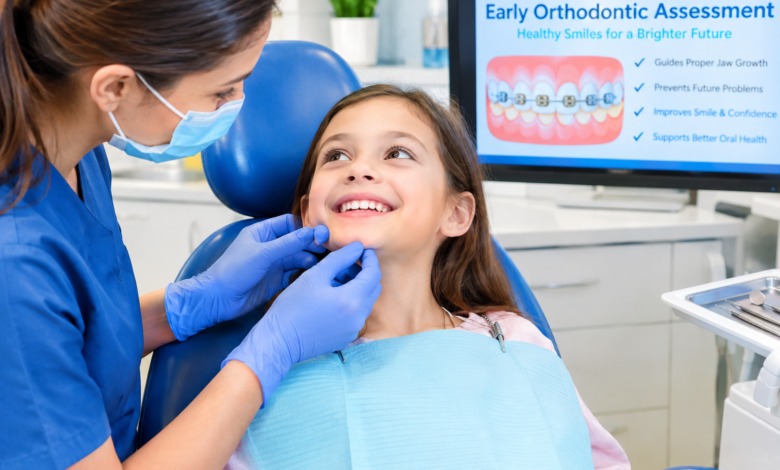
An early orthodontic assessment is an examination of a child’s developing teeth, bite, jaw relationship, and overall oral development. Around age seven, many children have a mixture of primary and permanent teeth, providing useful information about how the adult dentition is developing.
An orthodontist may look for crowding, spacing, crossbites, overbites, underbites, delayed eruption, missing or extra teeth, and other developing concerns. Depending on the child’s situation, additional diagnostic records may be considered appropriate. The American Academy of Pediatric Dentistry emphasizes that evaluating developing dentition can help determine treatment priorities and appropriate timing.
Early Detection of Developing Orthodontic Problems
One of the main benefits of early orthodontic assessment is identifying potential problems before they become more complicated.
A child may have a developing issue even when the teeth appear relatively straight from the outside. An orthodontic examination can assess how permanent teeth are erupting and whether the jaws and dental arches are developing as expected.
Problems that may be identified include:
- Crowded teeth
- Crossbites
- Overbites and underbites
- Teeth erupting in unusual positions
- Delayed eruption of permanent teeth
- Missing or extra teeth
- Insufficient space for incoming teeth
- Certain jaw-growth concerns
The AAPD recommends ongoing evaluation of developing dentition because abnormalities involving tooth eruption, tooth number, arch space, and bite can require different approaches depending on the child’s stage of development.
Understanding the Importance of Age Seven
Age seven is often discussed in connection with a child’s first orthodontic check-up because many children have entered the mixed-dentition stage by this point. This means both primary and permanent teeth are present.
An orthodontist can use this stage to evaluate how permanent teeth are developing and whether there appears to be enough space for them. The AAO explains that an early visit is primarily an assessment rather than an automatic decision to begin braces. In many cases, an orthodontist may recommend monitoring growth and returning for periodic observation.
This distinction is important for parents. An early orthodontic assessment does not automatically mean early orthodontic treatment.
Better Timing for Possible Treatment
Children develop at different rates, so there is no single treatment schedule that applies to everyone. Some orthodontic problems may benefit from intervention while a child is still growing, while other concerns may be better addressed later.
An early assessment gives the orthodontist an opportunity to consider the child’s growth, tooth eruption, and specific orthodontic needs before recommending a treatment schedule.
The AAPD notes that treatment timing can depend on the stage of dental development, the particular abnormality, growth patterns, risks and benefits, and whether treatment should be started or deferred.
Helping Create Space for Permanent Teeth
Crowding can occur when there is not enough room for permanent teeth to erupt normally. An early assessment can help identify whether a child may have a developing space problem.
In selected cases, orthodontic intervention during growth may help manage available space or guide developing teeth. The AAO notes that certain interceptive approaches can be useful in younger patients when clinically appropriate.
However, parents should not assume that every crowded smile requires immediate treatment. An orthodontist must evaluate the individual child before recommending any intervention.
Monitoring Jaw and Bite Development
Orthodontic assessment is not limited to the appearance of teeth. The way the upper and lower teeth meet is also important.
Crossbites, overbites, underbites, and other bite relationships may be identified during an examination. The AAPD includes crossbites and skeletal or dental discrepancies among concerns that may require evaluation during the developing dentition.
Monitoring these relationships while a child grows can help an orthodontist determine whether observation is appropriate or whether treatment should be considered.
Supporting Long-Term Oral Health
Properly aligned teeth can be easier to clean, although good brushing and flossing remain essential regardless of alignment. The AAO notes that well-aligned teeth can reduce areas where plaque becomes trapped and may support everyday functions such as chewing and speaking.
Early orthodontic assessment therefore forms part of a broader approach to oral health. It works alongside regular dental check-ups, professional cleanings, fluoride care when recommended, good nutrition, and daily oral hygiene.
Recognizing Signs Parents Should Watch For
Parents do not need to diagnose orthodontic problems themselves. Still, certain signs can be reasons to discuss an orthodontic evaluation with a dental professional.
These may include:
- Difficulty biting or chewing
- Teeth that appear unusually crowded
- A noticeable crossbite, underbite, or overbite
- Permanent teeth that seem delayed in appearing
- Baby teeth that are lost unusually early or late
- Teeth erupting out of their expected position
- Significant spacing or unusual tooth positioning
- Front teeth that protrude noticeably
- Concerns about jaw development
The AAO also advises parents not to wait for a specific age if they notice something that appears unusual. An orthodontist can determine whether the concern requires treatment, observation, or no orthodontic intervention.
What Happens During an Early Orthodontic Visit?
The first visit is generally designed to understand the child’s current dental development and identify possible concerns.
The orthodontist may examine the teeth, bite, jaws, facial development, and eruption pattern. Additional diagnostic records may be recommended when they are clinically appropriate.
Parents may also receive information about possible treatment options, timing, expected monitoring, and whether treatment is necessary. According to the AAO, one possible outcome is simply periodic observation while the child continues to grow.
Does Every Child Need Early Orthodontic Treatment?
No. This is one of the most important points for parents to understand.
An early orthodontic assessment and early orthodontic treatment are different things. A child can have an early examination and be told that no treatment is currently required.
Some children may benefit from interceptive treatment, while others may be monitored until more permanent teeth erupt. The appropriate approach depends on the child’s individual development and the specific orthodontic issue, if one exists.
The Benefits of Planning Ahead
Early assessment can give families more information about what to expect as a child’s smile develops. If a potential issue is identified, parents have time to understand the condition and discuss possible treatment timing with a qualified professional.
Planning ahead can also reduce uncertainty. Instead of waiting until a problem becomes obvious, families can understand whether the child needs treatment, observation, or routine dental care alone.
The AAO states that early evaluation can sometimes help reduce the complexity of later orthodontic care, although the outcome varies according to the child’s specific condition.
How Parents Can Prepare Their Child
Parents can make an orthodontic visit more comfortable by explaining that the appointment is simply a way to check how the teeth and jaws are growing.
It can help to avoid presenting braces or orthodontic treatment as something frightening. Children can be encouraged to ask questions and tell the orthodontist if they are worried about anything.
Parents should also continue regular dental visits and maintain daily brushing and flossing habits. Orthodontic assessment complements, rather than replaces, routine pediatric dental care.
Frequently Asked Questions
At what age should a child see an orthodontist?
The AAO recommends an initial orthodontic check-up no later than age seven, or earlier if a concern is noticed.
Does an early orthodontic check-up mean my child needs braces?
No. An evaluation may result in monitoring rather than immediate treatment.
Can younger children have orthodontic problems?
Yes. Problems involving tooth eruption, bite, spacing, and jaw development can appear while the dentition is still developing.
What if my child is already older than seven?
It is not too late. The AAO states that children older than seven can still receive an orthodontic evaluation and appropriate treatment when needed.
Can early assessment identify crowded teeth?
Yes. An orthodontist can evaluate available space and the position and eruption of developing permanent teeth.
Are regular dental visits still necessary?
Yes. Orthodontic assessments do not replace regular dental examinations and preventive oral care.
Can every orthodontic problem be treated early?
No. Treatment timing varies according to the child’s dental development, growth, and specific orthodontic condition.
Why is early orthodontic assessment useful?
It can help identify developing concerns, monitor growth, and determine whether treatment is needed and when it may be appropriate.
Conclusion
The benefits of early orthodontic assessment for children go beyond simply creating a straighter smile. An early examination can help identify developing tooth and bite problems, monitor jaw growth, assess space for permanent teeth, and give parents useful information about possible treatment timing.
For many children, an early visit does not lead to immediate treatment. Instead, it provides an opportunity for professional observation and planning. Because every child develops differently, the most appropriate approach should be determined through an individual evaluation by a qualified dental or orthodontic professional.
For parents, arranging an orthodontic assessment around the recommended age—or sooner when a concern is noticed—can provide valuable insight into how a child’s smile is developing and what steps, if any, may be appropriate in the future.




