How Warehouse Management Software Helps Growing Businesses Scale Operations
Smarter Warehouse Management for Efficient, Scalable Business Growth

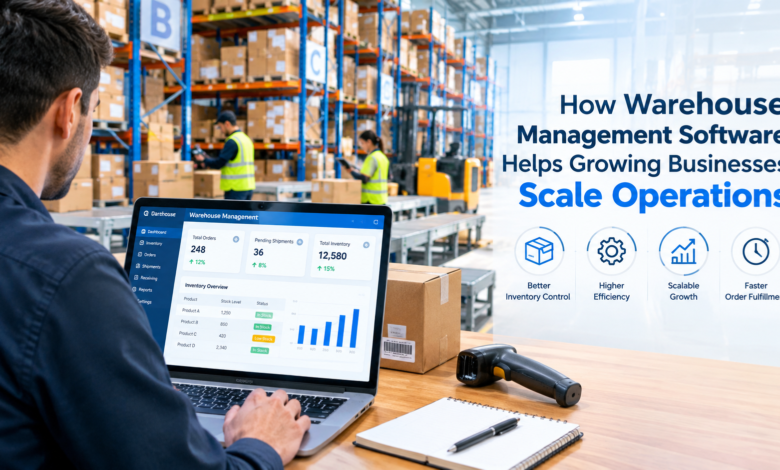
Introduction
Growth brings opportunities, but it also creates new operational challenges. As a business gains customers, expands its product range, and processes more orders, warehouse operations can quickly become difficult to manage with spreadsheets, paper records, and disconnected systems. Inventory becomes harder to track, picking errors can increase, and employees may spend more time searching for products or updating records.
This is where warehouse management software can make a significant difference. A modern warehouse management system (WMS) helps businesses coordinate receiving, storage, inventory tracking, picking, packing, and shipping through a centralized digital system. It can provide better visibility, automate repetitive processes, and give growing companies the operational structure needed to handle higher volumes.
What Is Warehouse Management Software?
Warehouse management software is a digital solution designed to control and optimize warehouse activities. Depending on the platform, it can manage processes from the moment products arrive at a facility through storage, order picking, packing, and dispatch.
Modern WMS platforms can use barcode scanning, RFID, mobile devices, warehouse rules, and real-time data to help employees perform tasks more consistently. They can also connect warehouse information with other business systems, including enterprise resource planning and transportation platforms.
For a growing company, this creates a centralized view of what inventory is available, where it is located, and what needs to happen next.
Better Inventory Visibility
Inventory visibility becomes increasingly important as a business grows. A small operation may be able to keep track of stock manually, but that approach becomes more difficult when there are hundreds or thousands of products, multiple storage areas, or several warehouses.
Warehouse management software can maintain information about inventory quantities, locations, movements, and status. Barcode and RFID technologies can further reduce dependence on manual data entry.
Better visibility helps employees answer important questions quickly:
- How much stock is available?
- Where is a particular product stored?
- Which products are running low?
- Which orders are waiting to be fulfilled?
- What inventory has recently moved?
- Which items require replenishment?
Having reliable information available to warehouse teams can support faster and more informed operational decisions.
Reducing Manual Warehouse Work
Manual processes can consume significant amounts of employee time. Workers may have to write down receiving information, search for products, update spreadsheets, check stock records, and manually confirm shipments.
Warehouse management software can automate or guide many of these activities. For example, a system can support digital receiving, directed put-away, barcode-based inventory movements, picking workflows, and shipping processes.
Automation does not necessarily mean replacing employees. Instead, it can reduce repetitive administrative work and give warehouse workers clearer instructions. This allows teams to spend more time on productive warehouse activities.
Faster and More Consistent Order Fulfillment
As sales increase, fulfillment speed becomes increasingly important. A warehouse that handles a few dozen orders per day may struggle when order volume suddenly reaches hundreds or thousands.
A WMS can organize picking and fulfillment activities according to defined warehouse rules. Some systems can generate optimized picking paths or support different picking strategies based on the operation.
The result can be a more structured workflow:
- An order enters the system.
- Required inventory is identified.
- Picking tasks are assigned or guided.
- Products are scanned and verified.
- Items move to packing.
- Shipping information is prepared.
- Inventory records are updated.
Creating a consistent process makes it easier for a growing warehouse to handle higher order volumes without relying entirely on informal procedures.
Supporting Multiple Warehouses and Locations
Business growth may eventually require additional warehouses, fulfillment centers, stores, or third-party logistics partners. Managing these locations separately can make inventory visibility more complicated.
Warehouse management technology can help organizations coordinate inventory across multiple locations. Microsoft, for example, describes warehouse and inventory capabilities that support tracking inventory across multiple warehouses or locations and integrating warehouse operations with broader business processes.
This can help management understand where inventory is stored and how stock is moving between facilities. It also provides a stronger foundation for businesses that are expanding geographically.
Improving Warehouse Space Utilization
Warehouse space is expensive, and inefficient storage can create unnecessary operational problems. Poorly organized inventory can increase walking and picking time while making it harder to locate products.
Warehouse management systems can support structured location management. Some platforms allow businesses to define warehouses by sites, zones, aisles, racks, shelves, and bins. They can also apply rules based on product characteristics, turnover, or storage requirements.
Better organization can help a growing business make more effective use of its existing warehouse capacity before immediately investing in additional space.
Reducing Picking and Shipping Errors
Incorrect shipments can create extra costs and negatively affect the customer experience. Manual processes can make it easier for employees to select the wrong item, quantity, or location.
Barcode and RFID scanning can help verify products during warehouse activities. A WMS can use these technologies to support receiving, picking, inventory movements, and shipping verification.
By introducing verification steps into the workflow, businesses can create greater consistency as their order volume increases.
Connecting Warehouse Operations With Other Business Systems
A warehouse does not operate independently from the rest of a company. Sales, purchasing, finance, transportation, manufacturing, and customer service all depend on accurate inventory and order information.
Modern WMS platforms can integrate with ERP and transportation systems, creating a more connected flow of information. Microsoft also documents scenarios in which warehouse management can work with an external ERP system, allowing different systems to handle different parts of the overall business process.
For growing businesses, integration can reduce duplicate data entry and help different departments work from more consistent information.
Supporting Data-Driven Decisions
Growth requires more than simply processing additional orders. Business leaders also need to understand what is happening inside the warehouse.
Warehouse management software can provide operational information about inventory, orders, warehouse activity, and product movement. These insights can support decisions involving replenishment, storage, workforce planning, and fulfillment processes.
Instead of relying entirely on assumptions, managers can use operational data to identify bottlenecks and determine where improvements are needed.
Making Growth More Scalable
One of the biggest advantages of warehouse management software is the ability to create repeatable processes. A growing company needs systems that can handle increasing complexity without requiring every task to be redesigned manually.
A scalable WMS can provide a foundation for adding products, users, warehouse locations, workflows, and order volume. The exact capabilities depend on the software selected, so businesses should evaluate whether a system can support their expected growth rather than choosing solely on current requirements.
The goal is not simply to automate today’s warehouse. It is to establish processes that can continue working as the business becomes larger and more complex.
What Growing Businesses Should Look For
Before selecting warehouse management software, companies should consider their current challenges and future requirements. Important areas to evaluate include:
- Real-time inventory visibility
- Barcode and RFID support
- Receiving and put-away management
- Picking and packing workflows
- Shipping and dispatch capabilities
- Multi-location inventory management
- Reporting and analytics
- ERP and other system integrations
- Mobile warehouse functionality
- Scalability and user management
- Security and data controls
Businesses should also consider implementation requirements, employee training, ongoing support, and the ability to adapt the software to their specific warehouse processes.
Conclusion
How Warehouse Management Software Helps Growing Businesses Scale Operations comes down to creating greater visibility, consistency, and control. As order volumes and inventory levels increase, manual warehouse processes can become difficult to maintain. A WMS can organize core activities such as receiving, storage, picking, packing, inventory tracking, and shipping while connecting warehouse information with other business systems.
For growing businesses, the value is not limited to faster warehouse tasks. A well-designed system can provide the operational foundation needed to manage increasing complexity, improve inventory control, support multiple locations, and make decisions using better data. Choosing software that matches both present requirements and future growth can help a warehouse become a stronger part of the overall business operation.