Local Shop vs Online Marketplace: Complete Comparison
Understanding the Key Differences Between Local Retail and Online Shopping

Introduction
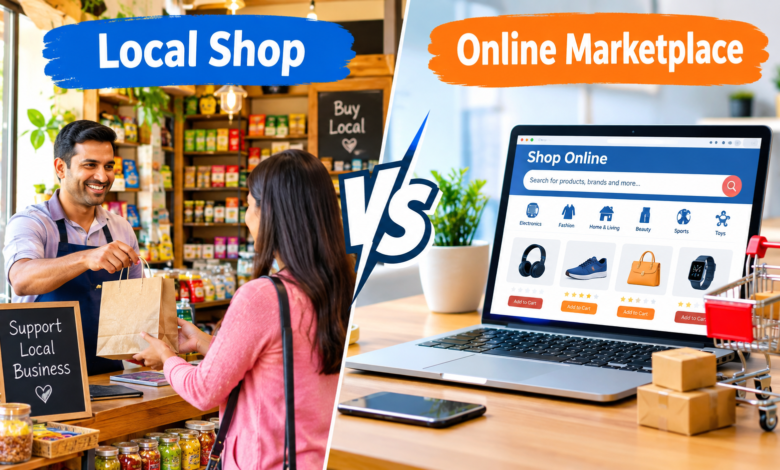
The choice between a local shop and an online marketplace is no longer simply a question of traditional retail versus digital shopping. Both models offer distinct advantages, and the better option depends on what customers value, what businesses sell, and how they want to grow.
A local shop gives customers face-to-face service, immediate product access, physical inspection, and personal relationships. An online marketplace provides convenience, broader product selection, price comparison, and access to customers beyond a particular neighborhood.
In Pakistan, both channels continue to matter. E-commerce is expanding, but physical retail remains deeply embedded in the country’s largely cash-based economy.
A local shop is a physical retail business serving customers within a particular neighborhood, town, or city. Customers can visit the premises, inspect products, ask questions, negotiate in some markets, and purchase items immediately.
Local stores can develop strong relationships with their communities. Research on small shops also identifies their familiarity with local markets and flexibility in quantities as competitive advantages.
What Is an Online Marketplace?
An online marketplace is a digital platform where multiple sellers offer products to customers through websites or mobile applications.
For buyers, marketplaces can provide a much larger selection than an individual shop. For sellers, they can provide access to an established digital audience without requiring the business to build an entire online shopping platform from scratch.
Pakistan’s e-commerce market has expanded considerably, with consumer categories including electronics, fashion, groceries, beauty products, and household goods.
Local Shop vs Online Marketplace
| Factor | Local Shop | Online Marketplace |
|---|---|---|
| Customer reach | Mostly local | Potentially nationwide |
| Shopping hours | Usually fixed | Generally available 24/7 |
| Product inspection | Customers can see products directly | Depends on listing, images and reviews |
| Immediate purchase | Yes | Requires delivery |
| Personal service | Strong | Usually digital |
| Product variety | Limited by physical space | Usually much broader |
| Price comparison | More limited | Very easy |
| Delivery | Usually unnecessary | Important part of the experience |
| Customer trust | Built through personal relationships | Built through reviews, ratings and platform policies |
| Operating costs | Rent, utilities and staff | Platform, technology, marketing and fulfilment costs |
| Geographic growth | More difficult | Easier to reach distant customers |
Advantages of Local Shops
1. Personal Customer Relationships
Local retailers can communicate directly with customers. This personal interaction can encourage loyalty and repeat purchases.
2. Immediate Product Availability
One of the biggest advantages is speed. A customer can select an item, pay and take it home immediately without waiting for delivery.
3. Physical Product Inspection
Customers can touch, examine and sometimes test products before purchasing. This can be especially valuable for clothing, furniture, electronics and other products where physical inspection matters.
4. Local Knowledge
A shopkeeper often understands the preferences and needs of the surrounding community. Small retailers can use this local-market familiarity as a competitive advantage.
5. Flexible Service
Depending on the business and local market, physical retailers may provide personalized recommendations, flexible quantities or negotiated prices.
Disadvantages of Local Shops
Local businesses also face significant challenges.
Higher operating costs: Rent, electricity, employees, maintenance and other expenses can put pressure on margins.
Limited geographical reach: A shop normally depends heavily on customers who can physically reach its location.
Limited opening hours: Customers cannot necessarily purchase products whenever they want.
Limited shelf space: Physical stores cannot display an unlimited number of products.
These limitations can make digital channels attractive for businesses seeking wider markets.
Advantages of Online Marketplaces
1. Wider Customer Reach
An online marketplace can connect a seller with customers outside its immediate neighborhood. This is particularly valuable for specialized products with relatively small local demand.
2. Convenience
Customers can browse products from home using a computer or smartphone. This is one of the fundamental advantages of online commerce.
3. Greater Product Variety
Digital marketplaces can display thousands or even millions of listings without requiring physical shelf space.
4. Easy Price Comparison
Customers can compare prices, specifications, reviews and sellers relatively quickly.
5. Digital Reviews
Ratings and customer reviews can help shoppers make purchasing decisions, although buyers should still evaluate reviews carefully.
6. Business Scalability
Online selling can make it easier for a small business to test products and reach customers in different cities. Recent Pakistan-focused e-commerce analysis also highlights nationwide reach and 24/7 availability as important advantages of online retail.
Disadvantages of Online Marketplaces
Online shopping has its own problems.
Delivery Delays
Customers cannot usually receive products immediately. Delivery time becomes part of the buying experience.
Returns and Refunds
Incorrect products, damaged goods or changes of mind can create additional logistics and customer-service work.
Strong Competition
A seller may appear beside dozens or hundreds of competitors offering similar products.
Trust Concerns
Customers cannot physically inspect products before purchasing. Product descriptions, photographs, reviews and seller reputation therefore become important.
Platform Dependence
Businesses selling through a marketplace must follow that platform’s rules, fees and policies. Marketplace economics can also reduce seller margins.
Which Is Better for Customers?
There is no universal winner.
A local shop may be better when customers want:
- Immediate purchases
- Personal assistance
- Physical inspection
- Local service
- Negotiation
- Products they need urgently
An online marketplace may be better when customers want:
- Convenience
- Wider selection
- Easy price comparison
- Home delivery
- Access to products unavailable locally
- Shopping outside normal store hours
Which Is Better for Businesses?
The answer depends on the business model.
A local shop can be particularly effective when location, personal service and immediate availability are important.
An online marketplace can be attractive for businesses that want to reach customers beyond their local area without opening physical branches.
For many businesses, however, the strongest strategy is not choosing one exclusively.
The Hybrid Retail Strategy
A business can combine a physical shop with digital selling.
For example, a retailer can:
- Operate a local storefront.
- Display selected products online.
- Accept orders through a website or marketplace.
- Offer local pickup.
- Provide delivery to nearby customers.
- Use social media to promote products.
- Encourage existing customers to return through digital channels.
This approach combines the trust and immediacy of physical retail with the reach and convenience of e-commerce.
Pakistan’s developing digital economy makes this hybrid approach increasingly relevant. E-commerce remains relatively small compared with total retail spending, meaning physical and digital commerce still have substantial room to coexist and develop.
Local Shop vs Online Marketplace: The Final Verdict
The debate between local shop vs online marketplace does not have to produce a single winner.
Local shops remain powerful because they offer human interaction, immediate availability and community relationships. Online marketplaces excel at convenience, product variety, digital discovery and geographic reach.
For customers, the best choice depends on the product and shopping situation. For businesses, combining both channels can provide a stronger long-term strategy than relying exclusively on either one.
The future of retail is increasingly about integration rather than replacement: local shops can build digital visibility, while online businesses can create stronger local connections through pickup points, local delivery and personalized service.