Precision Sheet Metal Fabrication: Accuracy That Builds Better Products
How accurate fabrication transforms metal sheets into durable, reliable, and high-quality components.

Introduction
Precision Sheet Metal Fabrication is an important manufacturing process used to create accurate metal components for a wide range of industries. From equipment enclosures and brackets to machine panels, cabinets, structural parts, and custom assemblies, fabricated sheet metal can be shaped into products designed for specific dimensions and performance requirements.
Modern fabrication combines computer-controlled equipment, experienced operators, careful material selection, and detailed quality control. The objective is not simply to cut or bend metal. It is to produce a finished component that matches the required design while maintaining consistency from one part to the next.
As product designs become more sophisticated, manufacturers increasingly need fabrication processes that can handle tight dimensions, repeatable production, clean finishes, and complex geometries. Precision manufacturing helps meet these requirements while supporting efficient production.
What Is Precision Sheet Metal Fabrication?
Precision Sheet Metal Fabrication is the process of transforming flat sheets of metal into finished components through operations such as cutting, bending, forming, punching, joining, and finishing.
The process can involve materials such as stainless steel, aluminum, mild steel, galvanized steel, and other alloys. Each material behaves differently during fabrication, so the selected process must account for thickness, strength, flexibility, surface requirements, and the intended application.
A typical project begins with a digital drawing or engineering specification. The design is then converted into manufacturing instructions for appropriate machinery. After cutting and forming, components may be assembled, inspected, finished, and prepared for delivery.
The combination of accurate design data and controlled manufacturing is what separates precision fabrication from basic metalworking.
Key Processes Used in Sheet Metal Fabrication
Laser Cutting
Laser cutting is commonly used when manufacturers need accurate shapes, openings, slots, and detailed profiles. A focused laser cuts the material according to a programmed design.
One advantage is flexibility. A single machine can produce different shapes without requiring a completely new mechanical setup for every design.
Laser cutting is particularly useful for prototypes, custom components, and production runs where dimensional consistency matters.
CNC Punching
CNC punching uses computer-controlled tooling to create holes, patterns, and other features in sheet metal. It can be effective for repetitive designs and components that require multiple openings.
The accuracy of the finished part depends on factors including machine setup, tooling condition, material characteristics, and the quality of the digital program.
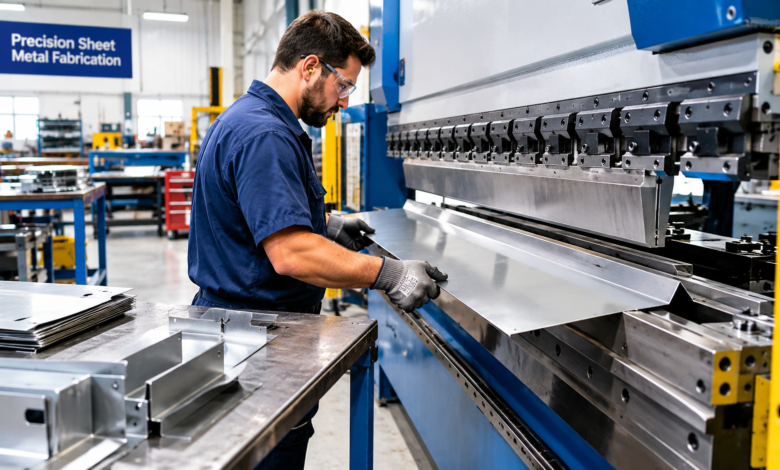
Press Brake Bending
After a sheet is cut, it may need to be bent into a three-dimensional component. Press brakes apply controlled force to create precise angles and forms.
Bending requires careful consideration of material thickness, bend radius, tooling, grain direction, and the required final dimensions.
For complex components, even a small bending variation can affect the way several parts fit together. That makes accurate setup and inspection especially important.
Welding and Assembly
Some fabricated components consist of multiple pieces that must be joined together. Welding can create strong permanent connections between compatible metal parts.
Depending on the design, fabrication companies may also use mechanical fasteners, threaded components, or other joining techniques.
The assembly stage should preserve the dimensional accuracy established during cutting and forming.
Why Accuracy Matters
Accuracy is one of the most important characteristics of professional sheet metal manufacturing.
A component may look correct while still being unsuitable if its holes are slightly misplaced, its bends are inconsistent, or its overall dimensions do not match the engineering specification.
Accurate fabrication can provide several benefits:
- Better component fit
- Consistent production results
- Reduced material waste
- Easier assembly
- Fewer rejected parts
- Improved product reliability
- More predictable manufacturing costs
For projects involving multiple interconnected components, dimensional consistency becomes even more important because small differences can accumulate during assembly.
The Importance of Material Selection
Choosing the correct metal is an essential part of the fabrication process.
Aluminum is lightweight and can be useful where reduced weight and corrosion resistance are important.
Stainless steel is valued for durability and corrosion resistance and is widely used in demanding environments.
Mild steel can offer strength and versatility for many general fabrication applications.
Galvanized steel provides a protective zinc coating and can be suitable for applications where corrosion protection is required.
The correct choice depends on the environment, mechanical requirements, appearance, budget, thickness, and manufacturing method.
Design for Manufacturing
A strong fabrication project starts before the metal reaches the machine. Engineers and designers should consider how a component will actually be manufactured.
Features such as extremely small bends, unnecessary cutouts, difficult-to-access welds, and unsuitable material thicknesses can complicate production.
Designing with fabrication in mind can make the process more efficient. It may also reduce unnecessary operations, improve repeatability, and simplify assembly.
Modern digital manufacturing makes this especially useful because three-dimensional models and detailed drawings can help identify potential production problems before manufacturing begins.
Quality Control in Precision Fabrication
Quality control is not limited to checking the final product. Reliable manufacturers can inspect important stages throughout the production process.
Measurements may include overall dimensions, hole locations, bend angles, material thickness, surface condition, and assembly fit.
Depending on project requirements, manufacturers may use precision measuring tools, gauges, coordinate measurement equipment, or other inspection systems.
Documentation can also be important when parts are produced for regulated or highly demanding industries. A clear inspection process helps manufacturers identify deviations and maintain consistent production standards.
Safety in Sheet Metal Manufacturing
Metal fabrication involves powerful machinery, sharp materials, moving components, and high forces. Safety therefore needs to be treated as an essential part of production rather than an afterthought.
OSHA emphasizes the importance of machine guarding and safe operation around machinery where workers could be exposed to points of operation. Its guidance also highlights the need for regular inspection and maintenance of machinery and safeguarding systems.
Press equipment can involve significant mechanical forces. OSHA’s mechanical power press requirements address areas such as guarding, controls, inspection, maintenance, and safety systems.
A professional fabrication environment should therefore combine trained operators, appropriate protective equipment, machine safeguards, maintenance procedures, and clear operating practices.
Industries That Use Precision Sheet Metal Fabrication
Precision fabrication supports many different sectors.
Industrial Manufacturing
Factories use fabricated panels, brackets, machine components, frames, guards, and equipment housings in production environments.
Electronics
Electronic equipment often requires protective enclosures and precisely positioned openings for controls, connectors, ventilation, and mounting hardware.
Construction
Fabricated metal components can be used in architectural, commercial, and building-related applications where specific dimensions and durable materials are required.
Automotive and Transportation
Vehicles and transportation equipment contain numerous metal components that require accurate cutting, forming, joining, and finishing.
HVAC and Equipment Manufacturing
Metal fabrication is also important for equipment housings, panels, ducts, brackets, and other components used in mechanical systems.
Choosing a Fabrication Partner
When selecting a fabrication company, price should not be the only consideration.
Look for a manufacturer with appropriate equipment, experienced personnel, reliable inspection procedures, and the ability to work with the required material and thickness.
It is also useful to consider production capacity. A company that can successfully produce one prototype may not necessarily have the systems needed for a large repeat order.
Ask about design support, tolerances, finishing options, inspection procedures, lead times, and packaging requirements before production begins.
Clear communication is especially valuable when drawings contain complex dimensions or unusual requirements.
How Technology Is Improving Fabrication
Digital technology continues to change the manufacturing process. Computer-aided design, CNC machinery, automated cutting, digital inspection, and production software can improve consistency and reduce manual errors.
Automation can also make repeat production more predictable. Once a design has been properly programmed and validated, the same manufacturing instructions can be reused for future production runs.
However, technology does not eliminate the importance of skilled workers. Experienced operators still play an important role in material handling, machine setup, inspection, troubleshooting, and quality assurance.
Conclusion
Precision Sheet Metal Fabrication combines engineering, materials knowledge, advanced machinery, skilled workmanship, and quality control to create dependable metal components.
From laser cutting and CNC punching to press brake forming, welding, assembly, and finishing, every stage can influence the final result. Careful design and accurate manufacturing help ensure that components fit properly and perform as intended.
For businesses developing equipment, machinery, enclosures, architectural components, or custom metal products, choosing the right fabrication process can make a significant difference. A capable fabrication partner can help turn a digital design into a consistent, functional, and professionally manufactured product.



