Best Tires for Muddy Terrain: Choose the Right Grip for Every Trail
Choose the right tires for better traction, control, and durability on muddy trails.

Introduction
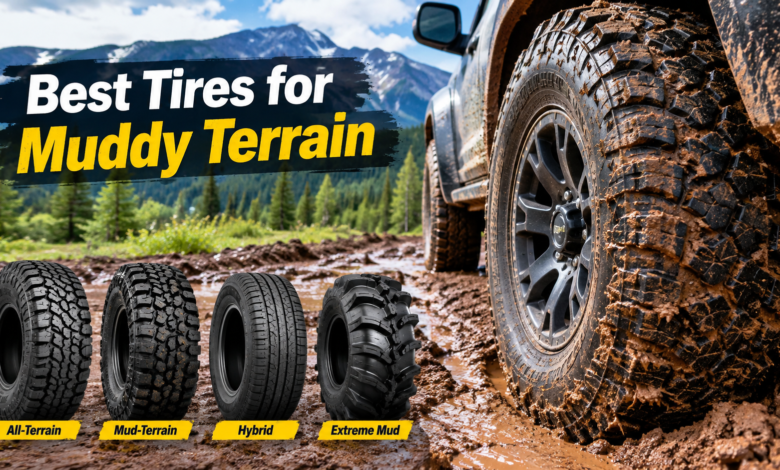
Driving through muddy roads, wet trails, and soft off-road terrain can challenge even a capable four-wheel-drive vehicle. Standard road tires may struggle to maintain traction when mud fills the tread, while aggressive off-road tires are designed to provide better grip and help clear mud as the wheel turns. Choosing the best tires for muddy terrain therefore depends on the type of mud you encounter, how frequently you leave paved roads, and how much highway driving you do.
The right tire can improve traction, stability, and confidence on difficult trails. However, no tire is perfect for every surface. A tire designed primarily for deep mud may be noisier and less comfortable on pavement, while an all-terrain tire may provide a better balance for drivers who regularly switch between roads and trails.
What Makes a Tire Good for Muddy Terrain?
The tread pattern is one of the most important features to examine when choosing tires for mud. Mud-terrain tires generally have large tread blocks separated by wide gaps. These spaces help prevent mud from packing tightly into the tread and allow the tire to continue finding traction.
Deep tread blocks can also provide stronger bite on loose surfaces. Shoulder lugs are another useful feature because they can provide additional traction when the vehicle moves through ruts or soft ground.
Self-cleaning capability is especially important. A tire that becomes packed with mud can lose some of the advantage of its aggressive tread. Tire manufacturers therefore use different tread shapes, grooves, and bars to help release compacted mud during rotation.
Mud-Terrain Tires for Deep and Soft Mud
For drivers who frequently encounter deep mud, loose soil, and challenging trails, mud-terrain tires are designed specifically for this type of environment.
Their aggressive tread patterns typically feature large blocks and substantial voids. This design helps the tire eject mud and maintain contact with the underlying surface.
Mud-terrain tires can also be useful on rocky and uneven trails. Some models incorporate reinforced sidewalls and specialized tread compounds intended to improve durability in demanding off-road conditions.
The trade-off is that aggressive tread can produce more road noise and may offer a less comfortable highway experience than an all-terrain tire. If most of your driving happens on pavement, choosing the most aggressive mud tire available may not be necessary.
All-Terrain Tires for Mixed Driving
Not every driver needs a dedicated mud tire. If your vehicle spends most of its time on highways, city streets, gravel roads, and occasional muddy trails, an all-terrain tire can offer a more balanced solution.
All-terrain tires use tread designs that combine on-road manners with off-road capability. Their patterns are generally less aggressive than mud-terrain tires, which can make them quieter and more comfortable during everyday driving.
They can be particularly practical for pickup trucks and SUVs used for commuting, work, towing, camping, and weekend trail trips.
The important point is to match the tire to your actual driving conditions rather than choosing based only on appearance.
Key Features to Look For
When comparing the best tires for muddy terrain, consider several features instead of focusing on tread depth alone.
Large Tread Blocks
Large tread blocks can provide strong mechanical grip on soft surfaces. They are commonly associated with mud-terrain designs and can help the tire bite into loose terrain.
Wide Tread Voids
Large spaces between tread blocks allow mud and soft soil to escape. This self-cleaning characteristic is particularly valuable when driving through deep or sticky mud.
Strong Sidewalls
Off-road trails can expose tires to rocks, roots, sharp edges, and other obstacles. Reinforced or rugged sidewall construction can provide additional protection against damage.
Durable Rubber Compound
The rubber compound influences traction, durability, and performance across different temperatures and surfaces. Look for a tire designed for the conditions in which you regularly drive.
Appropriate Load Rating
Always make sure the tire’s size and load capability are appropriate for your vehicle. Check the vehicle owner’s manual and the tire information label before purchasing. Tire size should never be selected simply because a larger tire looks more capable.
Tire Size Matters
Choosing the correct tire size is essential for safety and vehicle performance. The vehicle manufacturer’s recommended tire size provides an important starting point.
Changing tire dimensions can affect clearance, steering, gearing, handling, and speedometer readings. Larger tires can also add weight and change how the vehicle behaves.
Before purchasing an off-road tire, verify the correct size, load rating, speed rating, and wheel compatibility. If you are considering a significant size change, professional advice can help ensure the combination is suitable for your vehicle.
Tire Pressure and Muddy Conditions
Tire pressure can have a major effect on off-road traction. Some experienced off-road drivers adjust tire pressure for specific terrain, but pressure changes must be made carefully and according to the tire and vehicle manufacturer’s recommendations.
Driving with incorrect pressure on public roads can affect handling, braking, tire temperature, and wear.
After off-road driving, tires should be returned to the appropriate road pressure before normal highway travel. A portable compressor and reliable pressure gauge can be useful equipment for responsible off-road preparation.
How to Choose Tires for Your Driving Style
Your driving habits should determine your tire category.
If you regularly drive through deep mud and spend substantial time off-road, a dedicated mud-terrain design may make sense.
If you mostly commute on pavement but occasionally visit muddy trails, an all-terrain tire can provide a more practical balance.
If your vehicle is used for towing, work, camping, or long-distance travel, consider durability, load capacity, highway comfort, and tread life alongside off-road traction.
There is no universal tire that is perfect for every driver. The right choice is the one that matches your vehicle and the surfaces you actually encounter.
Maintenance Tips for Mud Tires
Even the best tires for muddy terrain need regular maintenance. Inspect the tread and sidewalls for cuts, cracks, embedded objects, or unusual damage after difficult trips.
Check tire pressure regularly and maintain the pressure recommended for your vehicle and tires. Tire tread should also be monitored because worn tires can lose important traction.
Wheel alignment and balancing are worth checking if the vehicle develops vibration, pulling, or uneven tread wear. Off-road impacts can sometimes affect wheel and suspension components.
After driving through heavy mud, clean the tires and inspect the tread carefully. Removing packed mud and debris makes it easier to identify potential damage.
Final Thoughts
The best tires for muddy terrain are not necessarily the biggest or most aggressive tires available. They should match the depth and type of mud you encounter, your vehicle’s capabilities, and the amount of time you spend on paved roads.
Mud-terrain tires are designed around aggressive traction and mud evacuation, making them suitable for drivers who frequently tackle demanding trails. All-terrain tires provide a more balanced option for people who combine everyday road driving with occasional off-road adventures.
Before buying, consider tread design, sidewall construction, tire size, load rating, pressure requirements, road usage, and maintenance needs. Most importantly, select tires that are correctly sized and rated for your vehicle. With the right combination, your tires can provide dependable traction while helping you explore muddy terrain with greater control and confidence.




