Everything You Need to Know About Forklift Parts: Essential
A practical guide to major forklift components, maintenance, inspections, and safe equipment operation

Introduction
Forklifts are essential machines in warehouses, distribution centers, manufacturing facilities, construction environments, and other material-handling operations. Their ability to lift, transport, and position heavy loads depends on many components working together correctly. Understanding forklift parts can make it easier to recognize equipment problems, plan maintenance, and support safer daily operation.
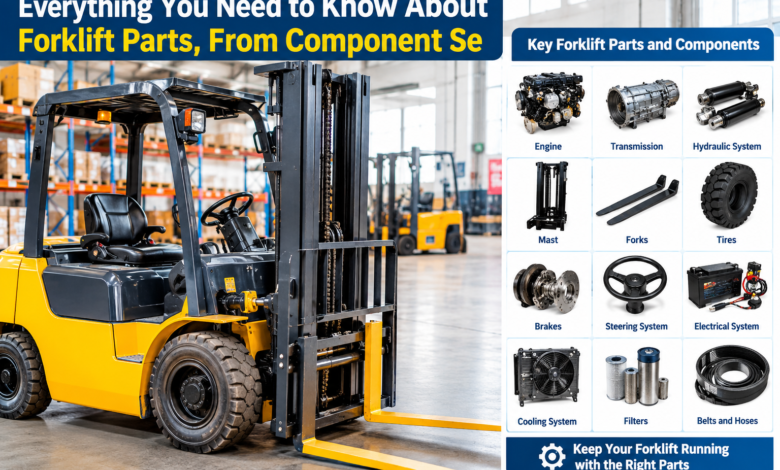
A forklift is more than its visible forks and mast. Major components include the carriage, hydraulic system, power source, tires, counterweight, steering system, braking system, electrical components, and operator controls. Toyota Forklifts identifies the mast, carriage, forks, overhead guard, tires, counterweight, hydraulic cylinders, and power source among the major parts found on forklifts.
What Are Forklift Parts?
Forklift parts are the mechanical, hydraulic, electrical, structural, and operating components that allow a forklift to move, lift, steer, stop, and handle loads.
Different forklift models use different designs and power systems. For example, electric forklifts rely on batteries and electrical systems, while internal-combustion models may use gasoline, diesel, or LPG systems. Because equipment designs vary, the correct replacement part should always be selected according to the forklift model and manufacturer’s specifications.
OSHA recommends consulting the manufacturer’s maintenance instructions and using inspection procedures appropriate to the specific type of powered industrial truck.
Major Forklift Parts and Components
1. Forks
Forks are the components that directly engage pallets and other loads. They are mounted to the carriage and are designed to support the load during lifting and transportation.
Fork condition is particularly important because damaged, bent, worn, or mismatched forks can affect safe load handling. OSHA’s inspection guidance specifically includes checking forks for cracks, bending, excessive wear, mismatching, and other problems.
2. Mast
The mast is the vertical structure responsible for raising, lowering, and tilting the load. It works with the carriage, hydraulic cylinders, chains, and other components to provide vertical movement.
Forklifts can have different mast configurations, including simplex, duplex, triplex, and quad designs. The configuration influences lifting height and free-lift characteristics. OSHA also notes that lifting capacity decreases as a load is raised.
3. Carriage
The carriage connects the forks and attachments to the mast. It travels vertically along the mast and provides the mounting structure for the load-handling equipment.
Depending on the forklift and application, attachments can include devices such as clamps or side shifters. Keeping the carriage and its associated components in good condition is important for reliable load handling.
4. Hydraulic System
The hydraulic system provides the force needed for many lifting and tilting functions. Hydraulic cylinders work with the mast and carriage to move loads.
Hydraulic hoses, cylinders, seals, fluid, and related components should be inspected for leakage or damage. OSHA’s daily inspection guidance includes checking hydraulic cylinders and hydraulic fluid levels.
A hydraulic problem can affect lifting performance and should not simply be ignored. Any significant defect should be assessed by an appropriately qualified person.
5. Lift Chains and Rollers
Lift chains and rollers help transfer movement through the mast assembly. They are important to the raising and lowering mechanism.
During inspections, operators should look for visible wear, damage, kinks, rust, or signs that lubrication may be required. OSHA includes lift chains and rollers in its sample forklift inspection checklist.
6. Power Source
A forklift’s power source depends on its design. Electric models use batteries, while internal-combustion forklifts use an engine and an appropriate fuel system.
Power-related components can include the battery, charging system, engine, cooling system, fuel system, and associated electrical or mechanical parts. Maintenance requirements therefore vary significantly between forklift types.
7. Tires and Wheels
Tires provide contact with the operating surface and influence traction, stability, steering, and ride characteristics.
Forklift tires should be checked regularly for cuts, missing pieces, separation, or other visible damage. OSHA’s sample checklist specifically calls for tire inspections.
The appropriate tire type also depends on the forklift and its operating environment.
8. Braking System
Brakes allow the forklift to slow and stop under operating conditions. A properly functioning braking system is essential to safe equipment operation.
OSHA states that powered industrial trucks must be maintained in safe working order and that braking systems must be operable and in safe condition under applicable requirements.
Brake problems should be treated as safety-related defects rather than ordinary wear that can be ignored.
9. Steering System
The steering system allows the operator to control the forklift’s direction. Steering components can vary depending on forklift design, but the system must provide predictable control.
OSHA includes steering among the standard functions that should be tested during forklift inspections.
10. Electrical System
Electrical components can include the battery, cables, connectors, switches, lights, gauges, warning equipment, and other electrical devices.
On electric forklifts, the battery and related electrical equipment are particularly important. Maintenance and charging procedures should follow the manufacturer’s instructions and applicable workplace requirements.
11. Cooling System
Internal-combustion forklifts use cooling components to help control engine temperature. These may include the radiator, coolant, fan, hoses, and related parts.
OSHA’s sample inspection checklist for propane forklifts includes checking engine coolant levels.
12. Counterweight
The counterweight is positioned toward the rear of many conventional forklifts. It helps balance the machine when it carries a load.
Because stability depends on the relationship between the truck, load, and operating conditions, the counterweight should never be modified casually. OSHA advises against modifications or additions that could affect capacity or safe operation without appropriate manufacturer approval.
Why Forklift Parts Maintenance Matters
Regular maintenance helps identify problems before they become larger equipment or safety issues. A damaged tire, leaking hydraulic cylinder, worn chain, faulty brake, or steering problem can affect how a forklift performs.
OSHA recommends maintaining forklifts according to manufacturers’ recommendations and removing from service any forklift found to be in an unsafe operating condition.
Maintenance is therefore not simply about extending equipment life. It is also part of maintaining safe working conditions.
How to Inspect Forklift Parts
A forklift inspection should follow the procedures appropriate to the particular machine. OSHA’s sample checklists include items such as the overhead guard, hydraulic cylinders, mast assembly, lift chains and rollers, forks, tires, battery, fluid levels, steering, brakes, lights, horn, gauges, and load-handling attachments.
A basic inspection approach can include:
- Examine the forklift before operation.
- Look for visible damage or leaks.
- Inspect forks, mast, carriage, chains, and tires.
- Check appropriate fluid levels.
- Examine the battery or power system.
- Test steering and brakes.
- Check lights, horn, gauges, and safety equipment.
- Report defects according to workplace procedures.
- Do not operate equipment that is unsafe.
The exact checklist should be adapted to the forklift model and manufacturer’s instructions.
Choosing Replacement Forklift Parts
Choosing the correct replacement part requires more than finding a component that looks similar. Part compatibility can depend on the forklift manufacturer, model, serial information, component specifications, and intended application.
Safety-related replacement parts are especially important. OSHA regulations for certain powered industrial trucks require replacement parts affecting operational safety to be equivalent in strength and performance to the original parts they replace.
For this reason, operators and maintenance teams should verify part information before installation and use manufacturer documentation whenever available.
Common Signs That Forklift Parts Need Attention
Some warning signs are easy to notice during normal inspections. These can include:
- Hydraulic fluid leaks
- Unusual noises
- Damaged or worn forks
- Cracked or damaged mast components
- Excessively worn tires
- Steering difficulties
- Weak or inconsistent braking
- Damaged chains or rollers
- Electrical warning indicators
- Unusual engine behavior
- Problems lifting or lowering loads
A warning sign does not automatically identify the exact failed component. Proper diagnosis should be performed by a qualified person.
Forklift Parts and Workplace Safety
Forklift maintenance and operation are closely connected. A well-maintained machine still needs to be operated correctly, while even good operating practices cannot compensate for a serious mechanical defect.
OSHA recommends removing unsafe forklifts from service and maintaining equipment according to manufacturer recommendations.
Operators should also follow workplace procedures for inspections, reporting defects, and taking damaged equipment out of service.
Conclusion
Understanding forklift parts provides a useful foundation for safer and more effective material handling. From forks and masts to hydraulic cylinders, tires, brakes, steering, electrical systems, and power sources, every major component has a specific role.
Regular inspections can help identify visible defects and maintenance concerns before equipment is used. However, inspection procedures and replacement decisions should always take the forklift model, manufacturer instructions, workplace requirements, and applicable safety regulations into account.
For businesses that depend on forklifts every day, knowing the basic components is a practical step toward better maintenance, fewer unexpected problems, and safer equipment operation.