How Stories Help Young Readers Connect With Civic Life
Stories turn everyday reading into empathy, participation, and community awareness.

Introduction
Books can do much more than help children improve vocabulary and reading fluency. A well-written story can introduce young readers to different people, communities, challenges, and ways of thinking. Through characters and their experiences, children can begin to understand how individual choices affect families, schools, neighborhoods, and wider society.
This is one reason stories can become a valuable bridge between literacy and civic learning. Instead of presenting civic life as a collection of complicated rules, stories make ideas such as fairness, responsibility, cooperation, inclusion, leadership, and community participation easier for children to understand.
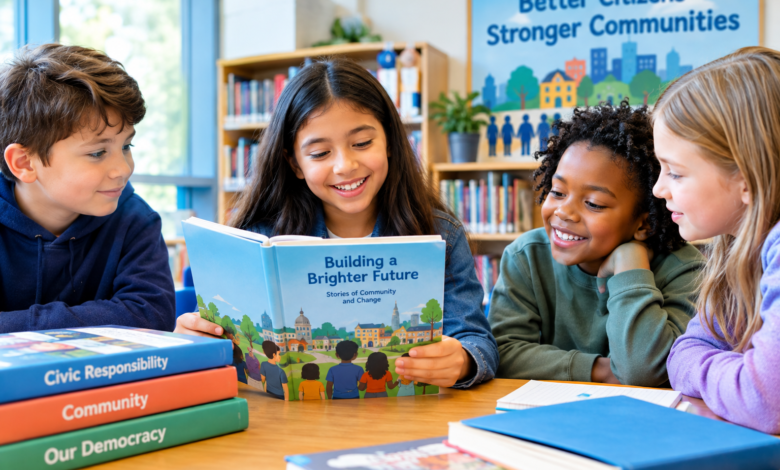
The connection becomes especially meaningful when adults encourage children to discuss what they read. Asking why a character made a decision, how a problem could be solved, or what might happen if everyone worked together can transform reading into an opportunity for thoughtful conversation.
What Does Civic Life Mean for Young Readers?
Civic life is not limited to elections, government buildings, or formal political activities. For children, it can begin with everyday experiences.
Sharing responsibilities in a classroom, listening respectfully to another person’s opinion, helping a neighbor, caring for a public space, solving disagreements, and understanding different perspectives are all connected to living within a community.
Stories provide safe situations in which children can explore these ideas. A character might face an unfair situation, discover a problem in the neighborhood, work with others to solve a challenge, or learn why listening matters.
These situations help young readers recognize that they also have a role in the communities around them.
Stories Make Civic Ideas Easier to Understand
Some civic concepts can feel abstract when they are explained only through definitions. A story gives those concepts a human context.
For example, instead of simply explaining cooperation, a book might show several characters working together to protect a community garden. Instead of defining responsibility, a story might follow a child who realizes that their actions affect classmates and neighbors.
When children see ideas demonstrated through characters, they have something concrete to discuss. They can identify the problem, examine the choices made by the characters, and consider alternative solutions.
This approach can make civic learning more engaging while also strengthening reading comprehension and critical thinking.
How Stories Build Empathy and Perspective
One of the strongest connections between literature and civic life is perspective-taking.
A child may read about a character whose family, culture, neighborhood, abilities, or experiences are different from their own. The story provides an opportunity to consider what life might look like from another person’s point of view.
Questions such as “How do you think this character feels?” or “Why might they see the situation differently?” encourage children to look beyond their immediate experiences.
This matters because communities include people with different backgrounds and opinions. Learning to recognize another person’s perspective can help children become more thoughtful listeners and participants.
Diverse stories can also help children see themselves represented in books while giving them opportunities to learn about people whose experiences differ from their own.
Stories Encourage Children to Ask Questions
Civic learning depends heavily on curiosity.
A strong story can make a child wonder why something happened, whether a decision was fair, or what could have been done differently. Those questions can lead naturally to conversations about community life.
For example, after reading a story about a neighborhood problem, a teacher or parent might ask:
- What was the main problem?
- Who was affected?
- Did everyone have the same opinion?
- How did the characters work together?
- What solution would you suggest?
- Could something similar happen in our community?
There may not be one perfect answer to every question. The important part is learning how to explain an opinion, listen to another viewpoint, and think carefully about possible solutions.
Reading Can Introduce the Idea of Civic Responsibility
Young readers can learn that being part of a community involves responsibilities as well as rights.
Stories can show characters caring for shared spaces, helping others, speaking up when something is unfair, respecting differences, or taking responsibility for mistakes.
These examples help children understand that communities work best when people contribute to the common good.
Civic responsibility does not need to be presented as something enormous. A child picking up litter, welcoming a new classmate, helping organize a school activity, or listening respectfully during a disagreement can be a small but meaningful example of participation.
Stories make these everyday actions visible.
Books Can Help Children Understand Community Problems
Many children’s books explore issues connected to real community life. These may include environmental concerns, accessibility, fairness, friendship, cultural differences, bullying, poverty, discrimination, or protecting local resources.
The purpose is not to overwhelm children with difficult subjects. Instead, age-appropriate stories can provide a manageable starting point.
A fictional character gives children enough distance to think about a difficult issue without immediately feeling that they personally have to solve it.
Once they understand the story, adults can carefully connect its themes to situations children may recognize in their own schools or communities.
Discussion Turns Reading Into Civic Learning
Simply reading a book does not automatically create civic understanding. Conversation plays an important role.
Parents, teachers, librarians, and caregivers can make reading more interactive by asking open-ended questions. Instead of asking only whether children liked a book, they can ask what the characters learned, whether a decision was fair, and how the story connects with real life.
Group discussions are particularly useful because children hear different interpretations of the same story.
A student may believe that a character made the right choice while another student may disagree. With supportive guidance, this becomes an opportunity to practice respectful disagreement.
These conversations can strengthen skills such as listening, explaining ideas, considering evidence, and responding thoughtfully.
Stories Can Inspire Positive Action
The most meaningful civic connection may happen when children move from discussion to action.
A story about environmental responsibility could inspire a classroom recycling project. A book about community kindness could lead students to create welcome messages for new classmates. A story about protecting a local place could encourage children to learn more about their neighborhood.
The action does not have to be large.
The important lesson is that young people can identify problems, imagine solutions, work with others, and contribute in age-appropriate ways.
This helps challenge the idea that civic participation is something reserved for adults.
Choosing Stories That Support Civic Understanding
Adults can look for books with strong, realistic characters and meaningful situations. Stories should offer opportunities for children to think rather than simply telling them what conclusion to reach.
It is also valuable to provide a range of perspectives. Children benefit from seeing different families, cultures, communities, abilities, and experiences represented in age-appropriate literature.
Books should encourage curiosity and discussion rather than relying on stereotypes or one-dimensional characters.
The best choice will depend on the child’s age, reading level, interests, and emotional readiness.
How Parents and Teachers Can Make the Most of Stories
A few simple habits can make civic learning through books more effective.
First, allow children to express their own interpretations. Adults do not always need to provide the “correct” response immediately.
Second, connect stories with everyday experiences. Ask children whether they have seen a similar situation at school, in their neighborhood, or among friends.
Third, encourage respectful disagreement. Children can learn that two people may interpret the same event differently without becoming enemies.
Finally, give children opportunities to act on positive ideas. A classroom discussion becomes more meaningful when students can use what they learned in a small community project or helpful activity.
The Lasting Value of Stories
Stories help young readers connect personal experiences with the wider world. A child begins with a character, a problem, and a sequence of events. From there, they can discover larger ideas about fairness, responsibility, cooperation, identity, community, and participation.
That makes literature a powerful complement to formal civic education.
When children regularly encounter thoughtful stories and have opportunities to discuss them, they can develop more than stronger reading skills. They can also practice empathy, perspective-taking, listening, questioning, and problem-solving.
Conclusion
How Stories Help Young Readers Connect With Civic Life is ultimately about turning reading into a meaningful connection with the world around children.
Stories give young readers opportunities to meet unfamiliar perspectives, explore community problems, understand consequences, and imagine positive solutions. With thoughtful discussion and age-appropriate activities, a simple book can become a starting point for civic learning.
The goal is not to turn every reading session into a lesson about government or politics. It is to help children recognize that they are already members of families, classrooms, schools, and communities.
When young readers understand that their voices, choices, and actions can affect others, reading becomes more than an academic skill. It becomes a pathway toward empathy, responsibility, participation, and a stronger connection with civic life.