How To Build Trustworthy AI Avatar Experiences For Learning, Support, And Public Service
Building Transparent, Accessible, and Human-Centered AI Experiences

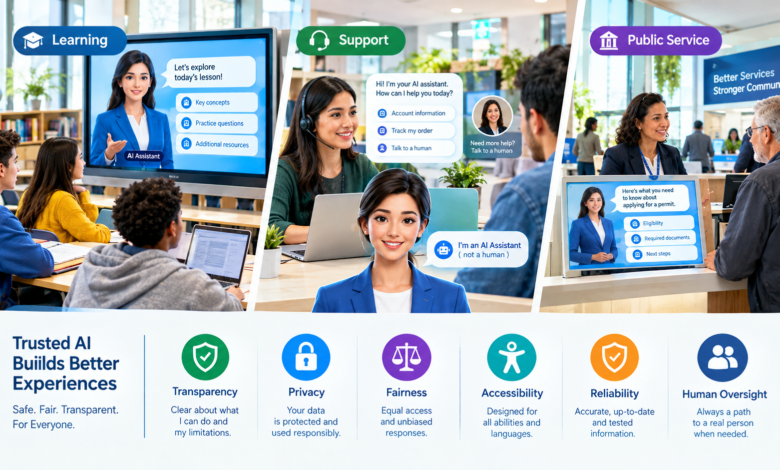
Introduction
AI avatars are becoming a practical way for organizations to communicate information, provide assistance, and create more engaging digital experiences. Instead of interacting only with text or traditional software interfaces, users can communicate with an animated digital character that speaks, listens, explains information, and responds to questions.
This approach can be particularly useful in learning environments, customer and employee support, and public services. However, a convincing avatar is not automatically a trustworthy one. A successful experience must combine useful AI capabilities with transparency, privacy, accessibility, security, and meaningful human oversight.
NIST identifies several characteristics of trustworthy AI, including validity and reliability, safety, security, accountability, transparency, explainability, privacy, and fairness. These principles provide a useful foundation for designing AI avatar experiences that people can understand and use with appropriate confidence.
What Makes an AI Avatar Trustworthy?
A trustworthy AI avatar should clearly communicate what it is, what it can do, and where its limitations are. Users should not be encouraged to believe that the avatar is a human being or that every response is guaranteed to be correct.
Transparency is especially important because an avatar’s realistic appearance and voice can make automated communication feel more personal. Users should be able to recognize when they are interacting with an AI system and understand when information may require verification.
Trust also depends on reliability. An avatar used to explain a lesson, answer support questions, or guide people through a public service should be tested against realistic situations before deployment.
Start With a Clear Purpose
The first step is defining exactly why the avatar exists.
For learning, it might explain difficult concepts, provide practice guidance, or help students navigate educational resources. For support, it might answer common questions and guide users toward relevant information. In public services, it might explain procedures, provide general information, or help people navigate digital services.
A clearly defined purpose reduces unnecessary functionality and makes evaluation easier. UNESCO and its partners emphasize that public digital learning platforms should be guided by educational needs rather than technology for its own sake.
The same principle applies beyond education: build the avatar around a real user need rather than simply adding an animated character to an existing system.
Design for Transparency From the Beginning
Users should know that they are interacting with AI.
A simple disclosure can explain that the avatar is an artificial system and that its responses may occasionally be inaccurate. This is particularly important when the avatar communicates information that could affect important decisions.
Transparency should also cover the purpose of data collection, the type of information being processed, and when a conversation may be transferred to a human representative.
NIST describes transparency as an important part of accountability because people need appropriate information about an AI system and its outputs.
Protect Personal Information
Privacy should be considered before an AI avatar begins collecting user information.
Organizations should determine what data is genuinely necessary and avoid collecting sensitive information simply because the technology makes it possible. Data retention, access controls, security measures, and deletion practices should be clearly defined.
This becomes especially important in education and public services, where interactions may involve information about learners, families, employees, or citizens.
UNESCO’s public digital learning guidance specifically emphasizes responsible stewardship of sensitive learner data and safety when AI technologies are integrated into educational platforms.
Keep Humans in the Loop
AI avatars should support people rather than unnecessarily replace human judgment.
A well-designed system should provide a straightforward path to human assistance when the question is complex, sensitive, disputed, or outside the avatar’s capabilities. Human oversight is particularly important for public services where automated outputs may affect people’s access to information or services.
The OECD notes that AI can improve public-service efficiency, but risks include errors, inadequate transparency, privacy concerns, and overreliance on automated systems.
Human escalation therefore should be treated as part of the experience rather than as a failure of the technology.
Build AI Avatars for Learning
In education, the avatar should enhance learning rather than distract from it.
Useful features can include:
- Explaining concepts in simple language
- Offering additional examples
- Guiding learners through digital resources
- Providing practice feedback
- Supporting different learning formats
- Helping users navigate educational platforms
The content should be aligned with learning objectives and reviewed for accuracy. An attractive avatar cannot compensate for poor educational content.
The 2026 UNESCO-UNICEF-ITU Charter for Public Digital Learning Platforms emphasizes accuracy, reliability, safety, age appropriateness, responsible data practices, and testing when AI is incorporated into learning platforms.
Create Better Support Experiences
AI avatars can also serve as digital support assistants.
For example, an organization could use an avatar to explain frequently asked questions, guide users through account procedures, or help people find the right department.
The key is to give the avatar a controlled knowledge base and clear boundaries. If the system does not know an answer, it should communicate that limitation rather than confidently inventing information.
Support experiences should also provide alternative communication methods. Some users may prefer text, while others may need accessibility features or human assistance.
Make Public-Service Avatars Accessible
Public services have a responsibility to serve diverse populations.
An AI avatar should therefore consider:
- Clear speech and readable text
- Captions and transcripts
- Keyboard and assistive-technology compatibility
- Multiple languages where appropriate
- Simple navigation
- Accessible alternatives to voice interaction
- Support for users with different digital abilities
Accessibility should not be treated as an optional feature added after launch. It should influence the design from the beginning.
UNESCO’s work on human-centered AI in government highlights inclusion, transparency, accountability, and human-rights considerations when AI is used for public administration.
Test the Avatar Before Launch
Testing should cover much more than whether the avatar produces technically correct answers.
Organizations should test:
Accuracy
Does the avatar provide information that is correct and supported by reliable sources?
Safety
Can users accidentally receive harmful or inappropriate responses?
Privacy
Does the system handle personal information appropriately?
Bias and Fairness
Does the avatar perform consistently for people with different languages, backgrounds, abilities, and communication styles?
Usability
Can ordinary users understand what the avatar is saying and what actions they can take?
Failure Handling
Does the system respond appropriately when it does not know something?
NIST’s 2026 ARIA Evaluation Planning Manual describes a holistic evaluation approach involving model testing, red teaming, and user testing. This approach is useful for AI avatar projects because trust depends on both technical performance and real-world interaction.
Avoid Making the Avatar Too Human
Realistic faces and voices can make digital interactions engaging, but excessive realism can also create confusion about the nature of the system.
The goal should be familiarity without deception.
An avatar can have a friendly personality, natural speech, and approachable visual design while still clearly identifying itself as an AI system. Users should not be pressured into treating it as a human authority.
This distinction is particularly important in education and public services, where users may interpret confident communication as evidence of official or expert authority.
Monitor the Experience After Launch
Trustworthy AI is not a one-time development task.
Organizations should monitor accuracy, user feedback, failed conversations, accessibility issues, security incidents, and changes in the underlying information.
Regular reviews can reveal problems that were not visible during initial testing. NIST’s current AI evaluation work emphasizes structured testing and evaluation as part of understanding AI risks and impacts.
Feedback should be used to improve both the AI model and the surrounding user experience.
Build for Trust, Not Just Realism
The strongest AI avatar experiences are not necessarily the most realistic. They are the ones that help users accomplish their goals while maintaining appropriate expectations.
A trustworthy system should be transparent about its identity, careful with personal information, accessible to different users, tested under realistic conditions, and supported by human oversight.
For learning, support, and public services, these principles can make AI avatars more useful without sacrificing accountability. OECD research also highlights the importance of transparency, fairness, privacy, and public confidence when AI is introduced into government services.
Conclusion
Building trustworthy AI avatar experiences requires more than creating a realistic digital person. The technology needs a clear purpose, reliable information, privacy protections, accessible design, transparent communication, human oversight, and continuous evaluation.
Organizations that put these foundations first can create AI avatars that are engaging while remaining responsible. Whether the goal is helping someone understand a lesson, answering a support question, or navigating a public service, trust should be designed into every stage of the experience.




