Why Industrial Embedded Controller PCB Design Needs Scenario Thinking
How Real-World Operating Conditions Are Reshaping Industrial PCB Engineering

Introduction
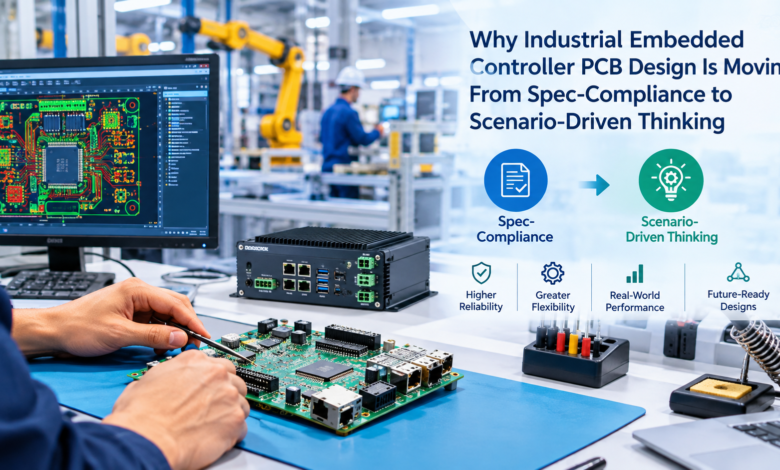
Industrial electronics are expected to do far more than simply meet a list of electrical specifications. Modern embedded controllers must operate reliably around motors, sensors, switching equipment, long cables, temperature changes, electrical noise, vibration, and continuously changing workloads. As a result, Why Industrial Embedded Controller PCB Design Is Moving From Spec-Compliance to Scenario-Driven Thinking has become an important question for engineers developing dependable industrial hardware.
Traditional compliance remains essential. Standards and component specifications establish important safety, EMC, electrical, and reliability requirements. However, a PCB can meet individual specifications and still experience problems when those specifications interact under real operating conditions. Modern design practices therefore increasingly consider how the complete controller behaves during realistic scenarios rather than evaluating isolated requirements.
What Spec-Compliance Means in PCB Design
Spec-compliance traditionally means designing a PCB so that its components and circuits remain within defined electrical and environmental limits.
Engineers may verify parameters such as voltage, current, temperature, timing, insulation, electromagnetic compatibility, and component ratings. They may also conduct formal qualification and compliance testing before a product reaches production.
This approach is valuable because industrial equipment must satisfy applicable requirements. For example, industrial systems can face electrostatic discharge, electrical fast transients, surge events, and electromagnetic interference. Texas Instruments describes industrial reference designs that specifically address these disturbances through protection and EMC design techniques.
The limitation is that individual specification checks do not always represent the complete operating environment.
A controller may work perfectly at room temperature during laboratory testing but behave differently when high processing loads increase board temperature while nearby equipment generates electrical noise.
Why Real-World Scenarios Matter More
Scenario-driven thinking starts with a different question: What will this controller actually experience during its lifetime?
Instead of considering temperature, vibration, electrical noise, power variation, and workload separately, engineers examine how these conditions interact.
Consider an industrial controller installed inside a factory machine. During normal operation, the processor may run at a moderate workload. When several motors start simultaneously, however, the electrical environment can change rapidly. At the same time, the processor may experience higher activity, power consumption can increase, and the enclosure may have limited airflow.
That combination is the real engineering scenario.
Texas Instruments notes that industrial computing platforms can face high ambient temperatures, limited airflow, increased power consumption, thermal stress, and noise susceptibility simultaneously.
Thermal Conditions Become a Design Scenario
Temperature is one of the most important examples of why scenario-based PCB design matters.
A component’s maximum temperature rating does not automatically guarantee reliable system operation. Engineers also need to understand heat generation, airflow, component placement, enclosure conditions, neighboring heat sources, and operating load.
Higher component temperatures can increase reliability concerns, particularly when several heat-producing components are concentrated in a small PCB area. TI’s reliability guidance emphasizes evaluating temperature, application use cases, lifetime targets, and operating extremes as part of reliability-aware development.
Scenario-driven design therefore asks questions such as:
- What happens during maximum processor utilization?
- What happens when ventilation is restricted?
- Which components become thermal hotspots?
- Does performance remain stable at maximum ambient temperature?
- Can the PCB maintain sufficient margin throughout its expected lifetime?
These questions produce a more realistic design target than simply checking a component’s stated temperature range.
EMC Must Be Considered During Actual Operation
Electromagnetic compatibility is another area where scenario-driven thinking becomes especially important.
Industrial controllers frequently connect to sensors, motors, drives, communication networks, and long external cables. These connections can provide paths for unwanted electrical disturbances.
PCB layout has a major influence on EMC behavior. Analog Devices and Texas Instruments both emphasize practical layout considerations such as grounding, return paths, component placement, loop areas, filtering, and signal routing when developing EMC-robust boards.
Instead of asking only whether a board passes an EMC test, engineers can examine realistic events:
What happens when a motor starts?
What happens when a relay switches?
What happens when an external cable receives a transient?
What happens when a sensitive analog measurement occurs during electrical interference?
These scenarios help engineers identify weaknesses before they become expensive field failures.
Reliability Is More Than Passing a Qualification Test
Reliability testing remains necessary, but modern PCB development increasingly considers the mechanisms that could cause failure during actual service.
Board-level reliability can depend on PCB construction, component package characteristics, solder materials, thermal cycling, mechanical stress, vibration, and other factors. TI’s board-level reliability documentation describes temperature-cycle testing and explains how application conditions influence material and package choices.
For industrial embedded controllers, engineers may therefore consider a combination of scenarios:
Repeated Temperature Cycling
A controller may repeatedly move between cold startup conditions and elevated operating temperatures. Repeated expansion and contraction can create mechanical stress within PCB assemblies.
Vibration and Mechanical Stress
Controllers mounted inside machinery can experience continuous vibration. Component selection and board construction need to account for the mechanical environment rather than assuming stationary laboratory conditions.
Power Cycling
Industrial equipment may be switched on and off frequently. Startup conditions can differ significantly from steady-state operation, making power sequencing and transient behavior important design considerations.
Software and Hardware Can No Longer Be Treated Separately
Embedded controller PCB design is also becoming more closely connected to software behavior.
A processor may consume different amounts of power depending on workload. Communication activity can change processor utilization. Sensor-processing algorithms can create temporary computational peaks.
This means the hardware should be evaluated under realistic software workloads.
A board that performs well when running a simple diagnostic program may behave differently when executing its full application continuously. Scenario-driven validation therefore combines hardware conditions with representative software activity.
Designing for Faults Instead of Only Normal Operation
Another major advantage of scenario-driven thinking is that it encourages engineers to examine abnormal but realistic events.
Industrial controllers may encounter:
- Temporary voltage disturbances
- Sensor disconnection
- Communication interruptions
- Unexpected thermal increases
- Electrical transients
- Startup and shutdown events
- Overloaded processing conditions
- External interference
The objective is not necessarily to prevent every abnormal event. Instead, the system should respond predictably and safely when such events occur.
This can involve protection circuits, monitoring, isolation, thermal management, appropriate component derating, filtering, watchdog mechanisms, and carefully designed recovery behavior.
Scenario-Driven Thinking Improves PCB Architecture
When engineers understand actual operating scenarios, PCB architecture can change accordingly.
For example, sensitive analog circuits may need stronger separation from noisy switching sections. High-current paths may require different routing strategies. Power conversion sections may need improved thermal paths. Communication interfaces connected to external wiring may require appropriate protection.
TI documentation on industrial digital inputs illustrates this challenge: field-connected interfaces can be exposed to surge, ESD, and fast electrical transients, making protection and circuit architecture important parts of the design.
The PCB is therefore treated as part of a complete industrial system rather than an isolated collection of components.
From Compliance Checklist to Engineering Model
The shift does not mean that compliance is becoming less important.
Instead, compliance becomes one part of a larger engineering model.
A practical development process can begin with the required standards and component specifications, then add realistic operating scenarios. Engineers can identify the stresses associated with each scenario, predict possible failure mechanisms, simulate important conditions, and validate the completed system.
This approach creates a connection between requirements and actual use.
The result is a PCB that is designed not only to pass a test but also to behave consistently in the environment where it will ultimately operate.
Why This Shift Matters for Future Industrial Controllers
Industrial systems are becoming more connected, compact, intelligent, and computationally demanding. More functionality is being placed into smaller spaces, increasing the importance of thermal management, power integrity, EMC, signal integrity, and reliability.
At the same time, industrial equipment is expected to operate for long periods with minimal interruption.
That combination makes scenario-driven PCB engineering increasingly useful. Instead of asking only whether a circuit meets its individual specifications, engineers can ask whether the complete controller maintains its intended behavior across realistic combinations of temperature, workload, electrical disturbance, mechanical stress, and environmental conditions.
Conclusion
The movement toward scenario-driven thinking does not replace specification compliance. It expands it.
Why Industrial Embedded Controller PCB Design Is Moving From Spec-Compliance to Scenario-Driven Thinking can ultimately be understood as a response to the complexity of modern industrial environments. Compliance establishes essential requirements, while scenario-based engineering examines how a complete embedded controller behaves when those requirements interact in real life.
For industrial PCB designers, the goal is increasingly clear: design around the conditions the product will actually experience, validate realistic operating scenarios, understand failure mechanisms, and build sufficient performance margin into the system.
That approach can turn PCB development from a simple exercise in meeting specifications into a broader process focused on dependable real-world performance.