Bridging the Automation Gap Through Smarter People and Technology
Connecting People, Processes, and Technology for Smarter Growth

Introduction
Automation is changing how businesses operate, communicate, manufacture products, manage information, and serve customers. From robotic systems and workflow software to artificial intelligence and data-driven tools, organizations have more opportunities than ever to automate repetitive work. Yet having access to automation technology does not automatically mean an organization can use it successfully.
This difference is often described as the automation gap. It exists between what modern technology can potentially accomplish and what businesses, employees, and systems are actually prepared to implement. Bridging the Automation Gap therefore requires more than buying new software or installing advanced machines. It involves improving skills, updating processes, connecting systems, and helping people work effectively alongside technology.
Recent OECD research identifies skills shortages as a major barrier to AI adoption, particularly among smaller businesses. The World Economic Forum has likewise identified skills gaps as a significant obstacle to business transformation.
What Is the Automation Gap?
The automation gap is the difference between an organization’s available automation potential and its current ability to capture that potential.
A company may have modern software, cloud services, artificial intelligence tools, robotics, or automated workflows, but still depend heavily on manual processes. This can happen when employees lack training, legacy systems cannot communicate with newer platforms, data is poorly organized, or leadership has not clearly identified which processes should be automated.
The gap can appear in almost any industry. Manufacturing companies may struggle to connect machines and production data. Offices may continue handling repetitive administrative tasks manually. Retail businesses may have customer data but lack integrated systems for using it effectively.
The issue is therefore not simply technological. It is also about people, processes, infrastructure, and strategy.
Why Bridging the Automation Gap Matters
Improving Productivity
One of the main reasons businesses invest in automation is productivity. Automated systems can handle repetitive activities consistently and quickly, allowing employees to spend more time on work requiring judgment, communication, creativity, and problem-solving.
OECD research on workplace AI has found that many surveyed workers reported improved performance after using AI, although successful adoption also requires organizations to address associated risks and workplace changes.
Reducing Repetitive Work
Automation can reduce the amount of time employees spend entering information, checking routine records, processing standard requests, or completing repetitive operational tasks.
This does not necessarily mean eliminating jobs. Research from the OECD has found that workplace AI implementation has often resulted in job reorganization, with workers moving toward tasks where human capabilities remain important.
Supporting Better Business Decisions
Automation can also improve the flow of information. When data is collected and processed consistently, managers can receive useful information more quickly.
Better access to reliable data can support planning, inventory management, customer service, quality control, and operational decision-making.
The Main Causes of the Automation Gap
Skills Shortages
Technology is only useful when people know how to use it. Employees do not necessarily need advanced programming skills to benefit from automation, but they increasingly need digital literacy, data skills, analytical thinking, and the ability to work with new tools.
The OECD’s 2026 research reports that lack of skills is a major barrier to AI adoption. It also emphasizes that most workers do not need advanced AI expertise; broader digital, data, managerial, problem-solving, creativity, and innovation skills remain important.
Legacy Technology
Older systems can create another major obstacle. A business may introduce a modern automation platform while continuing to operate important processes through disconnected legacy software.
When systems cannot exchange information easily, automation becomes fragmented. Employees may then have to move information manually between platforms, reducing many of the expected benefits.
Poor Process Design
Automating a poorly designed process can simply make a bad process happen faster.
Before implementing automation, businesses should understand how work currently moves from one stage to another. Unnecessary approvals, duplicated data entry, unclear responsibilities, and outdated procedures should be addressed before automation is introduced.
Limited Training
Training is another important part of closing the gap. Employees may resist or avoid new systems when they do not understand how those systems affect their work.
The OECD reports that training is a dominant employer response to changing AI-related skill requirements, and workers who receive training are more likely to report positive outcomes from AI use.
How Businesses Can Bridge the Automation Gap
Start With Specific Problems
Organizations do not need to automate everything at once. A practical approach is to identify repetitive, time-consuming, or error-prone activities and determine whether automation can improve them.
Examples may include appointment scheduling, document processing, inventory updates, customer inquiries, reporting, or routine data transfers.
Starting with a clearly defined problem makes it easier to measure whether automation is delivering useful results.
Invest in Employee Skills
Technology investment should be accompanied by workforce development.
Employees can benefit from training in digital tools, data interpretation, automation workflows, cybersecurity awareness, and responsible AI use. Training should be connected to real workplace tasks rather than treated as a separate activity.
The goal is to create employees who can understand technology and apply it appropriately within their roles.
Connect Data and Systems
Automation works best when important systems can communicate with each other. Businesses should examine where information is stored, how it moves, and where manual intervention is still required.
Better integration can reduce duplicated work and create more consistent information across departments.
Measure Results
Automation projects should have measurable objectives. Depending on the process, businesses might track processing time, error rates, customer response time, operating costs, productivity, or employee workload.
Measurement helps organizations identify which automation initiatives are producing meaningful results and which require adjustment.
The Human Side of Automation
Bridging the Automation Gap is not simply a technology project. People remain central to successful transformation.
Automation can perform repetitive tasks, process large quantities of information, and support routine decisions. Human workers continue to contribute judgment, creativity, communication, leadership, collaboration, and contextual understanding.
The World Economic Forum’s Future of Jobs research also highlights the continuing importance of human skills alongside rapidly growing technology skills.
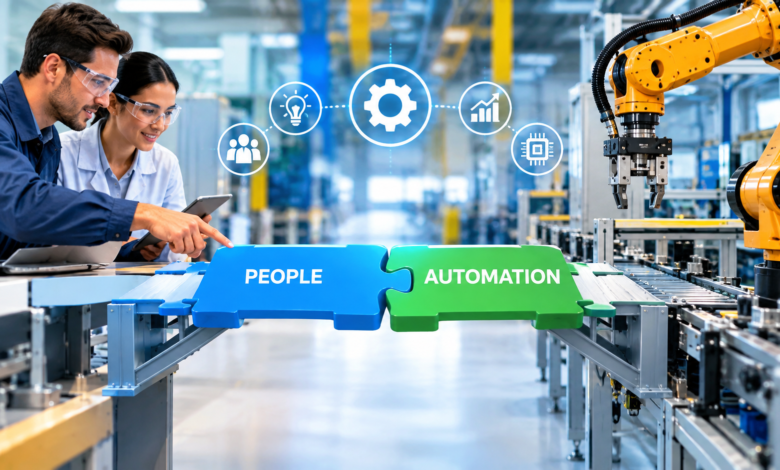
A successful automation strategy therefore combines technological capability with human expertise rather than treating them as competing forces.
Automation and Small Businesses
Small and medium-sized businesses can face particular challenges when adopting automation. They may have limited budgets, fewer technical specialists, older infrastructure, or less time available for experimentation.
The OECD’s 2026 survey of SMEs found that adoption of off-the-shelf AI tools is increasing, while strategic and secure integration remains uneven. Time constraints, maintenance costs, and skills gaps continue to create difficulties for implementation.
For smaller organizations, simple automation projects can provide a practical starting point. Cloud-based tools, automated communications, digital forms, scheduling systems, and basic data workflows can address specific problems without requiring a complete technological transformation.
Building a Sustainable Automation Strategy
A sustainable strategy should combine technology, people, and processes.
Businesses can begin by assessing current workflows, identifying repetitive tasks, checking data quality, reviewing technology compatibility, and determining which employees need additional training. After implementation, organizations should monitor performance and make improvements based on real results.
Automation should also include appropriate attention to cybersecurity, privacy, governance, and human oversight. These considerations become increasingly important as automated systems gain access to business information and influence operational decisions.
Conclusion
Bridging the Automation Gap requires a balanced approach. Technology can create powerful opportunities, but organizations need the right skills, processes, infrastructure, and leadership to turn those opportunities into practical results.
The strongest approach is not necessarily to automate the largest possible number of tasks. Instead, businesses can focus on meaningful problems, prepare employees, connect systems, improve processes, and measure outcomes.
As automation and AI continue developing, the organizations that adapt successfully will be those that understand technology as part of a broader transformation. By combining human capabilities with intelligent automation, businesses can create more efficient, flexible, and resilient operations while preparing their workforce for the changing demands of the digital economy.




