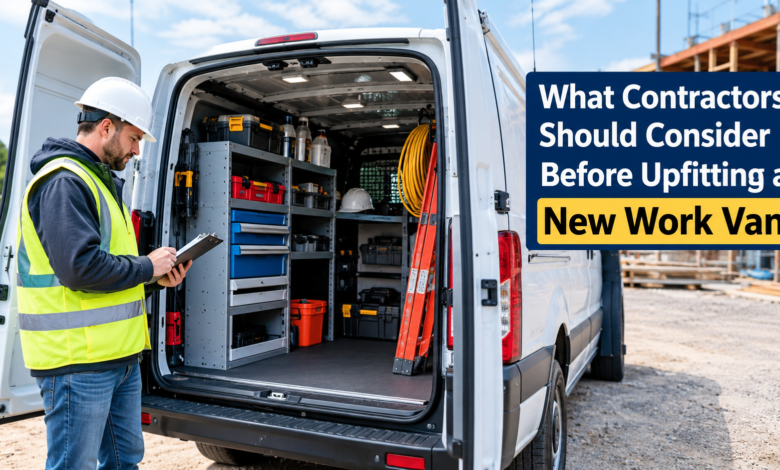
What Contractors Should Consider Before Upfitting a New Work Van
Plan Payload, Storage, Safety, and Productivity Before Your Next Van Upfit

Introduction
For contractors, a new work van is more than a way to travel between job sites. It can become a mobile workshop, equipment carrier, storage system, and daily productivity tool. That is why choosing the right upfit requires more planning than simply adding shelves and cabinets.
The best approach starts with the contractor’s actual workflow. Tools, materials, ladders, electrical equipment, parts, safety gear, and other supplies all compete for limited space and payload capacity. A well-planned upfit should organize those items without creating unnecessary weight or interfering with the vehicle’s original safety systems.
Manufacturers provide specific information about dimensions, payload, weight ratings, electrical systems, and modification requirements. GM, for example, publishes Body Builder Manuals and Upfitter Best Practice Manuals covering areas such as chassis, electrical systems, body modifications, and vehicle integrity.
Why Work Van Upfitting Requires Careful Planning
A commercial van may look spacious before equipment is installed, but every addition affects the finished vehicle. Shelving, flooring, partitions, drawers, racks, toolboxes, power systems, and exterior equipment all add weight.
Ford’s current commercial-vehicle information illustrates how configuration affects carrying capacity. Its 2026 Transit information lists maximum payload figures that vary by configuration, while Ford also notes that actual capacity depends on vehicle configuration and equipment.
This means contractors should think about the complete finished van rather than the empty vehicle shown at the dealership.
1. Start With the Contractor’s Daily Workflow
Before ordering an upfit, make a list of everything that normally travels to a job site.
Consider:
- Hand tools
- Power tools
- Ladders
- Extension cords
- Fasteners and hardware
- Replacement parts
- Safety equipment
- Consumable materials
- Diagnostic equipment
- Cleaning supplies
- Generators or power equipment
- Specialty equipment for particular trades
Then consider how frequently each item is used.
Frequently used tools should be positioned where they can be reached quickly. Less frequently used equipment can be placed in deeper storage areas.
This approach can prevent a common problem: designing a van around available accessories instead of designing it around the contractor’s actual work.
2. Calculate Payload Before Adding Equipment
Payload should be one of the first considerations in any work-van upfit.
The finished payload calculation should account for the vehicle’s occupants, shelving, flooring, partitions, tools, materials, accessories, and other equipment. Ford’s commercial-vehicle guidance states that maximum payload varies with configuration and accessories and directs users to the vehicle’s specific certification information for carrying capacity.
Contractors should therefore avoid assuming that the advertised maximum payload is the amount of equipment they can automatically add.
Think About the Fully Loaded Van
A useful planning exercise is to estimate the van’s normal working weight rather than its empty weight.
For example, consider:
- Upfit components
- Driver and passengers
- Daily tools
- Heavy equipment
- Materials
- Spare parts
- Fuel or charging-related equipment
- Exterior racks
- Seasonal equipment
The goal is to understand the vehicle’s real operating condition before installation begins.
3. Pay Attention to Axle Weight and Load Distribution
Total vehicle weight is not the only concern. Where the equipment is positioned matters as well.
GM’s Body Builder guidance states that body structures, interior arrangements, and accessories should be designed to provide proper load distribution across the axles and remain within the applicable gross axle weight ratings.
That makes equipment placement an important part of the design.
Heavy items should not simply be concentrated in one small area because the space happens to be available. The upfitter should consider the vehicle’s weight distribution and manufacturer specifications when deciding where major equipment belongs.
4. Choose Storage Around the Trade
Different contractors need different layouts.
A general contractor may need a combination of drawers, shelves, bins, hooks, and open floor space. An electrician may need organized drawers, wire-storage solutions, and dedicated areas for electrical tools. An HVAC technician may need larger shelves, specialized racks, and restraints for equipment.
Current Ford Pro trade packages demonstrate this trade-specific approach, offering configurations for general contractors, electricians, HVAC professionals, and delivery operations.
The important lesson is not that one factory package fits everyone. Instead, contractors should identify their trade’s storage requirements before selecting an upfit system.
5. Make Accessibility Part of the Design
A storage system can hold a large amount of equipment and still be inefficient if workers cannot reach what they need.
Think about:
- Which tools are used every day?
- Which items need two-handed access?
- Which equipment is heavy?
- Which tools should be stored at waist height?
- Which materials can remain in deeper storage?
- Can drawers and doors open without obstruction?
- Can equipment be removed without unloading other items?
A good layout reduces unnecessary movement around the job site.
Accessibility is especially important when the van is used throughout the day. Small improvements in organization can make loading, unloading, and tool retrieval more predictable.
6. Consider Flooring, Walls, and Interior Protection
Work vans experience substantially different use from passenger vehicles. Heavy tools, materials, equipment, and repeated loading can place significant demands on the cargo area.
Ford’s current Transit trade-package information includes heavy-duty flooring and wall-liner options designed for commercial applications, along with shelving and trade-specific storage solutions.
Contractors should consider how much abuse the cargo area will receive and choose materials accordingly.
Protection can also help preserve the van’s interior during years of daily use.
7. Protect Original Vehicle Safety Systems
Upfitting should never be treated as an isolated installation project. Modern commercial vans contain airbags, sensors, wiring, electronic controls, cameras, driver-assistance technology, and other safety-related systems.
NHTSA explains that businesses modifying vehicles must take care not to render safety equipment inoperative where federal safety requirements apply.
GM also publishes model-specific information for areas affected by upfitting, including airbag deployment zones and electrical systems. Its current 2026 upfitter resources include dedicated information for full-size vans.
For that reason, contractors should work with an experienced upfitter and follow the applicable manufacturer’s body-builder or modifier documentation.
8. Review Electrical Requirements Before Installation
Many modern work vans require more electrical equipment than older commercial vehicles.
Possible additions include:
- Interior LED lighting
- Auxiliary power outlets
- Inverters
- Battery-management equipment
- Tool chargers
- Refrigeration equipment
- Diagnostic devices
- Telematics
- Warning or work lighting
Electrical modifications should be planned around the vehicle’s existing electrical architecture rather than added as an afterthought.
GM maintains model-year-specific electrical information and technical bulletins because vehicle systems can change between model years.
That makes checking the documentation for the exact vehicle important before electrical work begins.
9. Think About Exterior Equipment
Some contractors need equipment outside the main cargo area.
Depending on the trade, that could include:
- Ladder racks
- Pipe carriers
- Roof-mounted storage
- Exterior work lights
- Conduit storage
- Specialty racks
Exterior equipment can affect overall vehicle dimensions, weight, accessibility, and operating characteristics. It should therefore be included in the initial design instead of being added after the interior is complete.
10. Consider How the Van Will Be Used on Different Job Sites
A contractor who primarily works in urban areas may have different requirements from one who regularly visits construction sites, rural properties, or unfinished developments.
Consider the typical environment:
- Narrow streets
- Parking garages
- Uneven construction sites
- Muddy areas
- Gravel surfaces
- Tight loading zones
- Long-distance highway travel
These conditions can influence choices such as vehicle length, roof height, storage placement, access points, and exterior equipment.
The most practical upfit is the one that matches the environments where the van actually operates.
11. Review Warranty and Manufacturer Requirements
Contractors should ask how modifications could affect vehicle systems, warranty coverage, and future service.
GM states that its Body Builder Manuals provide technical information for vehicle alterations and notes that warranty coverage does not cover certain damage or failures resulting from modifications or alterations to original equipment.
This makes documentation important.
Keep records of:
- Upfit specifications
- Equipment installed
- Electrical modifications
- Weight calculations
- Installer information
- Manufacturer documentation
- Service information
Good records can make future maintenance and troubleshooting easier.
12. Choose an Experienced Upfitter
The installer is just as important as the equipment.
A qualified upfitter should understand commercial vehicle construction, manufacturer requirements, electrical systems, weight distribution, and the practical needs of contractors.
GM describes its Upfitter Integration resources as technical assistance for companies that modify commercial vehicles and provides model-specific Body Builder Manuals, technical bulletins, and best-practice information.
Contractors should ask potential installers about their experience with the specific van model and the type of trade equipment being installed.
13. Don’t Forget Cargo Security
Tools and equipment represent a major investment for many contractors. Storage should therefore be designed not only for organization but also for secure transportation.
Drawers, bins, cabinets, racks, and restraints can help keep equipment in designated locations while the vehicle is moving.
The exact solution depends on the equipment and vehicle, but the principle is straightforward: equipment should have an intentional storage location rather than simply being placed loose inside the cargo area.
14. Plan for Future Changes
A contractor’s business can change.
The van may eventually need:
- Additional shelving
- Different equipment
- More electrical capacity
- New storage containers
- Additional racks
- Telematics
- Specialized equipment
A modular storage system can make future changes easier.
Planning for expansion can also prevent contractors from having to replace an otherwise useful upfit when their workload changes.
15. Compare the Total Cost, Not Just the Initial Price
The cheapest upfit is not necessarily the least expensive option over the vehicle’s working life.
Contractors should consider:
- Initial installation cost
- Equipment durability
- Added vehicle weight
- Maintenance
- Replacement parts
- Installation quality
- Future modifications
- Lost productivity caused by poor organization
A well-designed system can potentially improve daily workflow by making tools easier to locate and equipment easier to load.
A Practical Work Van Upfitting Checklist
Before approving an upfit, contractors can review the following checklist:
- Identify the tools and equipment carried every day.
- Estimate the fully loaded vehicle weight.
- Check the vehicle’s GVWR and axle ratings.
- Account for passengers and future equipment.
- Plan storage around the trade.
- Place frequently used equipment within easy reach.
- Protect the cargo floor and interior surfaces.
- Review electrical requirements.
- Check airbag, sensor, wiring, and safety-system restrictions.
- Consider exterior racks and their effect on the vehicle.
- Review manufacturer upfitter documentation.
- Choose an experienced installer.
- Keep records of the completed modification.
- Design the system so future changes are possible.
Final Thoughts
What contractors should consider before upfitting a new work van goes far beyond choosing shelves and toolboxes. Payload, axle loading, storage access, electrical requirements, safety systems, vehicle dimensions, durability, and future business needs all deserve attention.
The strongest starting point is the contractor’s actual workflow. Once the equipment and daily requirements are understood, the vehicle can be configured around those needs rather than forcing the work into a generic layout.
Manufacturer documentation should remain the reference point for technical modifications. Current resources from manufacturers such as Ford Pro and GM Upfitter show why model-specific information matters when modifying commercial vehicles.
A carefully planned work-van upfit can turn an ordinary cargo vehicle into a more organized and purpose-built mobile workspace while helping contractors keep weight, safety, and practicality in view from the beginning.
Frequently Asked Questions
What should contractors consider first when upfitting a work van?
They should first identify their daily tools, equipment, workflow, payload requirements, and storage needs.
Why is payload important when upfitting a van?
Every shelf, drawer, rack, tool, passenger, and material adds weight, so the complete loaded vehicle must remain within its applicable ratings.
Should storage be customized for the contractor’s trade?
Yes. Electricians, HVAC technicians, general contractors, plumbers, and other trades can have very different equipment and organization requirements.
Can an upfit affect vehicle safety systems?
Yes. Modifications can interact with airbags, wiring, sensors, lighting, and other safety-related systems, so manufacturer guidance should be followed.
Should contractors consider future equipment?
Yes. A modular design can make it easier to change or expand the storage system as the business develops.
Is an experienced upfitter important?
Yes. A qualified installer can help ensure that the modification is appropriate for the vehicle’s design, weight limits, electrical systems, and intended use.
What documentation should contractors keep?
They should retain upfit specifications, equipment details, installer information, weight calculations, and relevant manufacturer documentation.
Can exterior racks affect the vehicle?
Yes. Exterior equipment can add weight and change the vehicle’s dimensions and operating characteristics, so it should be included in the overall design.




