Transforming Finance Automation with Fujifilm’s Cutting-Edge Solutions for Growth
How Fujifilm’s Smart Solutions Are Reshaping Modern Finance

Introduction
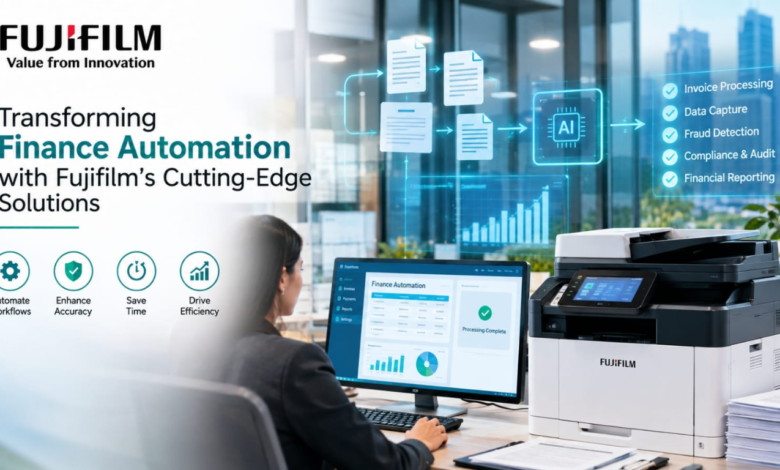
Finance departments are rapidly moving away from paper-heavy processes, spreadsheets, emails and repetitive manual tasks. As transaction volumes increase, organisations need faster, more accurate and more connected ways to manage financial operations. Fujifilm Business Innovation is addressing this challenge through finance automation, document digitisation and intelligent workflow solutions.
Fujifilm’s approach focuses on connecting finance processes, improving visibility and reducing unnecessary manual intervention. Its solutions are designed to support areas such as accounts payable, expense management, procurement, cash application, claims and deductions.
Rather than treating automation as a single technology, Fujifilm positions it as part of a broader transformation of business workflows. This approach can help organisations improve efficiency while strengthening control, compliance and decision-making.
Quick Overview
| Category | Details |
|---|---|
| Company | FUJIFILM Business Innovation |
| Focus | Finance automation and workflow transformation |
| Key Areas | Accounts payable, procurement, expenses, cash application |
| Technology | Digital workflows, intelligent capture, automation and integration |
| Business Goal | Reduce manual work and improve visibility |
| Industries | Financial services, healthcare, government, professional services and more |
| Key Benefits | Efficiency, control, accuracy, scalability and auditability |
What Is Fujifilm Finance Automation?
Fujifilm Finance Automation is a collection of digital workflow capabilities designed to modernise financial processes. The objective is to replace fragmented manual procedures with structured and connected workflows.
Traditional finance operations can involve employees entering invoice information manually, sending approvals through email, checking spreadsheets and repeatedly transferring information between systems. These activities can consume valuable time and increase the possibility of errors.
Fujifilm’s finance automation solutions are designed to address these problems through digital invoice capture, data extraction, validation, routing, approvals and matching. The company also highlights integration across ERP, procurement and finance systems.
Accounts Payable Automation
Accounts payable is one of the most important areas for finance automation because invoices often pass through several stages before payment.
Fujifilm’s approach supports end-to-end invoice processing. Its capabilities include invoice capture, data extraction, validation, automated routing, approvals and three-way matching.
Automating these stages can reduce repetitive data entry and help finance teams process invoices more consistently. It can also provide better visibility into whether an invoice is awaiting approval, being processed or ready for payment.
For organisations handling large invoice volumes, this type of workflow can make finance operations easier to monitor and scale.
Expense Management
Employee expenses can create another administrative burden for finance teams. Paper receipts, manual forms and separate approval procedures can make expense management slower and harder to control.
Fujifilm provides digitised expense capture and approval workflows intended to improve visibility over employee spending and support policy compliance.
A structured digital process can help organisations establish clearer approval paths while reducing unnecessary manual handling.
Procurement Workflow Automation
Procurement involves multiple stages, from purchase requests to approvals and purchasing. When these steps depend heavily on emails and spreadsheets, organisations may experience delays and inconsistent processes.
Fujifilm’s procurement capabilities are designed around structured workflows that improve purchasing governance, approval visibility and requisition-to-purchase consistency.
This can give finance and procurement teams greater control over purchasing activity while creating clearer records of approvals and transactions.
Cash Application and Reconciliation
Cash application is another area where automation can deliver operational improvements. Matching payments with invoices and customer accounts can become complicated when information arrives through different channels.
Fujifilm highlights automated remittance capture, payment matching and reconciliation workflows. These capabilities are intended to accelerate cash allocation while improving financial visibility.
Faster matching can help finance teams spend less time on repetitive reconciliation activities and more time on analysis and higher-value responsibilities.
Claims and Deductions Management
Disputes, claims and deductions can require significant administrative effort. Without structured processes, cases may remain unresolved while employees search for information across different systems.
Fujifilm provides workflow capabilities for claims and deductions designed to improve issue resolution and reduce potential revenue leakage.
Centralised workflows can make it easier to track cases, identify bottlenecks and maintain consistent procedures.
Document Digitisation and Intelligent Workflows
Finance automation depends heavily on the quality and accessibility of information. Fujifilm therefore also focuses on document digitisation and document automation.
Its digitisation services can convert physical records into digital information, while document automation can support accounts payable and receivable automation, smart forms, document generation, robotic process automation, digital signing and electronic content management.
This creates an important bridge between traditional paper-based processes and modern digital workflows.
Improving Visibility and Financial Control
One of the biggest advantages of automation is improved visibility.
Fujifilm’s finance automation offering highlights real-time tracking of invoices, approvals and workflow status, alongside centralised reporting and improved auditability. It also supports integration between finance workflows and business systems.
For finance leaders, this visibility can make it easier to identify delays, monitor performance and understand where improvements are needed.
Compliance and Risk Management
Finance departments operate in environments where accuracy, security and compliance are important. Manual processes can introduce inconsistent records and make audits more difficult.
Fujifilm’s broader workflow solutions include compliance automation, document governance, retention controls and automated compliance tracking and reporting.
Automated processes can therefore contribute not only to efficiency but also to stronger operational consistency and audit readiness.
Fujifilm and Financial Services
Fujifilm Business Innovation Australia also specifically supports banking, insurance and financial-services organisations. Its solutions are positioned around automating critical workflows, improving document governance and supporting secure and compliant operations.
For financial institutions, these capabilities are particularly relevant because they often manage high volumes of sensitive information while facing strict regulatory and customer expectations.
The Role of AI and Intelligent Automation
Modern finance automation increasingly combines workflow technology with intelligent data processing. Fujifilm’s broader business-process services describe intelligent capture using artificial intelligence and machine learning for data extraction and accuracy improvements.
This can be particularly valuable when organisations receive information in different formats. Instead of requiring employees to manually process every document, intelligent capture can help convert information into usable digital data.
Benefits for Modern Finance Teams
Fujifilm’s finance automation strategy can provide several potential benefits:
- Reduced manual invoice processing
- Faster approvals
- Better workflow visibility
- Improved reconciliation
- More consistent processes
- Stronger auditability
- Reduced repetitive administrative work
- Better scalability as transaction volumes increase
- Improved integration between business systems
- Greater opportunity for finance teams to focus on analysis and strategy
These benefits are especially important as organisations seek to transform finance from a largely administrative function into a more strategic business partner.
The Future of Finance Automation
The future of finance is likely to involve increasingly connected workflows rather than isolated automation tools. Fujifilm’s approach reflects this direction by combining finance automation with document management, digitisation, workflow redesign and system integration.
Its Australian automation strategy emphasises assessing process maturity, identifying improvement opportunities, redesigning workflows, improving data readiness and supporting ongoing optimisation.
This suggests that successful automation is not simply about purchasing software. Organisations also need to understand existing processes, identify bottlenecks and build automation around genuine business requirements.
Conclusion
Transforming Finance Automation with Fujifilm’s Cutting-Edge Solutions for Growth represents a broader shift toward connected, digital and intelligent financial operations.
Fujifilm Business Innovation provides capabilities across accounts payable, expenses, procurement, cash application, claims and deductions, while its wider automation portfolio supports document digitisation, compliance, workflow management and system integration.
For organisations struggling with manual finance processes, fragmented information and limited workflow visibility, automation can create a more structured operating environment. By combining digital documents, automated workflows and better information access, Fujifilm’s solutions aim to help finance teams improve speed, control and scalability while giving employees more time to concentrate on higher-value work.