How Lean Six Sigma Eliminates Process Waste and Improves Efficiency
Discover how Lean Six Sigma reduces waste, improves workflows, lowers costs, and builds more efficient business processe

Introduction
Lean Six Sigma is a structured approach organizations use to make processes faster, more consistent, and more valuable to customers. It combines Lean, which focuses on identifying and removing activities that do not create customer value, with Six Sigma, which focuses on reducing process variation and defects. ASQ describes Lean Six Sigma as combining Lean’s focus on waste reduction and flow with Six Sigma’s emphasis on reducing variation.
What Is Process Waste?
Process waste refers to time, effort, materials, movement, or resources spent on activities that do not add meaningful value for the customer.
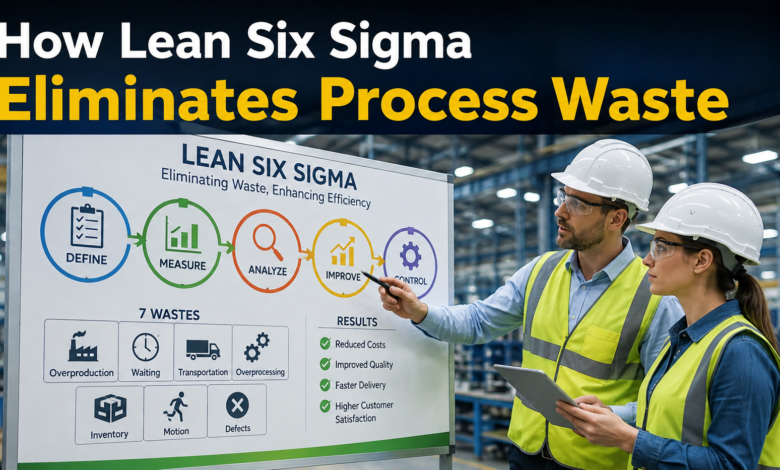
The traditional Lean framework identifies seven major forms of waste:
- Overproduction
- Waiting
- Transportation
- Overprocessing
- Inventory
- Motion
- Defects
These forms of waste can appear in manufacturing, healthcare, logistics, finance, customer service, technology, and administrative operations.
How Lean Six Sigma Eliminates Process Waste
Lean Six Sigma does not simply tell employees to work faster. Instead, it encourages organizations to examine the complete process, understand customer requirements, collect reliable data, identify root causes, implement improvements, and maintain those improvements.
A major framework used for this work is DMAIC: Define, Measure, Analyze, Improve, and Control. ASQ describes DMAIC as a structured approach for improving existing processes that do not meet performance standards or customer expectations.
Define the Problem Clearly
The first step is defining exactly what needs to improve.
For example, a company may discover that customers are waiting too long for orders. Instead of immediately adding more workers, a Lean Six Sigma team defines the problem, identifies the process boundaries, considers customer expectations, and establishes a measurable improvement objective.
A clear definition prevents teams from solving symptoms while leaving the underlying problem untouched.
Measure the Current Process
After defining the problem, teams collect data about current performance.
Useful measurements can include:
- Cycle time
- Waiting time
- Defect rates
- Rework
- Processing volume
- Inventory
- Customer complaints
- First-pass yield
This information creates a baseline. Without a reliable baseline, it becomes difficult to determine whether an improvement has actually produced meaningful results.
Analyze Root Causes
The Analyze stage asks an important question: Why is the waste happening?
Teams can use process maps, Pareto analysis, cause-and-effect diagrams, statistical analysis, and other quality tools to investigate the causes of poor performance.
The objective is to identify the factors that genuinely contribute to the problem rather than relying on assumptions.
Use Value Stream Mapping
Value Stream Mapping is an important Lean technique for understanding how work, information, and materials move through an entire process.
By creating a current-state map, teams can see delays, unnecessary steps, bottlenecks, excess inventory, and other sources of waste. They can then create a future-state map showing how the process could operate more effectively.
ASQ identifies value stream mapping as one of the core tools used to understand and improve process flow.
Improve the Process
Once root causes have been identified, the team develops and tests potential solutions.
Improvements may include:
- Removing unnecessary approval steps
- Simplifying paperwork
- Standardizing repetitive tasks
- Rearranging workplace layouts
- Reducing unnecessary movement
- Improving scheduling
- Automating suitable activities
- Reducing excess inventory
- Preventing defects at their source
The objective is not simply to remove activities. The goal is to create a process that delivers customer value efficiently while keeping necessary activities under control.
Control the Improvements
An improvement is not truly successful if performance returns to its previous level after the project ends.
The Control phase helps maintain the gains through:
- Standard operating procedures
- Process monitoring
- Control charts
- Performance dashboards
- Employee training
- Regular reviews
- Defined process ownership
ASQ notes that the Control phase includes long-term measurement, mistake-proofing, reaction plans, and standard operating procedures.
Reducing Waiting Waste
Waiting occurs when employees, products, information, or customers cannot move forward.
Lean Six Sigma can identify bottlenecks, unnecessary handoffs, approval delays, and scheduling problems. Removing or reducing these obstacles can improve process flow and shorten overall cycle time.
Reducing Defects and Rework
Defects create additional work because employees may need to inspect, repair, replace, or process an item again.
Six Sigma provides data-driven methods for identifying variation and reducing recurring defects. Instead of simply detecting mistakes at the end, improvement teams try to understand why the mistakes occur and prevent them from happening repeatedly.
Reducing Excess Inventory
Excess inventory can tie up resources and hide problems within a process.
Lean principles emphasize better flow and appropriate inventory levels. By understanding demand, process timing, and bottlenecks, organizations can work toward a more efficient flow of materials and information.
Reducing Unnecessary Motion
Employees can lose significant time walking, searching for equipment, reaching for materials, or moving between work areas.
Workplace organization techniques such as 5S and visual management can help make frequently used resources easier to locate and reduce unnecessary movement. ASQ identifies 5S as a Lean methodology for creating a cleaner, more organized workplace and reducing waste.
Reducing Overprocessing
Overprocessing occurs when a product, service, or task receives more work than is actually required.
Teams can examine each process step and ask whether it creates customer value, is required for compliance or quality, or can be simplified.
Removing unnecessary processing can reduce costs while making the workflow easier to manage.
Lean Six Sigma and Customer Value
Waste reduction should not become an isolated cost-cutting exercise.
The ultimate objective is to create greater value for customers. Lean thinking encourages organizations to understand what customers value and then examine the complete value stream.
This is important because improving one department without considering the wider process can sometimes move waste somewhere else instead of eliminating it.
Benefits of Lean Six Sigma
When properly implemented, Lean Six Sigma can help organizations achieve:
- Faster processes
- Fewer defects
- Less rework
- Lower operating costs
- Better resource utilization
- Improved workflow
- More consistent quality
- Reduced customer waiting
- Better process visibility
- A stronger continuous-improvement culture
ASQ case studies demonstrate applications of DMAIC and related quality tools in areas such as healthcare and manufacturing. One documented case reported a reduction in scrap from an average of 1.19% to 0.60%, with total scrap reduced by 55%.
Lean Six Sigma Across Different Industries
Manufacturing
Manufacturers can use Lean Six Sigma to address defects, downtime, changeover delays, excess inventory, scrap, and inefficient production flows.
Healthcare
Healthcare organizations can analyze patient waiting, administrative processes, handoffs, and other workflow challenges.
Banking and Finance
Financial organizations can apply process improvement to customer onboarding, documentation, approvals, transactions, and service processes.
Logistics
Logistics companies can examine transportation, inventory, scheduling, warehouse movement, and delivery processes.
Technology
Technology and IT teams can use process improvement principles to examine software defects, service delays, testing processes, and support workflows.
Building a Continuous Improvement Culture
Lean Six Sigma becomes more powerful when improvement is treated as an ongoing organizational practice rather than a one-time project.
Employees who perform processes every day often understand practical sources of waste that may not be obvious to managers. Involving employees in improvement activities can help organizations discover better solutions while creating greater ownership.
ASQ’s 2026 Lean Enterprise Body of Knowledge emphasizes waste elimination, team empowerment, customer value, process excellence, leadership, and organizational culture as interconnected elements of sustainable improvement.
Conclusion
How Lean Six Sigma Eliminates Process Waste is ultimately about creating better processes through disciplined improvement.
Lean helps organizations identify waste and improve flow, while Six Sigma provides a data-driven approach to reducing variation and defects. DMAIC gives teams a structured path from defining a problem through measuring performance, analyzing causes, implementing improvements, and controlling the results.
When organizations focus on customer value, reliable data, root causes, efficient flow, and continuous improvement, Lean Six Sigma can help transform inefficient processes into more consistent and effective systems.