How Lean Six Sigma Eliminates Process Waste and Improves Efficiency
Learn how Lean Six Sigma eliminates process waste, improves workflow efficiency, reduces errors, and supports continuous business improvement.

Introduction
How Lean Six Sigma Eliminates Process Waste
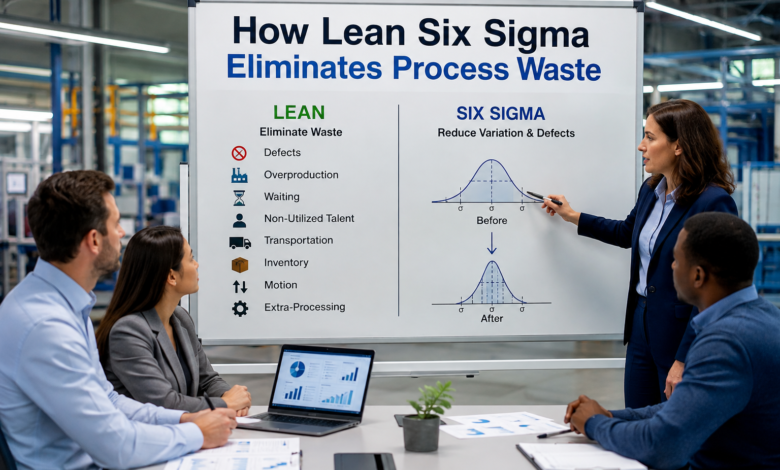
Lean Six Sigma combines Lean’s focus on eliminating waste with Six Sigma’s data-driven approach to reducing variation and defects. Together, these methods help organizations improve efficiency, quality, consistency, and customer value.
What Is Process Waste?
Process waste refers to activities that consume time, effort, materials, space, or other resources without creating value for the customer. Waste can occur in manufacturing, healthcare, logistics, finance, technology, retail, and office operations.
The eight commonly recognized Lean wastes are defects, overproduction, waiting, non-utilized talent, transportation, inventory, motion, and extra-processing.
Examples include:
- Waiting for approvals or information
- Producing more than customers require
- Excess inventory
- Repeated work and rework
- Defective products or services
- Unnecessary transportation
- Excessive employee movement
- Duplicate or unnecessary processing
Identifying these activities is the first step toward building a more efficient process.
How Lean Six Sigma Eliminates Waste
Lean Six Sigma looks beyond individual mistakes and examines the process as a whole. Lean focuses primarily on removing non-value-added activities and improving flow, while Six Sigma focuses on reducing variation that can cause defects and errors.
This combination allows organizations to ask two important questions:
- What activities are creating unnecessary waste?
- What causes the process to produce inconsistent results?
Answering both questions can lead to improvements that are faster, more reliable, and easier to sustain.
Using DMAIC to Reduce Process Waste
DMAIC stands for Define, Measure, Analyze, Improve, and Control. It is a structured problem-solving approach used to improve existing processes that are not meeting performance standards or customer expectations.
Define the Problem
The first stage is to clearly define the problem.
For example, a company may discover that customer orders take too long to process. Instead of immediately hiring additional employees, a Lean Six Sigma team defines the problem, establishes its scope, identifies customer requirements, and determines the desired outcome.
A clear problem statement keeps the improvement project focused.
Measure Current Performance
The Measure stage establishes a reliable baseline.
Teams may collect information about:
- Cycle time
- Waiting time
- Defect rates
- Rework
- Inventory
- Number of process steps
- Customer complaints
- Processing costs
Reliable measurements help teams understand how the process currently performs and provide a basis for evaluating improvements.
Analyze Root Causes
After collecting data, the team investigates why waste occurs.
Process maps, value stream mapping, cause-and-effect analysis, and statistical tools can help identify bottlenecks and potential root causes. Lean Six Sigma emphasizes evidence rather than assumptions when determining what is actually affecting process performance.
For example, if employees frequently wait for approvals, the root cause may be an unnecessarily complicated approval procedure rather than insufficient employee productivity.
Improve the Process
Once root causes have been identified, the team develops and tests solutions.
Possible improvements include:
- Removing unnecessary approvals
- Simplifying workflows
- Standardizing repetitive activities
- Reducing unnecessary handoffs
- Improving workplace organization
- Preventing errors before they happen
- Balancing workloads
- Reducing excess inventory
Kaizen and other Lean improvement techniques can also support rapid, focused process improvements.
Control the Improvement
Improvements need to remain effective after the project ends.
During the Control stage, organizations can establish standard operating procedures, monitoring systems, control plans, and reaction plans. These controls help prevent the process from returning to its previous condition.
The Role of Value Stream Mapping
Value stream mapping provides a visual representation of the flow of materials and information through a process. It helps teams see the complete process rather than concentrating on one isolated activity.
For example, a process may appear efficient when individual tasks are examined separately. However, a value stream map could reveal that work spends most of its time waiting between departments.
This makes hidden waste easier to identify and prioritize.
How 5S Reduces Workplace Waste
5S is another important Lean methodology. It focuses on creating a workplace that is organized, clean, standardized, and easy to manage.
The five stages are:
- Sort – Remove unnecessary items.
- Set in Order – Organize what is needed.
- Shine – Keep the workplace clean.
- Standardize – Establish consistent practices.
- Sustain – Maintain the improvements.
A well-organized workplace can reduce time spent searching for tools, materials, documents, and information.
Reducing Defects and Rework
Defects are particularly costly because they can lead to rework, replacements, additional inspections, delays, and dissatisfied customers.
Six Sigma approaches this problem by studying process variation and identifying factors that contribute to errors. The objective is to improve the process so defects become less likely rather than simply detecting them after they occur.
For example, if a company repeatedly sends customers incorrect orders, a Lean Six Sigma project can investigate where mistakes enter the ordering process and develop controls to prevent them.
Reducing Waiting and Bottlenecks
Waiting is one of the most common forms of process waste.
Employees may wait for:
- Managerial approval
- Materials
- Equipment
- Customer information
- Previous departments
- Technical support
Lean Six Sigma teams examine why these delays happen and look for ways to improve process flow.
Removing unnecessary handoffs, simplifying approvals, improving scheduling, or balancing workloads can reduce waiting without simply asking employees to work faster.
Improving Employee Productivity
Lean Six Sigma is not about forcing employees to work harder. It is about improving the system in which people work.
When employees spend less time searching for information, correcting mistakes, completing duplicate paperwork, or waiting for approvals, they have more time for activities that create value.
Lean also recognizes non-utilized talent as one of the eight wastes, highlighting the importance of making better use of employee knowledge and capabilities.
Benefits of Eliminating Process Waste
Organizations that successfully apply Lean Six Sigma can achieve several potential benefits, including:
- Lower operating costs
- Shorter cycle times
- Fewer defects
- Less rework
- Better resource utilization
- Improved workflow
- Reduced unnecessary inventory
- More consistent processes
- Better customer experiences
The exact results depend on the process, project scope, quality of data, and effectiveness of implementation.
Lean Six Sigma Across Different Industries
Lean Six Sigma is not limited to manufacturing.
Healthcare
Healthcare organizations can examine administrative processes, patient flow, scheduling, and other workflows to identify unnecessary delays and activities.
Banking and Finance
Banks can analyze loan applications, account services, document processing, and customer-support workflows for unnecessary steps.
Logistics
Logistics organizations can use Lean principles to examine transportation, inventory, waiting, warehouse movement, and order-processing activities.
Office Operations
Administrative teams can improve approval systems, document management, meetings, communication, and information transfer.
The underlying principle remains the same: understand the process, identify waste, determine its causes, improve the workflow, and maintain the results.
Why Data Matters in Lean Six Sigma
One of the major strengths of Lean Six Sigma is its emphasis on evidence and measurement.
Employees may have useful knowledge about operational problems, but assumptions alone can lead organizations toward ineffective solutions. Data provides a stronger foundation for deciding what needs to change.
Six Sigma uses measurement and analysis to reduce variation, while Lean provides practical methods for improving flow and eliminating waste.
Conclusion
How Lean Six Sigma Eliminates Process Waste can be understood through a simple principle: organizations improve performance by identifying activities that do not create customer value and addressing the causes behind them.
Lean helps organizations identify and remove waste, while Six Sigma provides a disciplined approach to reducing variation and defects. Through DMAIC, value stream mapping, 5S, root-cause analysis, and process controls, organizations can build processes that use resources more effectively while delivering consistent value.
Most importantly, waste elimination should not be treated as a one-time project. Continuous measurement, employee involvement, standardized work, and ongoing improvement can help organizations maintain gains and continue finding better ways to serve their customers.