What Is a Tracqueur? Meaning, Types, Uses, and How Tracking Devices Work
From GPS trackers in cars to tiny Bluetooth tags on everyday belongings, here is what a tracqueur means, how the technology works, and what you should know before using one.

Introduction
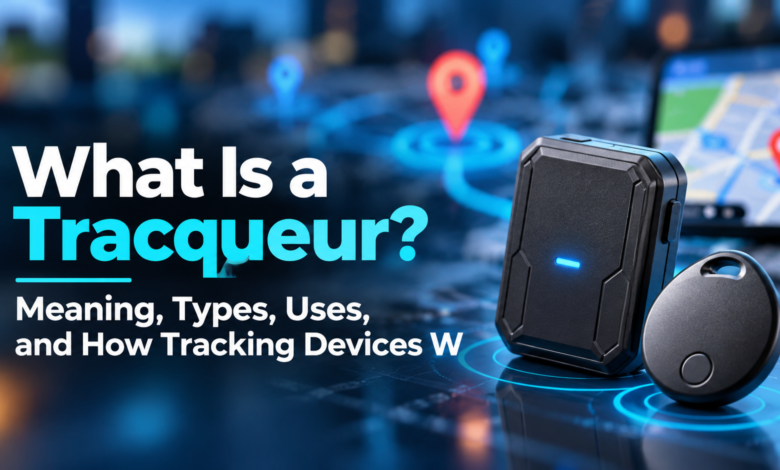
A tracqueur is a tracking device or system used to locate, monitor, or follow the movement of an object, vehicle, animal, or person. The term is related to the English word tracker and the French words traqueur and traceur. In technology, it is commonly understood as a device that helps users find something or monitor its location.
Lost your car keys? A small tracking tag might help. Want to know where a delivery vehicle is? A GPS tracking system can provide location updates. The technology behind these tools varies, but their basic purpose is the same: making location information available when it is needed.
Not every tracqueur works in the same way, though. Some use satellites, others depend on Bluetooth, and certain systems use mobile networks to send their location to an application.
Quick Facts About Tracqueur
| Feature | Details |
|---|---|
| Term | Tracqueur |
| Common English meaning | Tracker or tracking device |
| Related French terms | Traqueur, traceur |
| Main purpose | Finding or monitoring a location |
| Common technologies | GPS, Bluetooth, cellular networks, RFID |
| Popular applications | Cars, pets, luggage, equipment, valuable belongings |
| Location updates | Real-time, periodic, or last-known location |
| Internet requirement | Depends on the tracking technology |
| Main concerns | Privacy, battery life, accuracy, data security |
| Legal considerations | Tracking must comply with applicable privacy laws |
Understanding the Meaning Behind the Name
The word tracqueur can cause some confusion because it is not the standard French technical term for a location-tracking device.
In French, traqueur refers to someone or something that tracks or pursues. Traceur, meanwhile, has several meanings, including an electronic location tracker.
The French dictionary Larousse specifically recognises traceur as a small satellite-based location device used to follow a person’s, vehicle’s, or object’s movements.
In everyday English, the closest word is simply tracker.
It is also worth knowing that a tracker does not always identify a physical location. Website tracking tools, fitness trackers, and software activity monitors collect different kinds of information.
For this article, tracqueur mainly refers to electronic tracking devices that help users locate physical objects or monitor movement.
How Does a Tracqueur Work?
A tracking device gathers information about its location or proximity and makes that information available to another device or software system.
The exact process depends on the technology being used.
For a typical GPS tracker, the process works as follows:
- Satellite signals: The device receives signals from navigation satellites.
- Position calculation: Its GPS receiver calculates an estimated geographical position.
- Data transmission: A connected tracker sends the position through a mobile network or another supported communication system.
- Software processing: An application or online platform receives and displays the location data.
- User access: The owner can check the location, review movement history, or receive alerts if those features are supported.
Here is one important detail: GPS satellites do not directly track people or vehicles.
According to the official GPS website, satellites broadcast positioning signals. The receiving device calculates its own position, and a separate connection may be needed to share that information.
Bluetooth trackers work differently. They transmit short-range Bluetooth signals that compatible nearby phones or devices may detect. Certain finding networks can then help report the item’s approximate location to its owner.
That difference matters when buying a tracker.
A Bluetooth tag is not the same as a standalone GPS device with cellular connectivity.
Different Types of Tracking Devices
Several technologies fall under the tracqueur category. Some are small enough to fit on a keyring, while others are designed for vehicles, warehouses, or industrial equipment.
1. GPS Tracking Devices
GPS trackers use satellite navigation signals to determine their position.
They are widely used in vehicles, commercial transport, outdoor equipment, and other situations where location matters.
A connected GPS tracker can often provide movement history, location alerts, and updates through a smartphone application.
However, real-time monitoring requires a way to communicate the data. A GPS receiver alone does not automatically transmit its location over the internet.
2. Bluetooth Trackers
Bluetooth trackers are small wireless tags used to locate nearby belongings.
They are commonly attached to keys, wallets, bags, and luggage.
Products such as Apple AirTag use Bluetooth and a compatible finding network to help locate misplaced items.
These devices usually consume little power and can be convenient for everyday use.
Their limitation? They depend on nearby compatible devices or Bluetooth connections for location discovery. They do not operate like independent satellite-connected trackers.
3. Cellular Tracking Devices
Cellular trackers use mobile networks to communicate location information.
Many combine GPS positioning with a SIM card or built-in mobile connectivity.
These devices are useful when a user needs to view location updates remotely.
Depending on the design, they may use 4G, LTE-M, NB-IoT, or other supported networks.
Network coverage, service plans, and power consumption can affect their performance.
4. RFID Tracking Systems
Radio-frequency identification, usually called RFID, is another technology associated with tracking.
It uses tags and readers to identify objects.
For example, a warehouse may use RFID to recognise inventory items as they pass through a scanning point.
Unlike a GPS tracker, a typical passive RFID tag does not independently provide its location on a map.
Instead, the system records when and where a reader detects the tag.
This makes RFID useful for inventory management, asset identification, and stock control.
5. Pet Tracking Devices
Pet trackers are designed for animals such as dogs and cats.
Many GPS-based models connect to a mobile application and can show location updates when the device has sufficient satellite visibility and network coverage.
Some include virtual boundaries. If the animal leaves a defined area, the owner may receive an alert.
Pet owners should consider the weight, attachment, battery life, and water resistance of the device before choosing one.
6. Fitness and Activity Trackers
Fitness trackers are another type of tracking technology, although their purpose differs.
Smartwatches and activity bands may record steps, exercise, heart rate, and movement.
Models equipped with location technology can also record outdoor running or cycling routes.
However, a basic activity tracker may not provide live location-sharing features.
The term tracker is therefore broader than a device designed to find lost property.
Main Uses of a Tracqueur in Everyday Life
Tracking devices are no longer limited to large transport companies.
People now use them for everyday convenience, equipment management, and location awareness.
Finding Lost Belongings
Keys can disappear at the worst moment.
A small Bluetooth tracker attached to a keyring may help identify their last detected location or trigger a sound when nearby.
The same approach can work for backpacks, wallets, and other regularly misplaced items.
Vehicle Location Monitoring
GPS tracking systems can help vehicle owners and authorised fleet managers monitor where their vehicles are located.
Depending on the product, a system may provide journey records, geofence notifications, and alerts about unusual movement.
These tools can also assist with stolen-vehicle recovery, although they cannot guarantee that a vehicle will be found.
Business Fleet Management
Delivery and service businesses often need to know where company vehicles are during working hours.
Tracking systems can support route planning, estimated arrival times, and vehicle management.
Fleet managers may use movement records to understand how vehicles are being used.
Employee monitoring, however, requires particular care. Employers must respect applicable privacy and workplace rules.
Pet Location Monitoring
A suitable pet tracker can help owners check an animal’s approximate location.
This can be useful for pets that spend time outdoors or occasionally escape enclosed spaces.
The device still needs a functioning battery and the required network connection to provide updated information.
Equipment and Asset Management
Businesses sometimes track expensive tools, machinery, containers, and other valuable equipment.
Different technologies are suitable for different needs.
GPS may be appropriate for assets that move over long distances, while RFID may work better for inventory inside a warehouse.
Comparing Popular Tracking Technologies
| Technology | How it works | Best suited for | Main limitation |
|---|---|---|---|
| GPS | Uses satellite positioning signals | Vehicles and outdoor location | Weaker performance indoors |
| Bluetooth | Uses nearby Bluetooth connections and compatible finding networks | Keys, bags, wallets | Depends on nearby compatible devices |
| Cellular | Uses mobile networks to transmit data | Remote location monitoring | Requires coverage and often a plan |
| RFID | Identifies tags through compatible readers | Warehouses and inventory | Requires reading infrastructure |
| Wi-Fi positioning | Uses information about nearby wireless networks | Certain indoor and urban applications | Depends on network data and availability |
Some commercial tracking products combine more than one technology.
For instance, a GPS device may use cellular connectivity to report its location, while a smartphone can combine GPS, Wi-Fi, and cellular information when estimating its position.
How Accurate Are Tracking Devices?
Tracking accuracy depends on the hardware, environment, and technology.
Under open-sky conditions, GPS-enabled smartphones are typically accurate to around 4.9 metres, or 16 feet, according to GPS.gov’s accuracy guidance.
That figure is not a guarantee for every tracker.
Large buildings, tunnels, thick walls, trees, and other obstacles may interfere with satellite signals.
Bluetooth finding systems have different limitations. They may show an item’s last detected location rather than its exact current position.
RFID systems generally identify when an object is detected by a reader, rather than continuously calculating its coordinates.
So, can a tracqueur locate something perfectly every time?
No.
Even a high-quality tracking device can produce delayed, incomplete, or inaccurate location information.
What Features Should You Look for When Choosing One?
Before choosing a tracking device, think about what you actually need to find.
A tracker for luggage may have very different requirements from one installed in a commercial vehicle.
Battery life: Some Bluetooth tags can operate for extended periods using small replaceable batteries. Connected GPS trackers may need more frequent charging, depending on reporting frequency and battery capacity.
Location updates: Check whether the product offers continuous, periodic, or last-known location reporting.
Coverage: A cellular tracker needs support from the relevant mobile network. A Bluetooth finding tag relies on its compatible device network.
Application compatibility: Make sure the manufacturer’s application works with your phone and operating system.
Water resistance: Outdoor trackers may need protection against rain, splashes, or temporary exposure to water.
Alerts: Some devices support movement alerts, low-battery warnings, and virtual location boundaries.
Ongoing costs: Certain GPS and cellular tracking services require monthly or annual subscription payments.
Privacy controls: A trustworthy product should clearly explain who can access location data, how long it is stored, and how to delete it.
A low purchase price is not always the lowest long-term cost.
Advantages of Using a Tracking Device
A tracqueur can be useful when it solves a specific problem.
For personal belongings, tracking tags can reduce the time spent searching for lost items.
For businesses, location systems may improve visibility into vehicle movements and asset handling.
And for pet owners, compatible location devices can provide additional information when an animal wanders away.
Other potential benefits include better asset records, movement alerts, and access to previously recorded locations.
Still, none of these benefits is automatic. They depend on the device, service quality, coverage, and how responsibly the technology is used.
Limitations You Should Know About
Tracking devices have weaknesses that buyers sometimes overlook.
A discharged battery can stop a device from working. Weak mobile reception may prevent updates from reaching the owner. Bluetooth trackers can be difficult to locate when no compatible devices are nearby.
Indoor environments can also reduce satellite positioning accuracy.
Another concern is dependence on the manufacturer’s service.
An application, cloud platform, or subscription may be required to use certain functions.
Before purchasing, check whether basic location services will continue to work without a paid plan.
Most importantly, do not assume that the word real-time means perfectly continuous tracking.
Many devices send updates at intervals, and network delays may affect when those updates appear.
Are Tracking Devices Legal and Safe?
Tracking technology itself has many legitimate uses.
The legal issue often concerns who is being tracked, why the tracking takes place, and whether the person involved has been properly informed or has given consent where required.
Using a device to secretly follow another person may violate privacy, stalking, or harassment laws.
Workplace monitoring also has restrictions.
For example, France’s data protection authority, the CNIL, explains that employer vehicle-geolocation systems must comply with rules protecting employees’ privacy.
The exact requirements vary by country and situation.
For safer use, track your own belongings, communicate clearly when a shared vehicle or device is monitored, protect account access, and avoid collecting location records longer than necessary.
What If You Find an Unknown Tracker?
An unexpected tracking alert should not be ignored.
Apple and Google provide unwanted-tracker detection tools for compatible devices.
If your phone reports an unfamiliar tracker travelling with you, follow the device’s instructions to locate it, identify it, and learn how to disable it.
Google’s Android support guidance explains how users can examine unknown-tracker alerts and run manual scans.
If you believe someone is deliberately tracking you and you feel unsafe, move to a safe location and contact local authorities.
Tracqueur vs GPS Tracker: Is There a Difference?
The two terms are related, but they are not always interchangeable.
Tracqueur is a broad expression that may be used to describe different tracking technologies.
A GPS tracker is more specific. It uses satellite navigation signals to calculate geographical position.
Every GPS tracker can be considered a type of tracking device, but not every tracking device uses GPS.
A Bluetooth tag, for example, may help you locate your luggage without containing its own GPS receiver.
Understanding this distinction can prevent you from buying the wrong product.
The Future of Tracking Technology
Location and asset-tracking technology continues to develop.
Manufacturers are working on more efficient wireless communication, smaller electronic components, improved battery management, and better integration with smartphone platforms.
Finding networks have also become more useful as compatible devices have become widespread.
Privacy is receiving more attention too.
Apple and Google have developed a shared approach to detecting certain unwanted Bluetooth trackers across iOS and Android.
Future improvements may make trackers easier to manage, but accuracy, coverage, security, and responsible use will remain important considerations.
Final Thought
A tracqueur is more than a small electronic tag. It is a useful idea applied through several different technologies, each with its own strengths and weaknesses.
For finding keys, a Bluetooth tracker may be enough. For remote vehicle monitoring, a connected GPS system may be more appropriate. Businesses managing inventory may benefit from RFID instead.
The right choice depends on the job.
Understand how the device finds or reports a location, examine any subscription requirements, and make privacy part of the decision. A well-chosen tracker can save time and provide useful information without creating unnecessary complications.
Frequently Asked Questions
1. What does tracqueur mean in English?
Tracqueur generally means a tracker or tracking device. In a technology context, it refers to a tool used to locate objects or monitor their movement.
2. Is a tracqueur the same as a GPS tracker?
Not always. A GPS tracker uses satellite signals to calculate location, while the broader term may include Bluetooth, RFID, and other tracking systems.
3. Can a tracking device work without the internet?
Yes. GPS receivers can calculate their position without internet access. However, sending that location to a remote phone or platform usually requires a separate communication connection.
4. Can I use a tracker to find my car?
Yes. A suitable vehicle-tracking system can help you check your car’s reported location, provided the device is functioning and has the connectivity required to share updates.
5. How long does a tracking device battery last?
It varies considerably. Some Bluetooth tags use batteries that last many months, while frequently reporting GPS trackers may need more regular charging.
6. Are Bluetooth trackers accurate?
They can be useful for locating nearby objects. Their performance depends on signal conditions, compatible devices, and the finding technology supported by the product.
7. Can someone track me without my knowledge?
Tracking devices can be misused. Modern iPhone and Android systems support alerts for certain unfamiliar Bluetooth trackers travelling with a person. These protections do not detect every possible tracking method.
8. Which tracking technology is best?
For everyday belongings, Bluetooth tags are often convenient. For vehicles and remote location monitoring, connected GPS systems may be better. For warehouse inventory, RFID can be a practical choice.