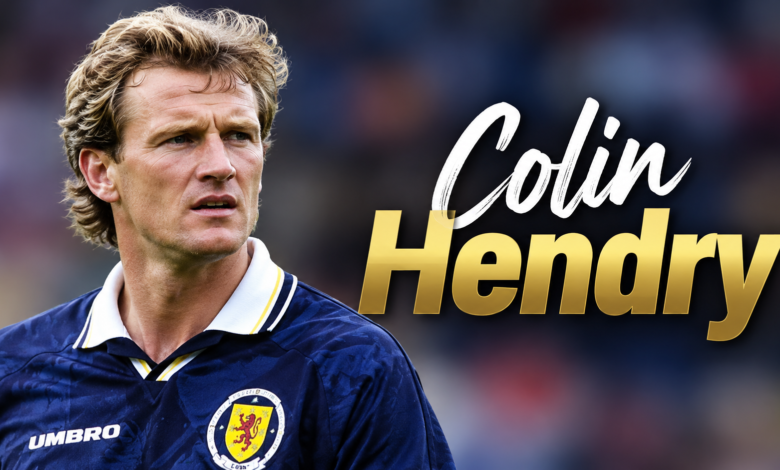
Colin Hendry: The Braveheart Who Led Scotland and Conquered English Football

Introduction
From a small Scottish town to Blackburn Rovers’ famous Premier League title and Scotland’s World Cup captaincy, his football story is packed with big moments.
Colin Hendry is a former Scottish professional footballer and manager. He is best remembered for his years at Blackburn Rovers and his leadership of Scotland at the 1998 FIFA World Cup.
Football fans called him Braveheart. And the nickname made sense.
He was strong in the air, fearless in tackles and difficult to beat. His defending was direct. His attitude was serious. He never seemed interested in making football look complicated.
His biggest club success came in 1995. Blackburn Rovers won the Premier League, beating Manchester United to the title.
But his career went much further. He played for Manchester City and Rangers, represented Scotland 51 times and later worked as a football manager.
Quick Facts About Colin Hendry
| Detail | Information |
|---|---|
| Full name | Edward Colin Hendry |
| Popular name | Colin Hendry |
| Nickname | Braveheart |
| Date of birth | 7 December 1965 |
| Age | 60 years old (October 2026) |
| Birthplace | Keith, Moray, Scotland |
| Nationality | Scottish |
| Profession | Former footballer and manager |
| Height | 1.85 m (approximately 6 ft 1 in) |
| Playing position | Centre-back |
| Preferred foot | Right |
| Youth clubs | Keith, Islavale |
| First professional club | Dundee |
| Famous club | Blackburn Rovers |
| International team | Scotland |
| International appearances | 51 |
| International goals | 3 |
| Major tournaments | Euro 1996, World Cup 1998 |
| Major honour | Premier League 1994–95 |
| Retirement year | 2003 |
| Former wife | Denise Hendry (died 2009) |
| Children | Four, including Callum Hendry |
Early Life and Scottish Roots
Hendry was born on 7 December 1965 in Keith, Moray, Scotland.
Keith is a small town. It is far from the huge football stadiums where he would later play.
His early football years were local.
He spent time with Keith and Islavale before joining Dundee in 1983. Those clubs gave him an introduction to the competitive side of the game.
He learned his trade gradually.
There were no Premier League cameras following him around as a teenager. His career began through Scottish football, where performances on the pitch mattered more than publicity.
Public records provide little reliable information about his parents, siblings or formal education. His early football career, though, is well documented.
Starting His Professional Career at Dundee
Dundee gave Hendry his first professional opportunity in 1983.
He was only 17.
His early years helped him grow into senior football. He learned how to deal with experienced opponents and the physical demands of professional matches.
He also developed the qualities that would later make him famous.
Strength mattered. So did timing.
Although he was known mainly as a central defender later in his career, he also played further forward during his early years.
His performances attracted attention from England.
In March 1987, Blackburn Rovers signed him.
That move changed everything.
First Blackburn Rovers Spell
Blackburn Rovers were not yet Premier League champions when Hendry arrived.
They were trying to build something.
He joined the club in 1987 and quickly became part of an important moment in its history.
On 29 March 1987, Blackburn faced Charlton Athletic in the Full Members’ Cup final at Wembley.
Hendry scored the winning goal.
Blackburn won 1–0.
Imagine that start. He had only recently arrived, yet he was already celebrating a Wembley trophy.
His first spell at Blackburn lasted until 1989.
By then, other English clubs had started paying attention.
Manchester City came calling.
Manchester City Career
Hendry joined Manchester City in November 1989.
It was another big move.
City were playing in England’s top division, and the competition was demanding.
He settled into the team and impressed supporters with his commitment.
During the 1989–90 season, he earned the club’s Player of the Year award.
That recognition mattered.
He had shown that he could handle top-flight football. Still, his best years were ahead.
In November 1991, Hendry returned to Blackburn Rovers.
The club had new ambitions under manager Kenny Dalglish.
And this time, something special was coming.
The Blackburn Years That Made Him Famous
Blackburn Rovers were building a side capable of challenging England’s biggest clubs.
Hendry became part of that rise.
He helped the team earn promotion to the newly formed Premier League in 1992.
Then Blackburn pushed even harder.
The squad included players such as Alan Shearer, Chris Sutton, Tim Flowers, Tim Sherwood and Graeme Le Saux.
It was a serious team.
Shearer scored goals. Sutton caused problems for defenders. In midfield, Sherwood helped control matches.
Hendry worked at the back.
His job was simple to describe but difficult to perform: win the ball, stop attacks and protect the goalkeeper.
He did it brilliantly.
Winning the Premier League in 1995
The 1994–95 season remains the biggest chapter of Hendry’s club career.
Blackburn Rovers were fighting Manchester United for the Premier League title.
The pressure was enormous.
Every dropped point mattered.
Hendry played 38 league matches during that campaign and scored four goals.
For a centre-back, that was a useful attacking contribution.
But his real value came through defending.
Blackburn finished the season as English champions, one point ahead of Manchester United.
The title was theirs.
For Hendry, it was a reward for years of hard work. He had joined Blackburn when the club was playing outside the top division and helped it reach the top of English football.
Very few players experience that kind of journey with the same club.
Why Blackburn Supporters Remember Him
Supporters remember his commitment.
He did not need fancy tricks.
He challenged forwards, attacked headers and competed for difficult balls. His playing style suited the tough English football of the 1990s.
He was also a player who could contribute goals.
Still, his main strength was his defensive presence.
When Blackburn needed someone to stand firm, Hendry was often there.
Scotland International Career
Playing for his country was another major achievement.
Hendry made his Scotland debut on 19 May 1993 against Estonia.
Scotland won 3–0.
He was 27 years old.
That is quite late for an international debut, especially for someone who would eventually captain the country at a World Cup.
But once he earned his place, he became an important part of the national team.
Between 1993 and 2001, he earned 51 international caps and scored three goals.
His international career included two major tournaments.
Playing at Euro 1996
Scotland qualified for the 1996 European Championship in England.
Hendry was part of the squad.
Scotland faced the Netherlands, England and Switzerland during the group stage.
Their match against England at Wembley became one of the tournament’s most famous games.
England won 2–0.
Paul Gascoigne scored a memorable second goal after lifting the ball past Hendry.
It was a difficult moment for Scotland’s defence.
But one incident never tells the whole story of a footballer.
Hendry remained a trusted national-team player and continued to represent his country at the highest level.
Captaining Scotland at the 1998 World Cup
The 1998 FIFA World Cup was one of the biggest moments of Hendry’s career.
He captained Scotland in France.
That responsibility meant a great deal.
Scotland had qualified for a tournament featuring the world’s strongest national teams.
Their group included Brazil, Norway and Morocco.
The Opening Game Against Brazil
Scotland faced Brazil on 10 June 1998.
It was the opening match of the World Cup.
Brazil had players such as Ronaldo, Rivaldo, Bebeto and Roberto Carlos.
Scotland entered the match as underdogs.
Brazil won 2–1.
But Scotland competed strongly and made the defending champions work for their victory.
Hendry led the team from central defence.
For a footballer who had started his journey in Keith, captaining Scotland against Brazil on the world’s biggest football stage was remarkable.
Scotland’s World Cup Results
Scotland played three group matches:
| Opponent | Result |
|---|---|
| Brazil | Lost 2–1 |
| Norway | Drew 1–1 |
| Morocco | Lost 3–0 |
Scotland were eliminated during the group stage.
The final defeat against Morocco was particularly disappointing.
Years later, Hendry continued to discuss the lessons from that tournament.
In June 2026, he spoke publicly about Scotland’s World Cup preparations and warned against underestimating opponents.
That showed how strongly the memories of France 1998 had stayed with him.
Moving to Rangers in 1998
After the World Cup, Hendry made another major career move.
Rangers signed him from Blackburn in August 1998 for a reported £4 million.
He returned to Scottish football as an established international defender.
Rangers were managed by Dick Advocaat.
The club enjoyed major domestic success during Hendry’s time there.
In the 1998–99 season, Rangers won the Scottish league, Scottish Cup and Scottish League Cup.
It was a domestic treble.
Hendry was part of that successful squad.
His time at Rangers was shorter than his years at Blackburn, but it added Scottish honours to his career record.
He left Rangers in February 2000.
His next destination was Coventry City.
Coventry City and Bolton Wanderers
Hendry joined Coventry City in 2000.
By then, he was an experienced footballer with major titles and international appearances behind him.
His stay at Coventry was relatively brief.
Later that year, he moved to Bolton Wanderers, initially on loan.
Bolton were chasing promotion to the Premier League.
Hendry helped the club during that period.
In 2001, Bolton defeated Preston North End in the First Division play-off final, earning promotion to the top division.
It was another successful team campaign.
He also spent time on loan with Preston North End and Blackpool during the closing stage of his playing career.
He retired in 2003.
Almost two decades of professional football had come to an end.
Complete Club Career Timeline
| Period | Football club |
|---|---|
| 1983–1987 | Dundee |
| 1987–1989 | Blackburn Rovers |
| 1989–1991 | Manchester City |
| 1991–1998 | Blackburn Rovers |
| 1998–2000 | Rangers |
| 2000 | Coventry City |
| 2000–2003 | Bolton Wanderers |
| 2002 | Preston North End (loan) |
| 2002–2003 | Blackpool (loan) |
His years at Blackburn stand out.
That was where he spent the longest and most successful part of his career.
Football Management and Coaching Career
Retirement did not mean leaving football.
Hendry moved into management.
His first major managerial position came at Blackpool in June 2004.
He had previously played for the club on loan, so he already knew something about its football environment.
Managing was different, though.
Now he had to make selections, organize training and handle results.
His time at Blackpool ended in November 2005.
He later worked as an assistant manager at Boston United.
Becoming Clyde Manager
On 11 June 2007, Clyde officially announced Hendry as their manager.
He returned to Scottish football with hopes of building a competitive team.
The position presented new challenges.
He worked on recruitment, training arrangements and preparation for the coming season.
However, his time in charge was short.
He left Clyde in January 2008.
Returning to Blackburn as a Coach
Years later, he returned to Blackburn Rovers.
This time, he worked with the club’s younger players.
He served as an assistant manager with Blackburn’s under-21 team between 2012 and 2014.
It was a different role from playing in front of thousands of supporters.
He could share lessons from professional football, including his experiences at Blackburn and with Scotland.
His recorded spell ended in June 2014.
Playing Style and Football Strengths
Hendry was a traditional central defender.
He had one main responsibility: stop the opposition from scoring.
His strengths were easy to recognize.
Aerial ability: He was strong when challenging for headers, particularly against physical forwards.
Tackling: He was willing to commit himself to difficult defensive situations.
Leadership: His experience and confidence helped him organize teammates.
Physical strength: He could compete with powerful attackers.
Goal threat: He also contributed goals, particularly during his earlier career and his successful Blackburn years.
Football has changed since the 1990s.
Modern central defenders are often expected to start attacks with short passes and carry the ball into midfield.
Hendry came from a different period.
His game was built around defending first.
And he became very good at it.
Major Trophies and Achievements
| Honour | Club | Season |
|---|---|---|
| Full Members’ Cup | Blackburn Rovers | 1986–87 |
| Premier League | Blackburn Rovers | 1994–95 |
| Scottish Premier League | Rangers | 1998–99 |
| Scottish Cup | Rangers | 1998–99 |
| Scottish League Cup | Rangers | 1998–99 |
| Scottish Premier League | Rangers | 1999–2000 |
| First Division play-off promotion | Bolton Wanderers | 2000–01 |
His international achievements were also impressive.
He represented Scotland at Euro 1996 and captained the national team at the 1998 World Cup.
Those honours explain why his name remains familiar to Scottish football supporters.
Personal Life and Family
Away from football, Hendry has experienced serious personal difficulties.
He was married to Denise Hendry.
The couple had four children.
Their family life was affected by tragedy when Denise died in July 2009, aged 43.
Her death followed serious medical complications linked to cosmetic surgery she had undergone in 2002.
The circumstances were later examined during a formal inquest.
It was a painful period for the family.
Hendry has spoken publicly at different times about the challenges he has faced outside football.
Although much of his career happened in public, the personal lives of his family members deserve privacy.
His Son Callum Hendry
Football continued into the next generation.
Hendry’s son, Callum Hendry, also became a professional footballer.
Callum built his own career in Scottish and English football, playing as a forward.
He is known for his own performances rather than simply being the son of a former Scotland captain.
Still, the family connection is interesting.
His father made his name stopping attackers.
Callum built his career trying to beat defenders and score goals.
Two different roles. One football family.
Life After Football and Recent Activities
Hendry remains a recognizable figure in Scottish football.
He has appeared in interviews, football discussions and events connected with his former clubs and the national team.
In June 2026, he discussed Scotland’s World Cup campaign and reflected on the mistakes made during France 1998.
His message was based on experience.
Big matches can change quickly, and players cannot afford to assume that a result will go their way.
He has also maintained an unusual connection with rock music.
In September 2026, FourFourTwo reported that Hendry was still playing football with Iron Maiden’s football team.
He has been a fan of the band for many years.
The group’s football activities have allowed him to keep playing recreational matches long after retiring professionally.
At 60, he still enjoys getting onto the pitch.
Where Is He Now?
As of October 2026, Hendry is retired from professional football.
He is no longer an active professional player.
There is no verified public record confirming a current permanent managerial appointment.
However, he continues to appear in football-related media and events.
His recent interviews show that he still follows Scotland and the wider game closely.
For now, that is the clearest picture of his publicly documented football activities.
Why His Career Still Matters
Blackburn’s Premier League title remains one of English football’s great stories.
The club beat established giants to win the championship.
Hendry was an important part of that achievement.
Then there was Scotland.
Captaining a national team at the World Cup is something very few players experience.
His career also showed that a footballer does not need to start at a famous academy to reach the highest level.
He came from Keith.
He worked his way through Scottish football.
He played at Wembley, won league titles and represented his country against Brazil.
That is quite a journey.
Final Thought
Colin Hendry built his reputation through hard work and fearless defending.
He was never a flashy footballer.
He did his job with commitment and became one of Scotland’s best-known defenders of the 1990s.
The Premier League title with Blackburn was his greatest club achievement. Leading Scotland at the 1998 World Cup gave him another lasting place in football history.
His life after football has included difficult personal experiences and new roles in the sport.
Still, supporters remember the defender who stood firm, challenged powerful forwards and wore the Scotland captain’s armband with pride.
For many fans, he will always be Braveheart.
Frequently Asked Questions
1. Who is Colin Hendry?
Colin Hendry is a former Scottish professional footballer and manager. He is best known for playing for Blackburn Rovers and captaining Scotland at the 1998 World Cup.
2. How old is Colin Hendry?
He is 60 years old as of October 2026. He was born on 7 December 1965.
3. Where was he born?
He was born in Keith, Moray, Scotland.
4. Which team did he win the Premier League with?
He won the Premier League with Blackburn Rovers in the 1994–95 season.
5. How many matches did he play for Scotland?
He made 51 senior appearances for Scotland and scored three international goals.
6. Was he Scotland’s captain?
Yes. He captained Scotland at the 1998 FIFA World Cup in France.
7. Who was Colin Hendry’s wife?
His wife was Denise Hendry. She died in July 2009.
8. Does he have children?
Yes. He has four children, including professional footballer Callum Hendry.
9. When did he retire from football?
He retired from professional football in 2003.
10. What is Colin Hendry doing now?
He remains involved in football-related events and interviews. He also takes part in recreational football matches, including games connected with Iron Maiden.